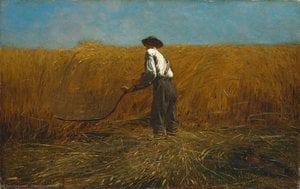
Samuel Eells: A Portrait of Dignity Amidst Victorian Elegance
Winslow Homer, arguably America’s most celebrated artist of the 19th century, captivated audiences with his masterful depictions of the American landscape and maritime life. Among his impressive oeuvre is Samuel Eells, a portrait that transcends mere representation—it embodies Homer’s profound understanding of human character and his ability to convey subtle emotions through meticulous observation.
Painted in 1800, this artwork measures 124 x 98 cm and is executed in oil on canvas. The composition centers around a man dressed impeccably in formal attire: a white collar shirt, black cravat, and a dignified waistcoat—a testament to the sartorial standards of Victorian England. His gaze is direct, unwavering, hinting at inner contemplation and conveying an aura of quiet confidence.
Detailed Analysis of Homer’s Technique
Homer's skill lies not only in capturing his subject but also in employing a technique that elevates the portrait beyond a simple likeness. He utilizes chiaroscuro—the dramatic interplay between light and shadow—to sculpt the figure, creating volume and texture with remarkable precision. Notice how the light illuminates the man’s face and torso, highlighting the contours of his features while casting deep shadows across his clothing, lending depth and realism to the scene.
The artist skillfully blends color palettes that are muted yet harmonious, reflecting the subdued tones characteristic of portraiture during Homer's time. Subtle shades of brown, gray, and ivory dominate the canvas, creating a sense of understated elegance and conveying an atmosphere of solemnity. The meticulous brushstrokes contribute to the overall texture—a hallmark of Homer’s style—enhancing the visual experience for the viewer.
Symbolism and Contextual Significance
Beyond its technical brilliance, Samuel Eells speaks to the broader cultural milieu of the early 19th century. The red curtain serves as a powerful visual element—a symbol of prestige and formality—emphasizing the importance of the subject’s status within society.
The inclusion of two figures in the background adds layers of narrative complexity. One stands to the left, partially obscured by shadow, suggesting an unspoken connection or perhaps representing a hidden aspect of the man's personality. The other figure is positioned further back on the right, contributing to the sense of depth and creating a visual dialogue between the subject and his surroundings.
Finally, the book placed near the bottom left corner symbolizes intellectuality and erudition—values highly esteemed during Homer’s era. It reinforces the portrait's message as an exploration of human dignity and inner reflection.
Winslow Homer: A Legacy of Observation
Winslow Homer solidified his place in art history through his unwavering commitment to realism, blending meticulous observation with expressive brushwork. Like other notable works by Homer—The Morning Bell, The Proud Mother, and Feeding the Bird—available for viewing on https://WahooArt.com—The Morning Bell, The Proud Mother, and Feeding the Bird—Homer’s art continues to inspire admiration for its honesty and beauty.
For discerning art enthusiasts seeking a piece of American artistic heritage, Samuel Eells represents an exceptional opportunity to appreciate Homer’s genius and immerse oneself in the refined aesthetic sensibilities of Victorian England.
WahooArt.com is your premier destination for high-quality, handmade oil painting reproductions. Explore our collection today and discover the beauty of art in your own home.
Preguntas y respuestas
¿A qué etapa de la trayectoria de Winslow Homer pertenece "Samuel Eells"?
Dentro de la trayectoria de Winslow Homer, "Samuel Eells" pertenece al Mature Period. Esta etapa permite compararla con otras obras del artista.
¿Qué estado de ánimo expresa "Samuel Eells" de Winslow Homer dentro de American Realism?
La emoción Misterioso de "Samuel Eells" acompaña a su estilo American Realism.
¿Es "Samuel Eells" una obra famosa del American Realism?
"Samuel Eells" figura con un nivel de Icónico entre las obras del American Realism en el catálogo.
¿Qué tipo de colores utiliza "Samuel Eells"?
Los colores de "Samuel Eells" conforman una paleta Tonos oscuros. Esta clasificación describe las familias de colores dominantes.
¿Qué espacio se sugiere para "Samuel Eells" de Winslow Homer?
Se recomienda "Samuel Eells" de Winslow Homer para un Salón principal. Esta sugerencia se basa en el tema, los colores y la atmósfera de la obra.
¿Puedo ver una vista de rayos X de "Samuel Eells" de Winslow Homer?
La vista de rayos X de "Samuel Eells" de Winslow Homer se encuentra en la página Rayos X de la obra: un examen interactivo de la imagen a través de once capas ópticas.
¿Cuántas personas ven "Samuel Eells"?
Existe una página de Estadísticas para "Samuel Eells". En ella se registran las visitas mensuales de la obra y de otras obras del artista, con desgloses por país e idioma.
¿Los colores de "Samuel Eells" se ven intensos o suaves?
Los colores en "Samuel Eells" de Winslow Homer tienen una intensidad Vívido.



 Vista previa
 Encargar reproducción pintada a mano
 Compartir
 Compartir
 Ver detalles
 Guía
Guía

 Descargar
 Ver artículos similares
 Radiografía
 Presentación de diapositivas
 Estadísticas


 Leer más






































 La opción de vidrio solo está disponible en tamaños inferiores a 110 cm.