


Impresiones giclée o en lienzo de calidad de museo con producción rápida y opciones de acabado flexibles. ( Comprar pintura hecha a mano Comprar imagen)





























Elija entre nuestros tamaños predefinidos que respetan las proporciones originales de la obra.

Puede introducir sus propias dimensiones para adaptarse a un marco o espacio específico. Si el tamaño seleccionado no coincide con las proporciones de la imagen original, recortaremos la obra de arte o extenderemos la imagen con un borde con efecto espejo o de color sólido. Se enviará una maqueta digital para su aprobación antes de que comience la producción.
Tenga en cuenta que la vista previa en pantalla no refleja el recorte o la extensión real. Solo la maqueta mostrará con precisión la composición final.
Aunque existen tamaños personalizados, recomendamos seleccionar una dimensión de la lista predefinida para preservar las proporciones originales.
Envío a todo el mundo () en 2 semanas en lugar de las 4/5 semanas estándar. (6 septiembre)


Análisis de la belleza
Dimensiones de la reproducción
In the mid-18th century, as the intellectual currents of Europe began to shift from the ornate excesses of the Baroque toward a more structured Neoclassicism, one artist dared to attempt something unprecedented: to capture the intangible essence of grace within the rigid confines of an engraving. William Hogarth’s "Analysis of Beauty," completed in 1753, is not merely a print; it is a profound visual manifesto. To gaze upon this work is to enter a meticulously constructed universe where every line and shadow serves a higher philosophical purpose. Hogarth, a master of the London art scene, sought to move beyond mere decoration, challenging his contemporaries to look deeper into the mechanics of visual pleasure. The artwork presents a densely populated landscape of symbolic representations, all held within an elegant arched framework that suggests both a window into another realm and a scholarly anatomical study of taste itself.
The emotional resonance of the piece lies in its delightful tension between chaos and order. At first glance, the viewer may feel overwhelmed by the sheer abundance of detail—a characteristic trait of the Rococo influence that dances through the composition. Yet, as the eye lingers, a sense of profound intellectual clarity emerges. There is a rhythmic pulse to the work, driven by what Hogarth famously termed the "Line of Beauty." This serpentine, undulating motion provides a sense of organic vitality that prevents the complex arrangement from feeling static or clinical. For the collector or the designer, this piece offers a rare duality: it possesses the intricate, ornamental charm required for sophisticated interior curation, while simultaneously providing a deep, conversational subject matter that rewards prolonged contemplation.
Technically, "Analysis of Beauty" is a triumph of 18th-century printmaking. Utilizing the precise medium of ink on paper, Hogarth employs masterful hatching and cross-hatching to breathe life into a monochromatic world. Through these fine, disciplined lines, he achieves a remarkable illusion of volume and texture, making the cold surfaces of classical sculptures feel palpable and the soft contours of organic forms appear supple. The interplay of light and shadow is subtle yet transformative; though the perspective remains somewhat muted, Hogarth’s manipulation of tonal gradations creates a multi-dimensional space that draws the viewer into his complex narrative. This technique allows for a seamless transition between geometric precision and fluid, naturalistic shapes, mirroring the very balance of beauty he sought to define.
Beyond its technical brilliance, the engraving is a treasure trove of layered symbolism. Every element—from classical busts and musical instruments to more satirical depictions of societal vice—acts as a character in Hogarth’s grand critique. The composition utilizes multiple vanishing points to guide the eye across an array of allegorical figures, creating a sense of immersive depth. This complexity makes the artwork an extraordinary choice for those seeking to add intellectual weight to a space. Whether placed in a library, a study, or a contemporary gallery setting, a high-quality reproduction of this masterpiece serves as a bridge between the historical pursuit of perfection and the modern appreciation for artistic wit. It is a piece that does not just decorate a wall; it enriches the very atmosphere of the room with the spirit of inquiry and the enduring allure of classical grace.


1697 - 1764 , Reino Unido

Descubre 10 obras maestras del siglo XVIII: Goya, Fragonard y más. Explora la historia, el arte barroco, rococó y neoclasicismo que inspiran decoración elegante. Reproducciones de alta calidad en WahooArt.com.

Explore the satirical world of William Hogarth, pioneering British painter & engraver. Discover his iconic works like *A Rake's Progress* and insightful social commentary on 18th-century London life.
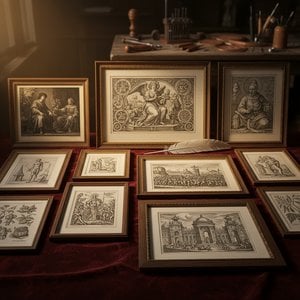
Descubre los 10 grabados legendarios de Dürer, Rembrandt y Goya que revolucionaron el arte. Explora la historia, técnicas y belleza atemporal de estas obras maestras. Reproducciones de alta calidad en WahooArt.com para decorar tu hogar con arte clásico.

Descubre las 10 obras maestras del Rococó que marcaron una época. Explora la elegancia de Fragonard, Boucher y Watteau en . Reproducciones de arte de calidad museo para decorar tu hogar con estilo.

Descubre la fascinante estética rococó: su historia, características clave y los artistas más influyentes del siglo XVIII. Un análisis profundo para amantes del arte y coleccionistas.

 Ver en contexto
 Enviar
 Compartir
 Detalles

 Descargar
 Similares
 Radiografía
 Presentación de diapositivas

 Ver más







 La opción de vidrio solo está disponible en tamaños inferiores a 110 cm.


