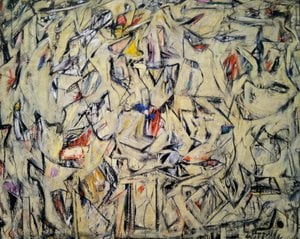
Still Life (1945): A Testament to Emotion and Form
Willem de Kooning’s “Still Life” stands as an emblem of abstract expressionism, encapsulating the movement's core tenets—a rejection of representational art in favor of spontaneous gesture and emotional intensity. Painted in 1945, amidst the turbulent aftermath of World War II, this artwork transcends mere depiction; it embodies a profound exploration of human experience through color, texture, and compositional arrangement.
- Artist: Willem de Kooning (1904–1997) – A Dutch-American painter who revolutionized artistic expression.
- Year Painted: 1945 – Created during the period of intense upheaval and uncertainty following the Second World War, reflecting a desire to grapple with existential questions.
- Style: Abstract Expressionism – Characterized by loose brushstrokes, vibrant hues, and an emphasis on subconscious impulses rather than rational observation.
The painting’s palette is dominated by warm tones—primarily yellows, pinks, reds—creating a visual dynamism that immediately captivates the viewer. These colors aren't merely decorative; they convey emotion—passion, vulnerability, and perhaps even melancholy—mirroring the psychological landscape of its time.
- Color Palette: Warm hues (yellows, pinks, reds) – Used to evoke feelings of vibrancy and emotional depth.
- Texture: Thick impasto technique – De Kooning applied paint in dense layers, resulting in a tactile surface that invites contemplation and enhances the painting’s expressive power.
At its center lies a fleshy pink mass—representing a woman's body—surrounded by an amorphous expanse of color. The woman appears naked, her arms outstretched in a gesture of vulnerability and longing. Alongside her is another figure, equally nude, engaged in an embrace that suggests intimacy and connection. This juxtaposition of forms isn’t intended to portray realistic anatomy; rather, it serves as a vehicle for conveying emotional states—desire, affection, and perhaps even fear.
- Composition: Dynamic arrangement – The figures are positioned on a bench amidst a complex interplay of shapes and colors, creating a visually stimulating experience.
- Symbolism: Represents themes of intimacy, vulnerability, and existential contemplation—reflecting the anxieties and aspirations of postwar America.
De Kooning’s artistic vision was profoundly influenced by movements like Cubism and Surrealism, blending geometric abstraction with dreamlike imagery. This synthesis resulted in a distinctive style that resonated deeply with audiences worldwide. “Still Life” exemplifies this legacy, demonstrating the artist's unwavering commitment to exploring the depths of human emotion through innovative formal techniques.
For those seeking inspiration or considering acquiring a high-quality reproduction, Willem de Kooning’s “Still Life” remains an enduring masterpiece—a testament to the transformative power of art and its ability to capture the essence of our inner lives.



 Vista previa
 Encargar reproducción pintada a mano
 Compartir
 Compartir
 Ver detalles
 Guía
Guía

 Descargar
 Ver artículos similares
 Radiografía
 Presentación de diapositivas
 Estadísticas

 Leer más






































 La opción de vidrio solo está disponible en tamaños inferiores a 110 cm.