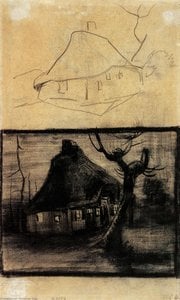
Tabernacle in the Heath
“Tabernacle in the Heath” by Vincent van Gogh stands as a poignant testament to the artist’s ability to distill profound emotion into deceptively simple visual elements. Created in 1886 during his formative years in Paris, this pencil drawing isn't merely an observation of rural landscape; it’s a carefully constructed meditation on solitude, faith, and the beauty found within quiet contemplation.
Artistic Style and Influences
Van Gogh’s approach to “Tabernacle in the Heath” firmly establishes him within the realm of Realism. Rejecting Impressionist fleeting impressions of light and color, he sought instead to capture the essence of his subject matter with unwavering accuracy. This dedication to truthful representation is evident in the meticulous rendering of textures—the rough thatch of the roof, the weathered bark of the tree—and the subdued palette dominated by earthy browns and greens. However, beneath this apparent simplicity lies a subtle influence from Post-Impressionism. Like artists such as Cézanne and Gauguin, Van Gogh employed bold lines to convey movement and energy, injecting vitality into what might otherwise appear static.
Notable Comparisons
To appreciate the depth of Van Gogh’s artistic vision, consider comparing “Tabernacle in the Heath” with other seminal works from his oeuvre. His depiction of Digger, a study of a potato plant bursting forth from the soil, shares a similar focus on organic forms and expressive brushstrokes—a characteristic that distinguishes him from Impressionists like Monet. Similarly, Apartment Blocks and Miscellaneous Studies showcases Van Gogh’s fascination with urban environments and architectural structures, reflecting his ongoing exploration of artistic innovation.
Similar Artists and Collections
Exploring the broader artistic landscape of the era reveals connections to artists who wrestled with similar themes of spirituality and observation. Niels Strøbek, a Danish painter known for his realistic landscapes reminiscent of Rembrandt’s chiaroscuro technique, embodies a kindred spirit in capturing the solemn beauty of rural life. Furthermore, the Contini Bonacossi Collection at the Uffizi Gallery in Florence houses an impressive array of artworks spanning centuries—a treasure trove for connoisseurs interested in tracing artistic lineages and appreciating stylistic evolution.
- Seashore, Martinique by Paul Gauguin
- Old Nag by Vincent van Gogh
“Tabernacle in the Heath” embodies Van Gogh’s unwavering commitment to portraying the world around him with honesty and sensitivity. Its understated elegance invites viewers to contemplate the profound connections between humanity and nature—a timeless message that continues to resonate today.
For more detailed information on Vincent van Gogh's life and artistic legacy, visit WahooArt.com or delve into the Uffizi Gallery collection on Wikipedia: Uffizi Gallery.



 Vista previa
 Cambiar a formato impreso
 Compartir
 Compartir
 Ver detalles
 Guía
Guía

 Descargar
 Ver artículos similares
 Radiografía
 Presentación de diapositivas
 Estadísticas

 Leer más






































 La opción de vidrio solo está disponible en tamaños inferiores a 110 cm.




![Irises [1889]](/media/artworks/images-thumb/ca/85/ca85582a4fd1dc392efef83ec4dc3124.jpg)


