The Illusion of Form: Exploring Zett-Ka
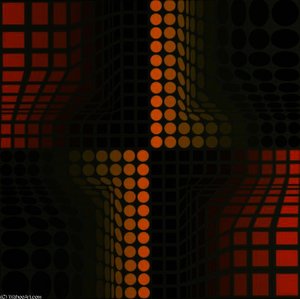
To stand before Victor Vasarely's Zett-Ka is not merely to observe a painting; it is to step into a meticulously constructed optical puzzle. This masterful piece, a quintessential beacon of the Op-Art movement, immediately arrests the viewer with its vibrant interplay of color and geometry. The eye cannot settle on one point for long, instead being drawn across the surface by an almost palpable sense of visual vibration. At its heart lies a commanding blue and red sphere, not solid in its appearance, but rather suggested through countless smaller circles and patterned elements. These constituent parts work together to create an illusion of depth and movement that seems to breathe with the viewer's own gaze.
A Dialogue Between Geometry and Perception
Vasarely’s genius lies in his ability to translate abstract mathematical principles into visceral, emotional art. The Op-Art style, which blossomed in the 1960s, was a direct intellectual response to modern life—a celebration of structure, pattern, and the very mechanics of human sight. In Zett-Ka, this is evident in the rigorous arrangement of its patterned surface. It speaks to an era fascinated by science and perception, where art could engage with physics as much as emotion. The composition itself is a sophisticated dance between order and perceived chaos; the geometric precision suggests intellect, while the resulting visual flutter evokes a more primal, almost dizzying sensory experience.
Historical Echoes and Artistic Lineage
This work stands firmly within a rich lineage of artistic inquiry that questions the nature of reality. Vasarely, whose career spanned decades of avant-garde exploration, utilized geometry as his primary tool for philosophical questioning. One cannot discuss Zett-Ka without acknowledging its conversation with contemporaries and predecessors who dared to challenge pictorial space. The echoes of Bridget Riley’s mesmerizing patterns or the thoughtful color juxtapositions found in Gershon Iskowitz's work resonate here, confirming Op Art’s status as a pivotal moment in modern art history. It is an artwork that demands scholarly appreciation while remaining immediately accessible to the casual admirer.
Bringing Dynamic Energy Home
For the collector or designer seeking a piece that transcends mere decoration, Zett-Ka offers unparalleled dynamism. Reproducing this work allows one to incorporate a focal point of intellectual energy into any space. Imagine its bold blue and passionate red hues set against a neutral wall—the painting itself becomes an active participant in the room's atmosphere. It is art that does not merely hang; it vibrates. Owning a reproduction of Zett-Ka means acquiring a piece of visual theory, a conversation starter, and a permanent source of optical delight for years to come.



 Vista previa
 Encargar reproducción pintada a mano
 Compartir
 Compartir
 Ver detalles
 Guía
Guía

 Descargar
 Ver artículos similares
 Radiografía
 Presentación de diapositivas
 Estadísticas
 Leer más






































 La opción de vidrio solo está disponible en tamaños inferiores a 110 cm.