A Dance of Perception: Unveiling Victor Vasarely’s “Untitled1”
Victor Vasarely's "Untitled1" is more than just an abstract composition; it’s a meticulously crafted illusion, a testament to the pioneering work of Op Art and a profound exploration of how our eyes perceive reality. Created by one of the movement’s key figures – born Károly Vaszary in 1906 in Pécs, Croatia – this artwork embodies his lifelong fascination with geometry and its power to manipulate visual experience. Initially drawn to medicine, Vasarely's destiny shifted dramatically when he embraced painting, a path forged through rigorous training at the Podolini-Volkmann Academy and, crucially, within the influential workshop of Sándor Bortnyik, where the principles of functional design and geometric abstraction were rigorously honed – directly echoing the Bauhaus movement’s emphasis on form and function. “Untitled1” stands as a potent distillation of these influences, a vibrant embodiment of Vasarely's artistic vision.
The Geometry of Illusion
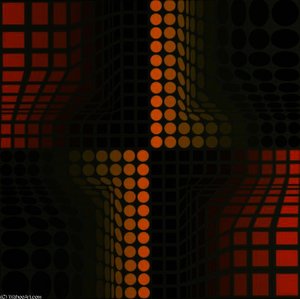
At first glance, "Untitled1" appears to be a chaotic jumble of shapes – interlocking circles and squares arranged in a seemingly random fashion. However, a closer examination reveals an astonishing level of control and precision. The artwork’s core is dominated by a large square, subtly differentiated from the surrounding areas, creating a dynamic tension that draws the eye across the canvas. This grid-like structure, punctuated by variations in density and placement, isn't merely decorative; it’s a deliberate orchestration designed to trigger optical illusions. The high contrast between the vibrant red/orange and black hues amplifies this effect, forcing the viewer’s eye to constantly adjust its focus, creating a mesmerizing sense of movement and depth despite the artwork’s fundamentally flat surface. Vasarely masterfully exploits our visual system, challenging our assumptions about space and perspective.
Technique and Materials: A Precision Execution
The creation of “Untitled1” speaks to a remarkable technical skill. Executed with likely acrylics on canvas or board, the artist’s control is evident in the clean lines defining each shape and the consistent repetition throughout the composition. The smooth texture, a product of careful application and precise geometric patterns, suggests a deliberate avoidance of impasto – textural variation – prioritizing clarity and optical impact above all else. This meticulous approach aligns with Vasarely's broader philosophy: to reduce art to its purest visual elements, focusing on the fundamental principles of perception rather than representational accuracy. The artwork’s enduring quality is a testament to the robustness of this technique.
Symbolism and Emotional Resonance
While undeniably abstract, “Untitled1” invites contemplation about its potential symbolic meanings. The repetitive patterns could be interpreted as representing order, infinity, or even a deliberate disorientation – mirroring the unsettling yet captivating effect that Op Art generates. Vasarely himself was interested in exploring the relationship between art and science, viewing his work as a visual investigation into the nature of perception itself. Beyond this intellectual engagement, however, lies an undeniable emotional resonance. The dynamic interplay of color and form evokes a sense of excitement, energy, and perhaps even a subtle feeling of unease – a reminder that our perceptions are not always reliable guides to reality. This piece is a powerful demonstration of how art can profoundly affect our psychological state.



 Ver en contexto
 Comprar pintura hecha a mano
 Enviar
 Compartir
 Detalles

 Descargar
 Similares
 Radiografía
 Presentación de diapositivas
 Estadísticas

 Ver más






































 La opción de vidrio solo está disponible en tamaños inferiores a 110 cm.