Impresiones giclée o en lienzo de calidad de museo con producción rápida y opciones de acabado flexibles. ( Comprar pintura hecha a mano Comprar imagen)





























Elija entre nuestros tamaños predefinidos que respetan las proporciones originales de la obra.

Puede introducir sus propias dimensiones para adaptarse a un marco o espacio específico. Si el tamaño seleccionado no coincide con las proporciones de la imagen original, recortaremos la obra de arte o extenderemos la imagen con un borde con efecto espejo o de color sólido. Se enviará una maqueta digital para su aprobación antes de que comience la producción.
Tenga en cuenta que la vista previa en pantalla no refleja el recorte o la extensión real. Solo la maqueta mostrará con precisión la composición final.
Aunque existen tamaños personalizados, recomendamos seleccionar una dimensión de la lista predefinida para preservar las proporciones originales.
Envío a todo el mundo () en 2 semanas en lugar de las 4/5 semanas estándar. (6 septiembre)


Untitled 20
Dimensiones de la reproducción
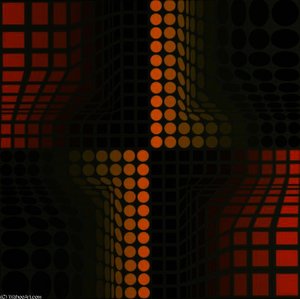
Victor Vasarely's "Untitled 20" is not merely a painting; it’s an invitation to reconsider the very nature of perception. This striking black and yellow composition, dominated by meticulously arranged squares and geometric forms, embodies the core tenets of Op Art – Optical Art – a movement that emerged in the mid-20th century with the audacious goal of stimulating visual responses through purely abstract designs. Born Károly Vaszary in 1906 in Pécs, Croatia, Vasarely’s artistic trajectory began unexpectedly, initially driven by an interest in medicine before he was captivated by the possibilities of visual expression. His formative years within the Bauhaus-influenced Műhely workshop instilled a profound understanding of functional design and geometric abstraction, principles that would become the bedrock of his revolutionary style.
The power of “Untitled 20” lies in its masterful manipulation of optical illusion. Vasarely employed a precise technique – layering squares of varying sizes and orientations – to create an effect that transcends the flat surface of the canvas. The interplay between yellow and black, combined with the nested square patterns, generates a dynamic sense of depth and movement. It’s as if the painting is actively shifting and morphing before your eyes, a testament to Vasarely's deliberate exploitation of human visual perception. This technique, central to Op Art, aimed to trick the eye into perceiving three-dimensional space within a two-dimensional format, a feat achieved through careful control of color, scale, and repetition.
Created in the late 1960s, “Untitled 20” reflects the broader artistic currents of its time. Following the devastation of World War II and the rise of consumer culture, artists sought new ways to engage with the modern world. Op Art, spearheaded by Vasarely alongside artists like Bridget Riley and Josef Albers, offered a radical response – a celebration of industrial design, technology, and the increasingly complex visual environment surrounding individuals. Vasarely’s work was deeply influenced by developments in kinetic art and his fascination with the principles of optics and color theory. He sought to create artwork that wasn't just observed but *experienced*, actively stimulating the viewer’s senses.
While ostensibly abstract, “Untitled 20” resonates with a deeper symbolic significance. The geometric forms – squares, in particular – represent order, structure, and rationality – concepts central to Vasarely's philosophical approach. The painting evokes a sense of controlled chaos, mirroring the complexities of modern life. It’s a visually stimulating experience that can be both calming and unsettling, prompting contemplation on perception, reality, and the relationship between art and the viewer. The bold use of color adds to this emotional impact, creating a vibrant and engaging visual field.
WahooArt offers meticulously crafted hand-painted reproductions of “Untitled 20,” ensuring that you experience the full power of Vasarely’s vision. Our skilled artisans employ traditional painting techniques to faithfully recreate this iconic artwork, capturing every nuance of color and detail. Whether adorning a contemporary interior or serving as a striking statement piece in a classic setting, this reproduction offers an unparalleled opportunity to own a piece of art history.

Victor Vasarely (nacido Károly Vaszary) fue una figura clave en el desarrollo del Op Art y el arte cinético. Su obra buscaba trascender la pintura tradicional explorando ilusiones ópticas y creando experiencias visuales dinámicas. Nacido en Pécs, entonces parte de Austria-Hungría (ahora Croacia), su vida temprana incluyó estudiar medicina en la Universidad Eötvös Loránd de Budapest antes de dedicarse por completo al arte.
La contribución de Vasarely a la historia del arte es multifacética. Se movió más allá de las técnicas pictóricas tradicionales para crear obras que involucran activamente la percepción del espectador. Su enfoque sistemático desafió las nociones convencionales de creatividad artística y allanó el camino para el arte generado por computadora y el diseño digital. Al abrazar la reproducibilidad y las aplicaciones comerciales, Vasarely difuminó los límites entre el arte fino y la cultura popular, dejando una huella perdurable en ambos.

1906 - 1997 , Croacia

Explore the profound spiritual depth of geometric abstraction. From Malevich's Suprematism to modern masters, our expert guide reveals how pure form and color command presence in fine art collections.

Discover the profound beauty of abstract art. Our expert guide explores geometric abstraction, Op Art, and Expressionism, offering connoisseurs deep insights into collecting and curating powerful, non-representational masterpieces for sophisticated interiors.

 Ver en contexto
 Enviar
 Compartir
 Detalles

 Descargar
 Similares
 Radiografía
 Presentación de diapositivas

 Ver más







 La opción de vidrio solo está disponible en tamaños inferiores a 110 cm.