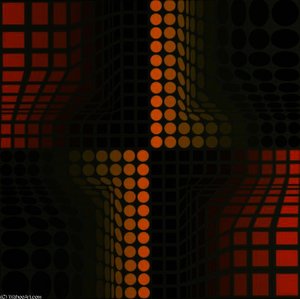
A Symphony of Perception: The Hypnotic World of Victor Vasarely’s “Tomor”
To encounter Victor Vasarely's “Tomor” is to step away from the static world of traditional imagery and enter a realm where the canvas itself seems to breathe, pulse, and vibrate with an engineered energy. Created during the height of the artist's creative powers between 1960 and 1970, this masterpiece serves as a profound testament to the transformative power of geometric abstraction. Eschewing any recognizable subject matter, the work invites the viewer into a mesmerizing tapestry of interlocking ovals and circles that dance against a velvety, infinite black backdrop. It is not merely a painting to be looked at, but an experience to be felt—a rhythmic vibration that challenges our very understanding of stability and depth.
The brilliance of “Tomor” lies in its mastery of Op Art, or Optical Art, a movement born from the fascinating intersection of fine art and perceptual psychology. Vasarely meticulously utilizes repetitive patterns to generate a startling illusion of movement; as your eyes traverse the dense arrangement of shapes, the composition appears to shift and undulate. Through a precise application of color and form, he achieves a remarkable level of precision that creates a sense of controlled chaos. The vibrant, saturated palette—dominated by intense blues, greens, reds, and oranges—clashes and harmonizes simultaneously, creating a visual tension that keeps the gaze perpetually engaged in an active process of interpretation.
Historical Resonance and Geometric Harmony
Emerging from the intellectual currents of the Cold War era, “Tomor” reflects a broader mid-century desire for clarity, order, and a rejection of subjective, heavy emotion. Vasarely, a pioneer who absorbed the rigorous functionalist principles of the Bauhaus movement, sought to democratize art through geometric precision. This piece embodies that mission, offering a structured, symmetrical universe where every circle and oval plays a vital role in a larger, cosmic grid. The artwork’s technical execution—characterized by smooth surfaces and crisp, clean edges—reinforces its hypnotic effect, making it feel less like a manual creation and more like a window into a mathematically perfect dimension.
For the discerning collector or interior designer, “Tomor” offers an unparalleled opportunity to introduce a focal point of intellectual depth and modern sophistication. Its ability to command attention through pure visual rhythm makes it an ideal centerpiece for contemporary spaces that value bold, avant-garde aesthetics. Whether placed in a minimalist gallery setting or as a striking element in a high-end residential lounge, this reproduction captures the essence of Vasarely’s vision: a world where mathematics meets magic, and where the simple geometry of a circle can evoke the profound complexity of the human eye.



 Encargar reproducción pintada a mano
 Compartir
 Compartir
 Ver detalles
 Guía
Guía

 Descargar
 Ver artículos similares
 Presentación de diapositivas
 Estadísticas

 Leer más






































 La opción de vidrio solo está disponible en tamaños inferiores a 110 cm.