Victor Vasarely’s “Relat”: A Symphony of Geometric Perception
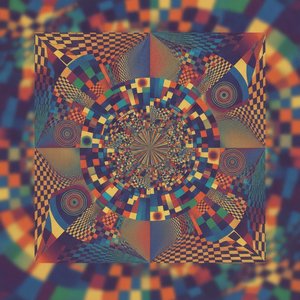
The artwork "Relat," a meticulously rendered geometric abstraction by Victor Vasarely, offers a profound meditation on perception and the very nature of visual experience. Created in the mid-20th century, this piece exemplifies the core tenets of Op Art – Optical Art – a movement that sought to manipulate our senses through precisely controlled patterns and colors. Vasarely, born Károly Vaszary in 1906 in Pécs, Croatia, was a pivotal figure in this revolutionary artistic approach, developing a unique style rooted in the principles of functional design and influenced by the Bauhaus movement’s emphasis on geometric abstraction. “Relat” isn't simply a decorative piece; it’s an invitation to actively engage with your own visual system, challenging assumptions about space, depth, and color.
A Study in Controlled Illusion
At first glance, "Relat" presents a striking composition dominated by a large circular element divided into four distinct quadrants. Each quadrant explodes with a carefully orchestrated palette of blues, reds, purples, and blacks, punctuated by repeating patterns of small oval shapes. The artwork’s power lies in its deliberate construction – a grid-like structure overlays the entire canvas, creating an illusionistic depth that draws the eye inwards. This technique, characteristic of Op Art, leverages our inherent tendency to perceive movement and rhythm within structured visual fields. The hand-painted or digitally rendered precision ensures that every element contributes to this captivating effect, resulting in a dynamic interplay between order and apparent chaos.
Historical Context and Artistic Influences
Vasarely’s work emerged during a period of significant artistic experimentation following World War II. The post-war era saw a rejection of traditional representational art, with artists seeking new ways to express themselves through abstraction. Influenced by the Bauhaus school's focus on functional design and the exploration of optical phenomena, Vasarely developed his signature style – a systematic approach to creating geometric abstractions that aimed to stimulate visual perception. His work anticipated developments in kinetic art, exploring how viewers could actively participate in shaping their own experience of the artwork.
Symbolism and Emotional Resonance
"Relat" transcends mere aesthetic appeal; its inherent symmetry and precise geometric forms evoke a sense of order, control, and perhaps even detachment. The repetition of shapes and patterns can be interpreted as a reflection of the underlying mathematical structures that govern our universe – a subtle nod to the artist’s scientific approach to artmaking. The artwork's cool color palette contributes to its calming effect, while the dynamic interplay of colors and shapes generates a feeling of visual excitement. The deliberate manipulation of perspective creates an unsettling yet fascinating experience, prompting contemplation on the nature of reality itself.
Technique and Materials
This artwork is executed with remarkable technical skill, utilizing acrylic paint on canvas or paper. The smooth texture, achieved through meticulous hand-painting or digital rendering, enhances the illusionistic effects. The careful layering of patterns and converging lines further contribute to the depth and spatial complexity of the piece. A high-quality reproduction captures this level of detail, allowing you to appreciate the artistry and precision that went into creating this iconic Op Art masterpiece.
Preguntas y respuestas
¿En qué tamaño se recomienda imprimir "Relat"?
El tamaño de impresión recomendado para "Relat" de Victor Vasarely es Large.
¿Con qué sentimiento se asocia "Relat"?
"Relat" se asocia con un sentimiento Reflective. El tono emocional describe la impresión que transmite la obra.
¿Cómo se recomienda imprimir "Relat": qué tamaño y qué orientación?
Para "Relat", la configuración de impresión recomendada es un tamaño de Large y una orientación Square.



 Vista previa
 Encargar reproducción pintada a mano
 Compartir
 Compartir
 Ver detalles
 Guía
Guía

 Descargar
 Ver artículos similares
 Radiografía
 Presentación de diapositivas
 Estadísticas

 Leer más






































 La opción de vidrio solo está disponible en tamaños inferiores a 110 cm.