A Dance of Perception: Exploring Victor Vasarely’s Nebulus II
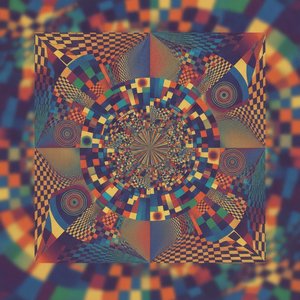
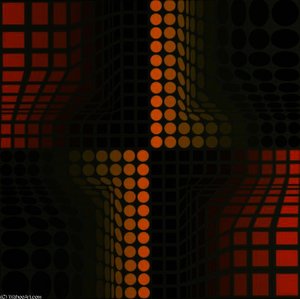
Victor Vasarely's Nebulus II is not merely a visual spectacle; it’s an invitation, a carefully constructed challenge to the very nature of perception. Created in the mid-20th century by this pivotal figure in Op Art and kinetic art, the work embodies a profound exploration into how our eyes interpret depth, movement, and form. The piece immediately captivates with its complex layering of three overlapping spheres, each meticulously rendered as an intricate tessellation of cubes – a visual puzzle designed to subtly shift your perspective with every glance.
- Geometric Harmony: Vasarely’s fascination with geometry is palpable here. The dominant use of cubic and spherical shapes, arranged in a tightly packed grid pattern, creates a mesmerizing rhythm that draws the viewer's eye across the canvas.
- Op Art Principles: Strongly influenced by Op Art, Nebulus II utilizes optical illusions to manipulate our visual experience. The carefully controlled repetition and variations in color saturation generate a dynamic sense of movement and depth, mimicking the effects of shimmering surfaces or vibrating light.
The Birth of an Illusion – Vasarely’s Artistic Journey
Born Károly Vaszary in 1906 in Pécs, Croatia (then part of Austria-Hungary), Victor Vasarely's artistic trajectory was remarkably unconventional. Initially pursuing a medical degree, he abandoned this path in 1927 to embrace the burgeoning world of painting, ultimately finding his true calling within geometric abstraction. His formative years were spent at the Podolini-Volkmann Academy and, crucially, in Sándor Bortnyik’s “Műhely” workshop – a space deeply rooted in the principles of Bauhaus functional design. This exposure ignited Vasarely's lifelong pursuit of understanding how visual elements interact to shape our perception, laying the foundation for his groundbreaking contributions to Op Art.
Technique and Materials: A Digital Masterpiece
Nebulus II is a testament to the power of digital art. Executed through meticulous pixel manipulation and advanced rendering techniques, the artwork showcases a remarkable level of control over form and illusion. The smooth textures achieved are entirely dependent on this digital process, creating an almost hyper-realistic effect despite the abstract subject matter. The artist’s deliberate use of angular lines and sharply defined cubes within the tessellations further enhances the sense of depth and movement, skillfully mimicking the effects of forced perspective – making the spheres appear to recede into the background with a convincing three-dimensional quality.
Symbolism and Emotional Resonance
While Nebulus II eschews overt symbolism or emotional narratives, its impact lies precisely in its ability to provoke a visceral response. The artwork’s primary function is not to represent something tangible but to challenge our assumptions about reality. It's an exploration of the subjective nature of perception, inviting viewers to actively participate in constructing their own interpretation. The piece resonates with a sense of intellectual curiosity and wonder – a reminder that the world we perceive is often far more complex and fascinating than it initially appears.



 Comprar pintura hecha a mano
 Enviar
 Compartir
 Detalles

 Descargar
 Similares
 Presentación de diapositivas
 Estadísticas

 Ver más






































 La opción de vidrio solo está disponible en tamaños inferiores a 110 cm.