Óleo sobre lienzo pintado a mano en el tamaño y marco de su elección, realizado por encargo por nuestros artistas. ( Comprar impresión Comprar imagen)





























Elija entre nuestros tamaños predefinidos que respetan las proporciones originales de la obra.

Puede ingresar sus propias dimensiones para adaptarse a un marco o espacio específico. Si el tamaño seleccionado no coincide con las proporciones de la imagen original, recortaremos la obra o extenderemos la pintura con elementos adicionales pintados a mano. Se le enviará una maqueta digital para su aprobación antes de comenzar la producción.
Tenga en cuenta que la vista previa en pantalla no refleja el recorte o la extensión reales. Solo la maqueta mostrará con precisión la composición final.
Si bien existen tamaños personalizados, recomendamos seleccionar una dimensión de la lista predefinida para preservar las proporciones originales.
Envío a todo el mundo () en 3-4 semanas en lugar de las 5 semanas estándar. (6 septiembre). Sin comprometer la calidad.


Koska Mez
Dimensiones de la reproducción
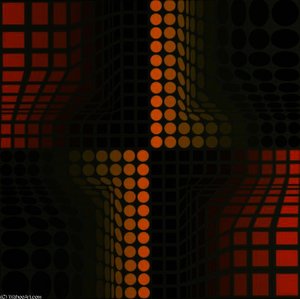
Victor Vasarely's Koska Mez (Honeycomb), painted in 1962, is more than just a visual puzzle; it’s a profound meditation on the nature of perception itself. This vibrant artwork, dominated by a bold yellow square punctuated with countless meticulously placed circles, embodies the core tenets of Op Art – Optical Art – a movement that emerged in the mid-20th century and sought to stimulate optical illusions through geometric abstraction. Vasarely, a key figure in this revolutionary style, wasn’t simply interested in creating pretty pictures; he was driven by a desire to scientifically explore how our eyes and brains interpret visual information. The painting's deceptively simple composition immediately draws the viewer into a dynamic interplay of space and movement, challenging our assumptions about depth and perspective.
Understanding Koska Mez requires acknowledging its historical context. Vasarely’s artistic journey began with a formal medical education, a testament to the rigorous intellectualism that would later inform his work. However, a pivotal encounter with Sándor Bortnyik's ‘Műhely’ workshop – directly influenced by the Bauhaus school – fundamentally shifted his trajectory. The Bauhaus emphasized functional design and geometric abstraction, principles that resonated deeply with Vasarely’s burgeoning interest in visual dynamics. This training instilled within him a fascination with kinetic art—the idea that perception itself could be manipulated through carefully controlled optical effects. The influence of Piet Mondrian and other early abstract artists is also evident, but Vasarely pushed beyond mere representation to create works that actively engaged the viewer’s senses.
Vasarely's technique in Koska Mez is remarkably precise. Each circle, rendered with meticulous attention to detail, contributes to the overall illusion of depth and movement. The varying sizes and positions of the circles create a sense of recession, mimicking the way our eyes perceive distance. He employed a layering technique, applying paint in thin washes to build up the intensity of color and achieve the desired optical effect. This careful control over scale, color, and placement is what elevates the work beyond mere decoration; it’s a deliberate manipulation of visual perception. The use of bright yellow, a color associated with energy and optimism, further amplifies this dynamic quality.
While ostensibly abstract, Koska Mez can be interpreted as representing a microcosm – a ‘honeycomb’ suggesting order within apparent chaos. The repetition of the circles evokes a sense of infinity, mirroring the vastness of space and the complexities of the universe. The artwork's impact is profoundly engaging; it invites contemplation on our relationship with visual information and challenges us to question our own perceptions. Vasarely aimed not just to create an image but to trigger a visceral response – a feeling of movement, energy, and perhaps even a sense of wonder. This piece remains a powerful example of how art can be both intellectually stimulating and emotionally resonant.
Victor Vasarely (nacido Károly Vaszary) fue una figura clave en el desarrollo del Op Art y el arte cinético. Su obra buscaba trascender la pintura tradicional explorando ilusiones ópticas y creando experiencias visuales dinámicas. Nacido en Pécs, entonces parte de Austria-Hungría (ahora Croacia), su vida temprana incluyó estudiar medicina en la Universidad Eötvös Loránd de Budapest antes de dedicarse por completo al arte.
La contribución de Vasarely a la historia del arte es multifacética. Se movió más allá de las técnicas pictóricas tradicionales para crear obras que involucran activamente la percepción del espectador. Su enfoque sistemático desafió las nociones convencionales de creatividad artística y allanó el camino para el arte generado por computadora y el diseño digital. Al abrazar la reproducibilidad y las aplicaciones comerciales, Vasarely difuminó los límites entre el arte fino y la cultura popular, dejando una huella perdurable en ambos.

1906 - 1997 , Croacia

Explore the profound spiritual depth of geometric abstraction. From Malevich's Suprematism to modern masters, our expert guide reveals how pure form and color command presence in fine art collections.

Explore the mesmerizing world of Victor Vasarely. Discover how his Bauhaus-inspired Op Art masters the science of perception through geometric abstraction and vibrant color. A sophisticated guide for discerning art collectors seeking to understand the legacy of optical illusion.

 Ver en contexto
 Enviar
 Compartir
 Detalles

 Descargar
 Similares
 Radiografía
 Presentación de diapositivas

 Ver más







 La opción de vidrio solo está disponible en tamaños inferiores a 110 cm.