A Dance of Perception: Exploring Victor Vasarely’s ‘Abstract Composition’
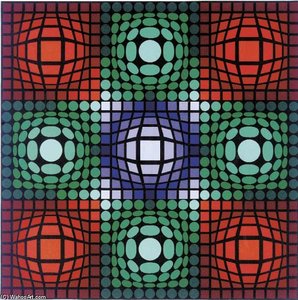
Victor Vasarely's 'Abstract Composition' is more than just a painting; it’s an invitation to question the very nature of visual reality. Created by one of the foremost figures in Op Art, this vibrant work encapsulates the movement’s core philosophy – to manipulate perception through carefully constructed geometric forms and intense color contrasts. The image presents a meticulously crafted three-dimensional cube, dissected into four distinct sections, each rendered with a bold palette of red, green, blue, and yellow. The interplay between solid blocks of color and intricate patterned surfaces creates an illusion of movement and depth, drawing the viewer’s eye across the canvas in a captivating dance.
The Genesis of Op Art: Vasarely's Bauhaus Roots
Born in 1906 in Pécs, Croatia – then part of Austria-Hungary – Károly Vaszary, as he was initially known, embarked on an artistic journey profoundly shaped by the intellectual currents of his time. His early studies in medicine were abruptly abandoned in favor of a pursuit far more compelling: visual expression. This pivotal shift occurred during his enrollment at the Podolini-Volkmann Academy and, crucially, within the influential workshop of Sándor Bortnyik, where he was immersed in the principles of functional design and geometric abstraction championed by the Bauhaus movement. The Bauhaus’s emphasis on reducing form to its essential elements – lines, planes, and colors – directly informed Vasarely's groundbreaking approach, laying the foundation for his signature Op Art style. This work exemplifies that influence, demonstrating a deliberate attempt to trick the eye through controlled optical illusions.
Technique and Illusion: Mastering the Principles of Op Art
Vasarely’s technique in ‘Abstract Composition’ is characterized by its precision and meticulous attention to detail. Each square is rendered with an almost photographic accuracy, yet the combination of solid color and patterned surfaces generates a powerful illusion of depth and movement. The artist skillfully employs contrasting colors – the saturated red against the cool green, the vibrant blue juxtaposed with the warm yellow – to heighten this effect. This deliberate manipulation of visual stimuli creates a dynamic experience for the viewer, forcing them to actively engage with the artwork and question their own perception. The use of flat planes and sharp edges, hallmarks of Op Art, further contributes to the illusion of three-dimensionality, creating a mesmerizing visual paradox.
Symbolism and Emotional Impact: A Modern Masterpiece
'Abstract Composition' transcends mere aesthetic appeal; it speaks to fundamental questions about how we experience the world. The geometric cube, a symbol of stability and structure, is deliberately fragmented, suggesting a disruption of traditional notions of form and space. This fragmentation mirrors the anxieties and uncertainties of the modern era, reflecting a desire to understand and control the increasingly complex realities of the 20th century. The overall effect is one of intense visual stimulation – captivating, slightly unsettling, and ultimately profoundly rewarding. It’s a testament to Vasarely's genius that he could create an artwork that simultaneously challenges and delights the viewer, inviting contemplation on the relationship between art, perception, and reality.
Preguntas y respuestas
¿Qué estado de ánimo y emoción expresa "Abstract composition" de Victor Vasarely?
El estado de ánimo capturado en "Abstract composition" de Victor Vasarely es Elegant, y su tono emocional es Calm.
¿Qué técnica y estilo caracterizan a "Abstract composition" de Victor Vasarely?
"Abstract composition" está realizada en Acrylic On Canvas, con el estilo Op Art.
¿Cuál es el color dominante de "Abstract composition" de Victor Vasarely?
El White (#f0e9e3) es el color predominante de "Abstract composition" de Victor Vasarely.



 Vista previa
 Encargar reproducción pintada a mano
 Compartir
 Compartir
 Ver detalles
 Guía
Guía

 Descargar
 Ver artículos similares
 Radiografía
 Presentación de diapositivas
 Estadísticas

 Leer más






































 La opción de vidrio solo está disponible en tamaños inferiores a 110 cm.