Ver en contexto Vista previa en RA Comprar pintura hecha a mano Cambiar a imagen digital Enviar
Detalles Guía Añadir a favoritos Descargar Similares Radiografía Presentación de diapositivas Q&A Estadísticas

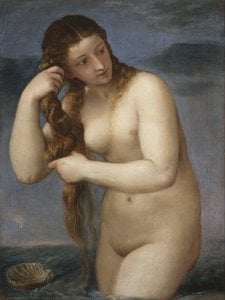
Venus Anadyomene

Experience Titian's 'Venus Anadyomene'! This iconic Renaissance masterpiece depicts the goddess rising from the sea, showcasing exquisite detail and beauty. Explore its rich history & symbolism.

Tiziano Vecellio, conocido como Titian, fue el pintor más destacado de la pintura veneciana del siglo XVI y pionero en el uso del color, dejando un legado artístico eterno.

Giclée / Impresión de arte

Impresiones giclée o en lienzo de calidad de museo con producción rápida y opciones de acabado flexibles. ( Comprar pintura hecha a mano Cambiar a imagen digital)

Corner sample of the P118B picture frame: poliestireno moldeado, 5 cm wide and 3 cm thick
P118B €10
Corner sample of the P118H picture frame: poliestireno moldeado, 5 cm wide and 3 cm thick
P118H €10
Corner sample of the P118W picture frame: poliestireno moldeado, 5 cm wide and 3 cm thick
P118W €10
Corner sample of the P438Z picture frame: poliestireno moldeado, 5.5 cm wide and 3.5 cm thick
P438Z €10
Corner sample of the P508JH picture frame: poliestireno moldeado, 7 cm wide and 3.5 cm thick
P508JH €12
Corner sample of the P508YH picture frame: poliestireno moldeado, 7 cm wide and 3.5 cm thick
P508YH €12
Corner sample of the P805H picture frame: poliestireno moldeado, 5 cm wide and 3.5 cm thick
P805H €10
Corner sample of the P805Z picture frame: poliestireno moldeado, 5 cm wide and 3.5 cm thick
P805Z €10
Corner sample of the P919BZ picture frame: poliestireno moldeado, 7 cm wide and 3.5 cm thick
P919BZ €10
Corner sample of the P919G picture frame: poliestireno moldeado, 7 cm wide and 3.5 cm thick
P919G €10
Corner sample of the P919XJ picture frame: poliestireno moldeado, 7 cm wide and 3.5 cm thick
P919XJ €10
Corner sample of the P959ZH picture frame: poliestireno moldeado, 5 cm wide and 3 cm thick
P959ZH €10
Corner sample of the P968JZ picture frame: poliestireno moldeado, 6 cm wide and 4 cm thick
P968JZ €12
Corner sample of the W106C picture frame: madera maciza, 5 cm wide and 3 cm thick
W106C €8
Corner sample of the W218G picture frame: madera maciza, 5 cm wide and 3 cm thick
W218G €10
Corner sample of the W218JH picture frame: madera maciza, 5 cm wide and 3 cm thick
W218JH €8
Corner sample of the W218Y picture frame: madera maciza, 5 cm wide and 3 cm thick
W218Y €10
Corner sample of the W307PJ picture frame: madera maciza, 6 cm wide and 3 cm thick
W307PJ €10
Corner sample of the W316G picture frame: madera maciza, 6 cm wide and 3 cm thick
W316G €10
Corner sample of the W316PJ picture frame: madera maciza, 6 cm wide and 3 cm thick
W316PJ €8
Corner sample of the W316Y picture frame: madera maciza, 6 cm wide and 3 cm thick
W316Y €10
Corner sample of the W398PJ picture frame: madera maciza, 5 cm wide and 3 cm thick
W398PJ €8
Corner sample of the W4111J picture frame: madera maciza, 6.5 cm wide and 3.5 cm thick
W4111J €10
Corner sample of the W500HY picture frame: madera maciza, 7 cm wide and 5 cm thick
W500HY €15
Corner sample of the W500JH picture frame: madera maciza, 7 cm wide and 5 cm thick
W500JH €15
Corner sample of the W692G picture frame: madera maciza, 8 cm wide and 4 cm thick
W692G €12
Corner sample of the W849H picture frame: madera maciza, 5 cm wide and 3 cm thick
W849H €8
Corner sample of the W940BG picture frame: madera maciza, 7.5 cm wide and 4.5 cm thick
W940BG €15
Corner sample of the W953PJ picture frame: madera maciza, 6 cm wide and 3.5 cm thick
W953PJ €8

Tamaño estándar
a medida
CM
INCH

Elija entre nuestros tamaños predefinidos que respetan las proporciones originales de la obra.

ancho
altura

Introduzca el ancho y el alto que necesite para adaptarse a su marco o pared. Una impresión solo puede recortarse, nunca hacerse más grande que la imagen original, por lo que un tamaño con una forma distinta perderá parte de la obra. Le enviaremos una maqueta digital para su aprobación antes de realizar cualquier impresión. La imagen que se muestra en esta página no refleja el recorte real; solo la maqueta lo hace.

Envío a todo el mundo () en 2 semanas en lugar de las 4/5 semanas estándar. (29 octubre)

Envío exprés gratuito a todo el mundo
Lienzo de lino de alta calidad
Seguro de envío total
Garantía de reembolso de aranceles aduaneros
Garantía de fidelidad cromática exacta
Política de devolución de 100 días (solo por defectos)
Garantía de devolución del 100% del dinero
Descuento por cantidad

Precio total

€ 60

Venus Anadyomene

Giclée / Impresión de arte

Dimensiones de la reproducción

-

Precio total final

€ 60

The Divine Emergence: Titian’s “Venus Anadyomene”

Titian’s “Venus Anadyomene,” painted around 1520, isn't merely a depiction of the goddess; it’s an embodiment of Renaissance ideals—a vibrant celebration of beauty, mythology, and the mastery of color. This oil on canvas masterpiece, now residing in the Scottish National Gallery, captures a pivotal moment: Venus rising from the sea, her hair cascading down as she sheds the remnants of her birth, a gesture simultaneously vulnerable and triumphant. The painting immediately draws the eye with its luminous palette—a symphony of blues, pinks, and golds that evoke both the depths of the ocean and the radiant glow of dawn. It’s a testament to Titian's unparalleled ability to render light and texture, creating an illusion of palpable wetness on Venus’ skin and the shimmering surface of the water.

A Myth Reimagined: The Story Behind the Scene

The title itself, “Anadyomene,” translates to "one who has risen from the sea," referencing a key episode in Greek mythology. According to Hesiod and other classical sources, Venus was born fully-grown from the sea foam—the result of Cronus’s discarded genitals thrown into the ocean. This birth wasn't gentle; it was an emergence, a forceful rising from the depths. Titian brilliantly captures this dynamic moment, portraying Venus not as a passive figure but as an active participant in her own creation. The inclusion of the small scallop shell—a symbol of femininity and fertility—reinforces this narrative, grounding the divine birth within the tangible world. Interestingly, the shell is smaller than in other depictions of Venus’s birth, suggesting that Titian isn't simply illustrating a mythological event but rather emphasizing the goddess’s inherent power and self-sufficiency.

Technique and Style: A Masterclass in Color and Form

Titian’s genius lies not just in his subject matter, but also in his revolutionary approach to painting. He employed a technique known as “alla prima,” meaning he worked directly on the canvas without underdrawing or preparatory sketches. This resulted in loose, vibrant brushstrokes that contribute significantly to the painting's dynamism and immediacy. Notice how Titian builds up layers of color—thin washes of pigment layered over each other to create depth and luminosity. The use of warm, saturated hues contrasts sharply with the cool blues of the sea, creating a captivating visual tension. Furthermore, his masterful handling of drapery – or rather, the *suggestion* of drapery – adds to the sense of movement and fluidity. Venus’s hair isn't rigidly defined; it flows organically around her form, mirroring the waves of the ocean.

Symbolism and Emotional Resonance: More Than Just a Pretty Picture

Beyond its aesthetic beauty, “Venus Anadyomene” is rich in symbolic meaning. Venus herself represents love, beauty, and fertility—powerful forces that have captivated artists and audiences for centuries. Her act of wringing her hair can be interpreted as a shedding of the past, a release from the primal chaos of her birth. It’s an assertion of her independence and her dominion over the natural world. The painting also subtly references classical sculpture, particularly the Crouching Venus and Cnidian Venus—statues that depicted Venus in a similar pose, emphasizing her graceful form and serene expression. Titian's deliberate inclusion of these echoes from antiquity demonstrates his ambition to not only capture a mythological scene but to engage with the artistic traditions of the past.

Ultimately, “Venus Anadyomene” is more than just a beautiful painting; it’s a profound meditation on birth, beauty, and the enduring power of myth. It invites us to contemplate the goddess's emergence from the depths—a potent symbol of renewal, transformation, and the eternal allure of the feminine ideal.

Preguntas y respuestas

¿Qué color predomina en "Venus Anadyomene"?

El color que más destaca en "Venus Anadyomene" es el Gris masilla (#d8b696). El color dominante resulta muy útil a la hora de combinar una obra de arte con un espacio interior.

¿A quién se le puede regalar "Venus Anadyomene" y para qué ocasión?

Se sugiere "Venus Anadyomene" como un regalo para Aniversario, pensando en Pieza central.

¿Cuáles son las dimensiones de la obra original "Venus Anadyomene"?

"Venus Anadyomene" mide 76 x 57 cm en su formato original. Las dimensiones originales son una referencia útil al elegir el tamaño de una reproducción.


Biografía del artista

Tiziano Vecellio: The Venetian Titan

Tiziano Vecellio, universally known as Titian, stands as a monumental figure of the Italian Renaissance—perhaps its most celebrated colorist and a master who redefined the possibilities of oil painting. Born around 1490 in Pieve di Cadore, nestled amidst the dramatic landscapes of the Venetian Alps, his journey from humble beginnings to international acclaim is a testament to prodigious talent and an unwavering dedication to artistic innovation. The exact date of Titian’s birth remains elusive, debated by scholars, but contemporary sources and his early stylistic development converge on estimates between 1488 and 1490.

His father, Gregorio Vecellio, was a military man—a profession that instilled in young Tiziano a disciplined spirit and an appreciation for observation. Lucia, his mother, nurtured him with affection and fostered his artistic inclinations. Recognizing their sons’ potential, the family arranged for Tiziano and Francesco to apprentice with Sebastiano Zuccato, a mosaicist—a decision that would irrevocably alter the course of art history. This formative experience exposed them to the meticulous craftsmanship required for creating intricate decorative panels, shaping their aesthetic sensibilities from an early age.

Titian’s artistic training continued under Giovanni Bellini, who was then Venice’s most prominent painter and a revered teacher. Bellini’s workshop fostered a tradition of Venetian painting characterized by lyrical beauty and subtle tonal harmonies—influences that would permeate Titian’s oeuvre throughout his life. Notably, he collaborated closely with Giorgione—a fellow Venetian artist whose groundbreaking style championed atmospheric perspective and psychological depth.

A Master's Early Style: Giorgione's Influence

The partnership between Titian and Giorgione proved pivotal in shaping Titian’s artistic vision. Their collaboration on the exterior frescoes for the Fondaco dei Tedeschi—a bustling trading post frequented by German merchants—established a stylistic precedent that would endure for decades. The paintings showcased a remarkable sensitivity to light and color, reflecting Giorgione’s pioneering exploration of atmospheric perspective—a technique that aimed to convey the illusion of depth and realism.

Titian’s early works embody this Giorgionesque aesthetic—characterized by hazy landscapes, muted palettes, and an emphasis on capturing mood rather than precise detail. Paintings like *A Man with a Quilted Sleeve* exemplify his burgeoning talent for portraiture, skillfully portraying not only the physical likeness of his subjects but also their inner character—a hallmark of Venetian Renaissance painting.

Expanding Horizons: Bellini's Legacy and Artistic Maturity

Following Giorgione’s untimely death in 1510, Titian continued his artistic development under Giovanni Bellini’s guidance—though Bellini himself was gradually withdrawing from active painting. This period witnessed a gradual shift toward bolder compositions and more assertive color palettes—reflecting Titian’s growing confidence as an independent artist.

His monumental altarpiece for Santa Maria Gloriosa dei Frari—commissioned in 1518—marked a watershed moment in Venetian painting history. The ambitious undertaking demanded mastery of technique, compositional innovation, and chromatic brilliance—qualities that Titian possessed in abundance. This masterpiece cemented his reputation as Venice’s foremost painter and established him as a pioneer of monumental fresco painting.

The Venetian School's Dominance

Titian’s influence extended far beyond his own lifetime, shaping the artistic landscape of Europe for centuries to come. He became a cornerstone of the Venetian school—a movement that championed coloristic realism and psychological depth—inspiring artists across generations. From Rubens and Rembrandt to Delacroix and Monet, Titian’s techniques—particularly his innovative layering of pigments and his masterful manipulation of light—became models for aspiring painters.

His legacy endures not only in the masterpieces he created but also in the enduring fascination with color and emotion that characterizes Venetian art. Tiziano Vecellio—Titian—remains an unparalleled figure in the history of painting, a testament to artistic genius and an embodiment of the Renaissance spirit.

Tiziano

Tiziano

1490 - 1576 , Italia

Datos clave

  • Artistic Movement Or Style: Renacimiento Veneciano
  • Artists Or Movements Influenced By This Artist:
    • Rubens
    • Delacroix
  • Artists Who Influenced This Artist:
    • Giovanni Bellini
    • Giorgione
  • Date Of Birth: c. 1490
  • Date Of Death: 1576
  • Full Name: Tiziano Vecellio
  • Nationality: Italiano
  • Notable Artworks:
    • La Schiavona
    • Venus de Urbino
  • Place Of Birth: Pieve di Cadore, Italia
Explore obras de arte organizadas por temas, estilos y características.