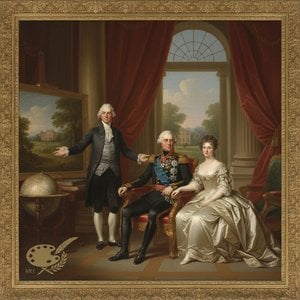
The Enigmatic Lady Brisco
Thomas Gainsborough’s “Lady Brisco,” painted in 1776, is more than just a portrait; it's a carefully constructed tableau of Georgian society, brimming with subtle details that whisper stories of wealth, status, and the complexities of human relationships. The painting depicts Caroline Alicia Fleming, later Lady Brisco, as she married John Brisco, a baronet who inherited substantial estates on St. Christopher Island. It’s a work steeped in the fashionable sensibilities of Bath society, yet simultaneously imbued with Gainsborough's signature blend of observation and artistic license – a masterful combination that elevates it beyond a simple likeness.
The composition immediately draws the eye to the sitter, whose posture exudes an understated grace. She stands slightly off-center, holding the lead of her dog on a leash, a detail that speaks volumes about her position within the social hierarchy – a woman of leisure and influence. The lighting is expertly controlled, highlighting her face and dress while casting delicate shadows that add depth and dimension to the scene. The background, rendered with a loose, atmospheric brushstroke, suggests an outdoor setting, likely a carefully cultivated garden or park, further reinforcing the image of refined elegance.
A Study in Fashion and Symbolism
Gainsborough’s choice of attire for Lady Brisco is particularly revealing. Her shimmering silver gown, adorned with gold trim, isn't merely decorative; it references classical drapery – a deliberate nod to the ‘Grand Manner’ style championed by Sir Joshua Reynolds, a rival painter and Gainsborough’s former mentor. However, this reference is subtly subverted by the contemporary silhouette of the dress, demonstrating Gainsborough’s willingness to blend tradition with innovation. The elaborate hairstyle, piled high and embellished with an ostrich feather, was the height of fashion in the 1760s, a visual marker of her social standing and wealth.
The inclusion of the dog is another significant element. Dogs were highly valued companions during this period, symbols of loyalty and status. The dog’s presence reinforces Lady Brisco's position as a woman of means, capable of affording such a luxury. Furthermore, the dog’s leash subtly directs the viewer’s gaze back to the sitter, creating a visual loop that emphasizes her importance within the composition.
Historical Context and Artistic Technique
Painted during a period of significant social and economic change in Britain, “Lady Brisco” reflects the rise of the merchant class and the increasing emphasis on material wealth. Gainsborough’s career was marked by a constant negotiation between his desire to paint landscapes – his true passion – and the demands of portrait commissions from wealthy patrons. He often employed strategic techniques to achieve desired effects, such as subtly distorting proportions to accommodate crowded exhibition spaces at the Royal Academy.
The painting’s oil on canvas technique is characterized by loose brushstrokes and a delicate palette, creating an ethereal quality that belies the underlying structure of the composition. Gainsborough's ability to capture fleeting moments of expression – the subtle curve of her lips, the gentle tilt of her head – is remarkable. His work demonstrates a keen eye for detail and a masterful understanding of light and shadow.
A Legacy of Elegance
“Lady Brisco” remains one of Gainsborough’s most celebrated portraits, admired for its exquisite beauty, subtle symbolism, and technical brilliance. It offers a captivating glimpse into Georgian society, revealing the complexities of wealth, status, and human relationships. Reproductions of this iconic work continue to inspire art lovers and collectors alike, serving as a testament to Gainsborough's enduring legacy as one of Britain’s greatest artists.



 Vista previa
 Encargar reproducción pintada a mano
 Compartir
 Compartir
 Ver detalles
 Guía
Guía

 Descargar
 Ver artículos similares
 Radiografía
 Presentación de diapositivas
 Estadísticas


 Leer más






































 La opción de vidrio solo está disponible en tamaños inferiores a 110 cm.