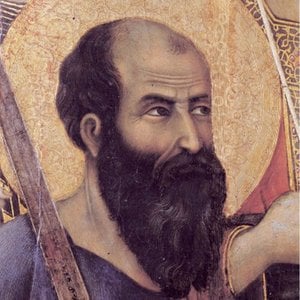
MaestÓ (front, predella), The Flight into Egypt
Duccio di Buoninsegna stands as an undisputed titan of Sienese Gothic painting, his legacy cemented by the monumental Maestá altarpiece—a masterpiece that redefined artistic expression and profoundly influenced subsequent generations. Among its many panels, MaestÓ (front, predella), The Flight into Egypt commands particular attention, not merely for its visual splendor but also for the profound narrative it conveys and the masterful execution that embodies Buoninsegna’s artistic vision.
This oil on panel artwork measures 26 x 57 cm and immediately captivates viewers with its luminous palette—primarily golds and blues—a hallmark of Buoninsegna's distinctive style. The artist eschewed the rigid formalism of Byzantine art, opting instead for a humanist approach that prioritized emotional resonance and naturalistic detail. This decision was revolutionary at the time, marking a decisive step away from stylized representations toward a more truthful depiction of human experience.
Introduction to the Painting and its Artist
Born around 1255 in Siena, Duccio’s formative years coincided with the flourishing of Byzantine art in Italy—particularly in Constantinople. However, he swiftly absorbed influences from Giotto di Bondone, whose groundbreaking frescoes at Assisi championed naturalism and psychological depth. This encounter proved pivotal in shaping Buoninsegna's artistic trajectory, propelling him toward a synthesis that blended Byzantine grandeur with Giotto’s humanist realism.
His work is prominently displayed in the Museo d'Arte Sacra della Val d'Arbia in Buonconvento, Italy—a testament to Siena’s enduring patronage of exceptional art. Visiting this museum offers an unparalleled opportunity to immerse oneself in the artistic milieu that nurtured Buoninsegna’s genius and to appreciate the profound impact of his oeuvre on Italian Gothic painting.
Historical Context
MaestÓ (front, predella), The Flight into Egypt was conceived as part of Buoninsegna’s monumental Maestá altarpiece—commissioned by the Cathedral of Siena in 1308. This ambitious undertaking aimed to glorify Mary and Christ, reflecting the spiritual fervor of the era and establishing Siena as a beacon of artistic innovation.
The predella panels served as the foundation of this grand composition, presenting viewers with a series of scenes from the Gospels—specifically, the Flight into Egypt, depicting Mary and Joseph fleeing Herod’s persecution to protect Jesus. This narrative resonated deeply with medieval audiences, embodying themes of faith, pilgrimage, and divine providence.
Artistic Analysis
Buoninsegna's masterful technique is evident in every brushstroke—particularly his use of gold leaf, which imbues the panel with an ethereal glow and symbolizes divine illumination. The composition is meticulously structured, dividing the scene into three horizontal sections that emphasize spatial depth and harmonic balance.
- The central figure—Mary—holds Jesus aloft on her lap, conveying tenderness and maternal devotion.
- Joseph guides the donkey forward, demonstrating steadfastness and protection.
- The background landscape—characterized by rugged mountains—creates an atmosphere of solemn grandeur.
Furthermore, Buoninsegna’s subtle modeling—the manipulation of light and shadow—reveals the contours of the figures beneath drapery, conveying a remarkable sense of realism. This approach distinguishes him from earlier artists who favored flattened surfaces and stylized representations.
Visit WahooArt.com to explore more of Duccio di Buoninsegna’s works, including MaestÓ (front, predella), The Flight into Egypt.
Learn more about the Museo d'Arte Sacra della Val d'Arbia and its collection of Sienese School paintings on WahooArt.com.
Discover the International Gothic style and its influence on artists like Gentile Da Fabriano on Wikipedia.
Duccio di Buoninsegna’s contribution to Italian Gothic art transcends mere stylistic innovation—it embodies a profound spiritual aspiration that continues to inspire artists and admirers alike. MaestÓ (front, predella), The Flight into Egypt remains a testament to Buoninsegna’s unparalleled artistic mastery and a cornerstone of Western art history.



 Vista previa
 Cambiar a formato impreso
 Compartir
 Compartir
 Ver detalles
 Guía
Guía

 Descargar
 Ver artículos similares
 Radiografía
 Presentación de diapositivas
 Estadísticas

 Leer más






































 La opción de vidrio solo está disponible en tamaños inferiores a 110 cm.