Ver en contexto Vista previa en RA Cambiar a impresiones Cambiar a imagen digital Enviar
Detalles Guía Añadir a favoritos Descargar Similares Radiografía Presentación de diapositivas Estadísticas

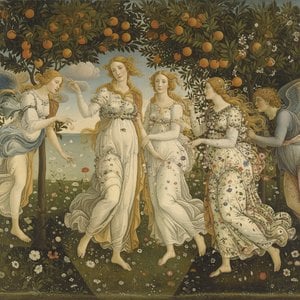
Primavera (La Primavera)

Primavera (La Primavera) de Sandro Botticelli: Un icono del Renacimiento italiano que celebra la belleza y el amor con figuras mitológicas en un jardín exuberante. Una obra maestra de la armonía y el detalle.

Explore la cautivadora obra de arte de Sandro Botticelli (1445-1510), un maestro de la pintura del Renacimiento Temprano. Conocido por su elegante linealidad, obras icónicas como 'El Nacimiento de Venus' & 'La Primavera', y por conectar los estilos gótico y renacentista. ¡Descubre su legado!

Reproducción al óleo hecha a mano

Óleo sobre lienzo pintado a mano en el tamaño y marco de su elección, realizado por encargo por nuestros artistas. ( Cambiar a impresiones Cambiar a imagen digital)

Corner sample of the P118B picture frame: poliestireno moldeado, 5 cm wide and 3 cm thick
P118B €10
Corner sample of the P118H picture frame: poliestireno moldeado, 5 cm wide and 3 cm thick
P118H €10
Corner sample of the P118W picture frame: poliestireno moldeado, 5 cm wide and 3 cm thick
P118W €10
Corner sample of the P438Z picture frame: poliestireno moldeado, 5.5 cm wide and 3.5 cm thick
P438Z €10
Corner sample of the P508JH picture frame: poliestireno moldeado, 7 cm wide and 3.5 cm thick
P508JH €12
Corner sample of the P508YH picture frame: poliestireno moldeado, 7 cm wide and 3.5 cm thick
P508YH €12
Corner sample of the P805H picture frame: poliestireno moldeado, 5 cm wide and 3.5 cm thick
P805H €10
Corner sample of the P805Z picture frame: poliestireno moldeado, 5 cm wide and 3.5 cm thick
P805Z €10
Corner sample of the P919BZ picture frame: poliestireno moldeado, 7 cm wide and 3.5 cm thick
P919BZ €10
Corner sample of the P919G picture frame: poliestireno moldeado, 7 cm wide and 3.5 cm thick
P919G €10
Corner sample of the P919XJ picture frame: poliestireno moldeado, 7 cm wide and 3.5 cm thick
P919XJ €10
Corner sample of the P959ZH picture frame: poliestireno moldeado, 5 cm wide and 3 cm thick
P959ZH €10
Corner sample of the P968JZ picture frame: poliestireno moldeado, 6 cm wide and 4 cm thick
P968JZ €12
Corner sample of the W106C picture frame: madera maciza, 5 cm wide and 3 cm thick
W106C €8
Corner sample of the W218G picture frame: madera maciza, 5 cm wide and 3 cm thick
W218G €10
Corner sample of the W218JH picture frame: madera maciza, 5 cm wide and 3 cm thick
W218JH €8
Corner sample of the W218Y picture frame: madera maciza, 5 cm wide and 3 cm thick
W218Y €10
Corner sample of the W307PJ picture frame: madera maciza, 6 cm wide and 3 cm thick
W307PJ €10
Corner sample of the W316G picture frame: madera maciza, 6 cm wide and 3 cm thick
W316G €10
Corner sample of the W316PJ picture frame: madera maciza, 6 cm wide and 3 cm thick
W316PJ €8
Corner sample of the W316Y picture frame: madera maciza, 6 cm wide and 3 cm thick
W316Y €10
Corner sample of the W398PJ picture frame: madera maciza, 5 cm wide and 3 cm thick
W398PJ €8
Corner sample of the W4111J picture frame: madera maciza, 6.5 cm wide and 3.5 cm thick
W4111J €10
Corner sample of the W500HY picture frame: madera maciza, 7 cm wide and 5 cm thick
W500HY €15
Corner sample of the W500JH picture frame: madera maciza, 7 cm wide and 5 cm thick
W500JH €15
Corner sample of the W692G picture frame: madera maciza, 8 cm wide and 4 cm thick
W692G €12
Corner sample of the W849H picture frame: madera maciza, 5 cm wide and 3 cm thick
W849H €8
Corner sample of the W940BG picture frame: madera maciza, 7.5 cm wide and 4.5 cm thick
W940BG €15
Corner sample of the W953PJ picture frame: madera maciza, 6 cm wide and 3.5 cm thick
W953PJ €8

Tamaño estándar
a medida
CM
INCH

Elija entre nuestros tamaños predefinidos que respetan las proporciones originales de la obra.

ancho
altura

Indique el ancho y el alto que necesite para adaptarse a su marco o pared. Al tratarse de una obra pintada a mano, si requiere un tamaño con una proporción distinta, el artista puede pintar un poco más alrededor de la imagen o recortarla ligeramente; usted elige. Le enviaremos una maqueta digital para su aprobación antes de comenzar la pintura. La imagen que se muestra en esta página no refleja el resultado real; solo la maqueta lo hace.

Ejemplos de lo que se puede personalizar: Reemplace el rostro con una foto del cliente; Agregue una mascota (por ejemplo, cambie un gato por un perro); Incluya un mensaje oculto en el fondo; Cambie el paisaje o los elementos del fondo.
Tras realizar el pedido, el equipo de WahooArt.com enviará un correo electrónico al cliente para solicitar instrucciones y proporcionarle una vista previa del boceto.

Envío a todo el mundo () en 3-4 semanas en lugar de las 5 semanas estándar. (26 octubre). Sin comprometer la calidad.

Envío exprés gratuito a todo el mundo
Lienzo de lino de alta calidad
Seguro de envío total
Garantía de reembolso de aranceles aduaneros
Garantía de fidelidad cromática exacta
Política de devolución de 100 días (solo por defectos)
Garantía de devolución del 100% del dinero
Descuento por cantidad

Precio total

€ 239

Primavera (La Primavera)

Técnica de reproducción

Dimensiones de la reproducción

-

Precio total final

€ 239

Datos clave

  • Medium: Tempera sobre lienzo
  • Influences:
    • Ovidio
    • Lucrecio
  • Notable elements or techniques: El uso de colores brillantes y suaves, así como la composición equilibrada.
  • Movement: Renacimiento italiano
  • Artist: Sandro Botticelli

Test de conocimientos artísticos

Cada pregunta tiene una única respuesta correcta.

Pregunta 1:
¿Quién pintó Primavera?
Pregunta 2:
¿En qué época se creó Primavera?
Pregunta 3:
¿Cuál es el tema principal de la pintura?
Pregunta 4:
¿Qué técnica artística utilizó Botticelli para pintar Primavera?
Pregunta 5:
¿Dónde se encuentra actualmente Primavera?

Primavera (Botticelli): A Symphony of Myth and Renaissance Grace

Sandro Botticelli’s *Primavera*, completed around 1482, stands as an emblem of the Florentine Renaissance—a testament to humanist ideals intertwined with a profound fascination for classical mythology. More than just a beautiful depiction of spring blossoms, it's a complex allegory brimming with symbolic meaning that continues to captivate viewers centuries later.

  • Subject Matter: The painting portrays nine figures – gods and goddesses – arranged in a lush garden setting. At its heart is Venus, goddess of love and beauty, surrounded by the Three Graces (representing chastity, grace, and joy), Zephyr (god of the west wind), Chloris (transformed into Flora, goddess of flowers), Mercury (messenger god), Cupid, and Pomona (goddess of fruit trees).
  • Style: Botticelli’s style is characterized by elegant lines, delicate coloration, and a remarkable fluidity that defies the conventions of academic painting. He employs a technique known as tempera on poplar wood, resulting in luminous pigments and subtle tonal variations—a masterful achievement considering the limitations of the medium.
  • Technique: Botticelli’s meticulous attention to detail is evident throughout the composition. The artist painstakingly rendered each petal of the flowers, capturing their textures and colors with astonishing accuracy. Furthermore, he skillfully utilized perspective to create a sense of depth within the garden space, enhancing the overall visual impact.
  • Historical Context: Created during Lorenzo de Medici’s reign—a period marked by artistic patronage and intellectual ferment—*Primavera* reflects the humanist revival that swept across Europe. Botticelli drew inspiration from classical texts and imagery, aligning his work with the broader Renaissance quest for knowledge and beauty.
  • Symbolism: The painting is laden with symbolism reflecting Neoplatonic philosophy prevalent in Florence at the time. Venus embodies divine love and regeneration, while the Graces symbolize virtues essential to human flourishing. Zephyr’s wind signifies renewal and fertility, mirroring the blossoming of spring itself. Cupid's arrow represents desire and passion—a reminder that beauty and pleasure are integral components of a fulfilling life.

Botticelli’s *Primavera* transcends mere visual splendor; it speaks to fundamental human concerns about love, harmony, and the cyclical rhythms of nature. Its ethereal grace and evocative imagery continue to inspire artists and collectors alike—a timeless masterpiece that embodies the spirit of the Renaissance.

Preguntas y respuestas

¿Qué orientación tiene "Primavera (La Primavera)" de Sandro Botticelli?

"Primavera (La Primavera)" de Sandro Botticelli tiene un formato Alargado. El formato describe las proporciones de la composición.

¿Qué tipo de pieza es "Primavera (La Primavera)"?

En el catálogo, "Primavera (La Primavera)" de Sandro Botticelli está clasificado como Arte de pared. Esta categoría permite localizar obras similares.

¿Dónde se encuentra actualmente en exposición "Primavera (La Primavera)" de Sandro Botticelli?

Puede ver la obra original "Primavera (La Primavera)" en el Galería de los Uffizi, Florencia, Italia.


Biografía del artista

vida temprana y formación

Sandro Botticelli, nacido Alessandro di Mariano di Vanni Filipepi alrededor de 1445, fue una figura clave en el Renacimiento temprano de la pintura italiana. Inicialmente eclipsado post mortem, la obra de Botticelli fue revitalizada a finales del siglo XIX por los pre-rafaelitas, lo que llevó a una reevaluación de sus contribuciones artísticas. Botticelli nació en Florencia, Italia, y vivió toda su vida en el mismo barrio. Su familia, incluyendo a su padre Mariano di Vanni d'Amadeo Filipepi, estuvo involucrada en diversas profesiones, lo que les permitió entrar en contacto con artistas. Giorgio Vasari informó que Botticelli fue inicialmente entrenado como joyero.

Estilo artístico y obras notables

La obra de Botticelli se caracteriza por una elegante linealidad, que conecta el gótico tardío italiano con el Renacimiento temprano. Sus obras más famosas, El nacimiento de Venus y Primavera, se exhiben en la Galería Uffizi en Florencia, que alberga una importante colección de su arte. * El nacimiento de Venus (ver en WahooArt) * Primavera (explorar el arte de Sandro Botticelli en WahooArt) * La natividad mística (Galería Nacional, Londres), fechada en 1501, es la única obra de Botticelli con una fecha clara.

Legado e influencia

El estilo de Botticelli evolucionó hacia un enfoque más personal en la década de 1490, divergente de sus contemporáneos como Leonardo da Vinci y el estilo del Alto Renacimiento emergente. Su obra ha sido reconocida como una contribución significativa al movimiento artístico del Renacimiento italiano. * El movimiento artístico del Renacimiento italiano * Sandro Botticelli en Wikipedia
  • Artistas notables del Renacimiento italiano incluyen a Sandro Botticelli, Leonardo da Vinci, Miguel Ángel y Tiziano.
  • La Galería Uffizi de Florencia alberga una importante colección de arte de Botticelli.
  • La obra de Botticelli ha sido reconocida como una figura clave en el Renacimiento temprano de la pintura italiana.
Fechas clave: * 1445: Sandro Botticelli nació en Florencia, Italia. * 1474: Pasó tiempo en Pisa. * 1481-1482: Trabajó en la Capilla Sixtina en Roma. * 1501: La natividad mística (Galería Nacional, Londres) fue fechada.

Sandro Botticelli

Sandro Botticelli

1445 - 1510 , Italia

Datos clave

  • Artistas Que Influyeron:
    • Fra Angelico
    • Paolo Uccello
  • Estilo Artístico: Renacimiento Temprano
  • Fecha De Muerte: 1510
  • Fecha De Nacimiento: c. 1445
  • Influenciado A Artistas: ['Pre-Rafaelitas']
  • Lugar De Nacimiento: Florencia, Italia
  • Nacionalidad: Italiana
  • Nombre Completo: Sandro Botticelli
  • Obras Notables:
    • El Nacimiento de Venus
    • Primavera
    • Natividad Mística
Explore obras de arte organizadas por temas, estilos y características.