Impresiones giclée o en lienzo de calidad de museo con producción rápida y opciones de acabado flexibles. ( Comprar pintura hecha a mano Comprar imagen)





























Elija entre nuestros tamaños predefinidos que respetan las proporciones originales de la obra.

Puede introducir sus propias dimensiones para adaptarse a un marco o espacio específico. Si el tamaño seleccionado no coincide con las proporciones de la imagen original, recortaremos la obra de arte o extenderemos la imagen con un borde con efecto espejo o de color sólido. Se enviará una maqueta digital para su aprobación antes de que comience la producción.
Tenga en cuenta que la vista previa en pantalla no refleja el recorte o la extensión real. Solo la maqueta mostrará con precisión la composición final.
Aunque existen tamaños personalizados, recomendamos seleccionar una dimensión de la lista predefinida para preservar las proporciones originales.
Envío a todo el mundo () en 2 semanas en lugar de las 4/5 semanas estándar. (6 septiembre)


Mirror -6
Dimensiones de la reproducción
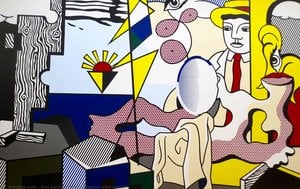
In the vast landscape of twentieth-century art, few images possess the immediate, arresting power of Roy Lichtenstein’s "Mirror -6." Created in 1972, this work serves as a breathtaking testament to the Pop Art movement's ability to transform the mundane into the monumental. At first glance, the viewer is met with a striking, primary-colored composition: a bold red circle, rhythmically interrupted by stark black and white stripes. Yet, beneath this deceptively simple surface lies a profound exploration of identity and perception. The painting functions as more than just an abstract arrangement; it acts as a conceptual window, where the circular form mimics a reflective surface, inviting us to look not just at the canvas, but into the very heart of the artist's vision.
The brilliance of "Mirror -6" lies in its masterful manipulation of Ben-Day dots, a signature technique that Lichtenstein famously adapted from the mechanical printing processes of comic books and mass media. By meticulously recreating the illusion of halftone shading through these tiny, patterned dots, he bridges the gap between high art and popular culture. This method lends the painting a unique, textured immediacy, as if the artwork itself were a vibrant fragment of a printed page brought to life on canvas. The interplay between the saturated red, the deep blacks, and the crisp whites creates a dynamic visual tension that keeps the eye moving, ensuring that the composition feels alive with energy and movement.
Beyond its aesthetic brilliance, "Mirror -6" is steeped in symbolic depth. The title itself suggests a duality—a reflection that goes beyond the physical. In this piece, the mirror becomes a metaphor for introspection and self-awareness. By utilizing a motif that reflects the artist's own presence within the work, Lichtenstein challenges the traditional boundaries between the creator and the subject. He moves away from the grand, sweeping narratives of previous eras to focus on the intimate, psychological experience of looking inward. This shift mirrors the broader cultural transition of the 1970s, where the focus turned toward questioning identity and the role of the individual within a media-saturated society.
For the discerning collector or interior designer, this painting offers an unparalleled opportunity to introduce a sense of historical significance and modern sophistication into a space. The bold geometry and high-contrast palette make it a versatile centerpiece, capable of anchoring a contemporary gallery wall or providing a striking focal point in a minimalist room. Owning a high-quality reproduction of such a masterpiece is not merely about decoration; it is about possessing a piece of the cultural revolution that redefined what art could be. "Mirror -6" remains an enduring icon of boldness, inviting every viewer to pause, reflect, and rediscover the beauty in the most fundamental shapes of our visual world.


1923 - 1997 , Estados Unidos de América

Explore the profound impact of the Pop Art Revolution on modern aesthetics. From Lichtenstein’s dots to Warhol’s icons, gain expert insights into how this vibrant movement redefined culture through consumerism and mass media. A definitive guide for art lovers and collectors.

Explore the profound psychological depth of Roy Lichtenstein's color theory. An expert analysis for art collectors on how bold palettes and Ben-Day dots redefine modern aesthetics and luxury interior curation.

Explore the profound impact of Pop Art on modern aesthetics. From Warhol’s icons to Lichtenstein's bold dots, discover how mass media redefined the masterpiece and continues to inspire sophisticated art collectors and contemporary interior design.

 Ver en contexto
 Enviar
 Compartir
 Detalles

 Descargar
 Similares
 Radiografía
 Presentación de diapositivas

 Ver más







 La opción de vidrio solo está disponible en tamaños inferiores a 110 cm.