Vista previa Vista previa en RA Cambiar a formato impreso Encargar reproducción pintada a mano Compartir
Ver detalles Guía Añadir a favoritos Descargar Ver artículos similares Radiografía Presentación de diapositivas Estadísticas

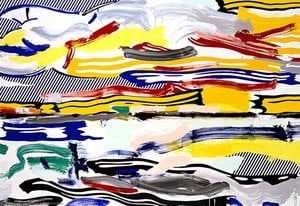
Bull (2) (1973)

Experience Roy Lichtenstein’s ‘Bull (2)’ (1973) – a dynamic Pop Art screenprint bursting with bold yellow and red hues. A captivating study of form, color, and iconic imagery by a modern art master.

Roy Lichtenstein (1923-1997) fue una figura destacada del arte Pop estadounidense, conocido por sus pinturas icónicas con estilo de cómic que exploran el consumismo y el arte fino. Descubre 'Whaam!', 'Drowning Girl' y más.

Adquiera una imagen digital de alta resolución y optimizada, muy superior a la vista previa en línea.

Cada archivo es preparado meticulosamente por nuestros especialistas internos mediante el uso de herramientas avanzadas y un experto retoque manual. Nos aseguramos de que cada imagen posea una claridad excepcional, una precisión cromática impecable y un detalle minucioso.

El archivo final se entrega por correo electrónico en un plazo de 72 horas, optimizado para su uso inmediato en entornos profesionales, editoriales y de impresión. Esta es la misma calidad en la que confían los estudios de diseño, las editoriales y las galerías de primer nivel.

Imagen Digital

Descarga un archivo de alta resolución para exhibición personal, impresión y proyectos creativos. ( Cambiar a formato impreso Encargar reproducción pintada a mano)

Precio total

$ 24,90

Incluido en cada pedido de imágenes digitales

Entrega digital experta, garantizada.

Al elegir WahooArt.com, no solo está adquiriendo una imagen; está recibiendo una obra de arte digital mejorada profesionalmente, elaborada con precisión y respaldada por una garantía de satisfacción. Esto es todo lo que incluye su pedido, automáticamente:

shipping_icon
Entrega inmediata por email

Recibirá su archivo de imagen digital en alta resolución por correo electrónico en un plazo de 72 horas tras realizar su pedido, listo para su uso inmediato.

canvas_icon
Archivo digital optimizado por IA

Su obra de arte se optimiza profesionalmente mediante herramientas avanzadas de IA y edición manual, garantizando el máximo detalle, claridad y precisión cromática.

insurance_icon
Reenvío gratuito de por vida

¿Has borrado o perdido tu archivo por error? No te preocupes: te lo volveremos a enviar en cualquier momento, sin coste adicional.

tax_icon
Sin gastos de importación, siempre

Disfrute de su obra de arte al instante sin aduanas, aranceles ni gastos de envío; las descargas digitales siempre están libres de impuestos.

color_icon
Garantía de precisión de color

Garantizamos que su imagen digital refleje los colores originales con la mayor fidelidad posible, mediante el uso de herramientas profesionales y gestión del color.

return_icon
Garantía de satisfacción de 100 días

Si no está satisfecho con su imagen digital, la revisaremos o le reembolsaremos el 100% en un plazo de 100 días, sin preguntas.

guarantee_icon
100% Garantía de devolución de dinero

¿No está satisfecho? Obtenga un reembolso completo dentro de los 100 días posteriores a la recepción de su archivo digital, sin preguntas.

discount_icon
Descuentos por volumen

Compra 3 imágenes, ahorra 10% - Compra 5, ahorra 15% - Compra 10+, ahorra 20%. Ideal para proyectos creativos, galerías y agencias.

Datos clave

  • Notable elements: Bold colors
  • Title: Bull (2)
  • Artistic style: Pop Style
  • Year: 1973
  • Subject or theme: Bull Image
  • Movement: Pop Art

Cuestionario de arte

Cada pregunta tiene una única respuesta correcta.

Pregunta 1:
What artistic movement is Roy Lichtenstein most closely associated with?
Pregunta 2:
The dominant colors in 'Bull (2)' are primarily:
Pregunta 3:
Based on the image description, what is the subject of the painting?
Pregunta 4:
Which of the following best describes the style evident in 'Bull (2)'?
Pregunta 5:
Roy Lichtenstein often drew inspiration from which of the following sources?

Roy Lichtenstein’s ‘Bull (2)’ – A Pop Art Icon of Boldness and Contemplation

Roy Lichtenstein's “Bull (2),” created in 1973, is more than just a depiction of an animal; it’s a potent distillation of the artist’s signature Pop Art style—a vibrant explosion of color, simplified forms, and a deliberate engagement with the visual language of advertising and comic books. This particular iteration, part of a series exploring the motif of the bull, stands as a testament to Lichtenstein's ability to imbue seemingly mundane subjects with layers of meaning and emotional resonance. The painting immediately commands attention through its striking use of yellow and red – colors traditionally associated with energy, passion, and even danger – creating a dynamic visual tension that draws the viewer in.

The composition itself is deceptively simple. A stylized bull dominates the canvas, rendered in broad, flat areas of color rather than meticulously detailed brushstrokes. This technique, borrowed directly from Ben-Day dots used extensively in commercial printing, gives the image a graphic, almost mechanical quality. The repetition of these small squares creates an illusion of depth and texture, mimicking the effect of printed images. It’s a deliberate move away from traditional representational painting, signaling Lichtenstein's rejection of academic art conventions and his embrace of the visual culture surrounding him.

The Genesis of a Pop Visionary: Context and Influences

To fully appreciate “Bull (2),” it’s crucial to understand the context in which it was created. The 1970s were a period of significant social and cultural change, marked by consumerism, mass media saturation, and a growing skepticism towards established institutions. Pop Art emerged as a direct response to this environment, challenging traditional notions of artistic value and exploring the relationship between art and everyday life. Roy Lichtenstein’s work was deeply influenced by artists like Andy Warhol, who similarly appropriated imagery from advertising and popular culture. However, Lichtenstein's approach differed in its deliberate use of Ben-Day dots and his exploration of themes beyond mere replication – he sought to imbue these borrowed images with a sense of narrative and psychological depth.

Born in Manhattan in 1923, Roy Fox Lichtenstein’s artistic journey began with an interest in realistic drawing and painting. His early training at the Art Students League and subsequent studies at Ohio State University provided him with foundational skills, but it was his encounter with Reginald Marsh, a pioneering realist painter, that truly shaped his approach. Marsh's emphasis on direct observation and capturing the essence of subjects through simplified forms proved to be a key influence on Lichtenstein’s later work. His marriage to Dorothy Herzka (née Lichtenstein), also an artist and art historian, further enriched his intellectual and artistic life.

Decoding the Symbolism: Beyond the Surface

While superficially resembling a commercial print, “Bull (2)” invites deeper interpretation. The bull itself is a potent symbol – often associated with strength, virility, and aggression, but also with fertility and protection. In this context, it can be seen as representing primal forces or perhaps even the anxieties of a rapidly changing society. The vibrant yellow and red colors intensify these associations, creating a sense of urgency and dynamism. The simplified form, devoid of intricate detail, suggests an emotional state rather than a literal representation.

Interestingly, Lichtenstein’s exploration of the bull motif coincided with his interest in mythology and folklore. He frequently referenced ancient stories and symbols in his work, adding layers of historical and cultural significance to his Pop Art images. The series as a whole can be viewed as an investigation into the enduring power of archetypal imagery – how these fundamental symbols continue to resonate across time and cultures.

A Timeless Masterpiece: Reproduction and Interior Design

WahooArt offers meticulously crafted, hand-painted reproductions of “Bull (2)” that capture the essence of Lichtenstein’s original work with remarkable fidelity. Our artists utilize traditional oil painting techniques to faithfully recreate the bold colors, graphic textures, and dynamic composition of this iconic piece. Whether you're a seasoned art collector or seeking to add a touch of Pop Art flair to your interior design scheme, our reproductions provide an authentic and affordable way to bring Lichtenstein’s vision into your home or office.

The scale and color palette of “Bull (2)” make it exceptionally versatile for various settings. Consider pairing it with complementary neutrals to allow the artwork's vibrancy to truly shine, or juxtapose it with more muted tones for a sophisticated contrast. Explore our range of sizes and framing options to find the perfect fit for your space – and experience the enduring appeal of this Pop Art masterpiece.


Biografía del artista

vida temprana y educación

Roy Fox Lichtenstein, un destacado artista pop estadounidense, nació el 27 de octubre de 1923 en la ciudad de Nueva York. Creció en una familia judía de clase media alta, con su padre como corredor de bienes raíces y su madre como ama de casa. El interés de Lichtenstein por el arte y el diseño comenzó como un pasatiempo durante sus años escolares.

Carrera artística

Después de completar su educación secundaria en la Dwight School en 1940, Lichtenstein asistió a la Art Students League of New York bajo la tutela de Reginald Marsh. Luego continuó con una licenciatura en artes visuales de la Universidad de Ohio, que fue interrumpida por un servicio militar de tres años durante la Segunda Guerra Mundial.
  • Look Mickey (1961, Galería Nacional de Arte, Washington D.C.), una de las primeras obras pop art de Lichtenstein, marcó el comienzo de su influyente carrera.
  • Su trabajo estuvo fuertemente influenciado por los estilos de publicidad y cómics populares, con obras notables como Wham!, Drowning Girl y Oh, Jeff... I love you too... but...
  • La obra más cara de Lichtenstein, Masterpiece, se vendió por 165 millones de dólares en enero de 2017.

Enseñanza e influencias

Lichtenstein enseñó en varias instituciones, incluyendo la Universidad Estatal de Nueva York en Oswego y la Universidad Rutgers. Su trabajo fue influenciado por Allan Kaprow, un colega profesor en Rutgers, lo que reavivó su interés en las imágenes proto-pop. Exposiciones notables:
  • The Museum Chambre de Commerce (Tolosa, Francia), que presentaba varias obras de arte, incluyendo aquellas del movimiento pop art.
  • El trabajo de Lichtenstein fue exhibido en la Leo Castelli Gallery en la ciudad de Nueva York, con su primera exposición individual en 1962 siendo comprada por completo por coleccionistas influyentes antes de que abriera.

Legado e impacto

Roy Lichtenstein falleció el 29 de septiembre de 1997, dejando atrás un legado como figura destacada del movimiento pop art. Su obra continúa siendo celebrada por su innovadora mezcla de arte alto y bajo, haciendo que sea accesible a una audiencia más amplia. Referencias:
Roy Lichtenstein

Roy Lichtenstein

1923 - 1997 , Estados Unidos de América

Datos clave

  • Artistas Que Influyeron:
    • Reginald Marsh
    • Allan Kaprow
  • Fecha De Muerte: 29 de septiembre de 1997
  • Fecha De Nacimiento: 27 de octubre de 1923
  • Lugar De Nacimiento: Manhattan, EE. UU.
  • Movimiento Artístico: Pop Art
  • Nacionalidad: Estadounidense
  • Nombre Completo: Roy Lichtenstein
  • Obras Notables:
    • Look Mickey
    • Whaam!
    • Drowning Girl
    • Masterpiece