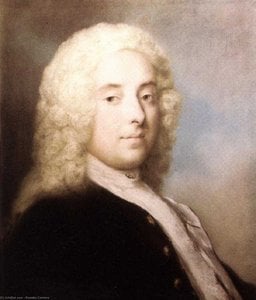
A Symphony of Softness: The Ethereal Grace of Rosalba Carriera’s Winter
In the quietude of 1725, a masterpiece emerged from the hands of the Venetian luminary Rosalba Carriera, capturing not just a season, but a profound state of being. “Winter” is far more than a mere portrait; it is a delicate embrace of the Rococo spirit, where grace and refinement meet the subtle chill of a contemplative moment. As one gazes upon this work, there is an immediate sense of intimacy, as if the viewer has stumbled upon a private thought frozen in time. The subject, a young woman of poised elegance, serves as the heart of the composition, her presence radiating a soft luminosity that seems to defy the muted, wintry atmosphere surrounding her.
Carriera’s mastery of the pastel medium is on full display here, showcasing the very technique that would eventually revolutionize European portraiture. Unlike the heavy, layered oils of the preceding Baroque era, this work breathes through the velvety softness of pigment applied directly to ivory paper. By meticulously blending layers with her fingertips and fine cloths, Carriera achieved a skin texture so supple and luminous it appears almost translucent. This tactile approach creates a surface that invites the eye to linger on the gentle curves of her face and the intricate, flowing lines of her hair, lending the piece an ethereal, dreamlike quality that is quintessential to the Rococo aesthetic.
A Palette of Quiet Elegance and Symbolic Depth
The color story of “Winter” is one of sophisticated restraint. A harmonious blend of beige, soft pink, and muted grey dominates the frame, creating a tonal landscape that mirrors the stillness of a frost-covered morning. These colors are not merely decorative; they carry a profound symbolic weight. The beige tones evoke a sense of serenity and purity, while the subtle highlights of pearl white—seen in the delicate shimmer of her necklace and the light catching her skin—provide much-needed brilliance against the dark, charcoal gray background. This deliberate use of contrast creates a striking depth, pushing the subject forward and ensuring that her features remain the undisputed focal point of the viewer's attention.
For the discerning collector or interior designer, this artwork offers a unique emotional resonance. It possesses a quiet strength that does not demand attention through loudness, but rather commands it through subtle emotion and impeccable balance. The composition, though focused closely on the upper torso, utilizes a slight asymmetry in the subject's pose to inject a sense of life and movement into an otherwise still scene. This tension between stillness and dynamism makes the piece an extraordinary choice for spaces designed for reflection, such as a private study, a sophisticated library, or a serene bedroom suite.
The Venetian Legacy and Timeless Appeal
To understand “Winter” is to understand the golden age of Venice. Carriera, a woman who defied the societal constraints of her era to become one of the most sought-after portraitists in Europe, infused her work with the very essence of Venetian light. Her ability to capture the "powdery" and idealized beauty of the Enlightenment era has allowed her works to remain eternally fashionable. This painting stands as a testament to her innovation—a bridge between the meticulous detail of miniature painting and the expressive freedom of large-scale pastel portraiture.
Owning a high-quality reproduction of this masterpiece allows one to bring a piece of art history into the modern home. It is an invitation to experience the Rococo fascination with beauty and the enduring power of a single, well-placed gaze. Whether used as a focal point in a contemporary minimalist setting or integrated into a classic, ornate interior, Carriera’s “Winter” continues to offer a sense of peace, luxury, and timeless artistic excellence.



 Ver en contexto
 Cambiar a Impresión
 Enviar
 Compartir
 Detalles

 Descargar
 Similares
 Radiografía
 Presentación de diapositivas
 Estadísticas


 Ver más






































 La opción de vidrio solo está disponible en tamaños inferiores a 110 cm.