x
Ver en contextoVer en contexto Vista previa en RAVista previa en RA Comprar pintura hecha a mano Comprar pintura hecha a manoComprar imagen Comprar imagen EnviarEnviar
DetallesDetalles Añadir a favoritos Añadir a favoritos DescargarDescargar SimilaresSimilares RadiografíaRadiografía Presentación de diapositivasPresentación de diapositivas

La Raza Blanca

René Magritte's *La Raza Blanca* desafía la percepción con figuras fragmentadas y una perspectiva plana, explorando temas de identidad y simbolismo surrealista en esta obra maestra visual.

René Magritte (1898-1967) fue un pintor surrealista belga reconocido por sus pinturas provocadoras que desafían la realidad. Explore obras icónicas como 'Los Amantes' y su uso de objetos cotidianos en contextos inesperados. Descubra reproducciones en WahooArt.

Giclée / Impresión de arte

Impresiones giclée o en lienzo de calidad de museo con producción rápida y opciones de acabado flexibles. (Comprar pintura hecha a mano Comprar pintura hecha a manoComprar imagen Comprar imagen)

P118B $10
P118H $10
P118W $10
P438Z $10
P508JH $12
P508YH $12
P805H $10
P805Z $10
P919BZ $10
P919G $10
P919XJ $10
P959ZH $10
P968JZ $12
W106C $8
W218G $10
W218JH $8
W218Y $10
W307PJ $10
W316G $10
W316PJ $8
W316Y $10
W398PJ $8
W4111J $10
W500HY $15
W500JH $15
W692G $12
W849H $8
W940BG $15
W953PJ $8

Estándar
a medida
CM
INCH

Elija entre nuestros tamaños predefinidos que respetan las proporciones originales de la obra.

ancho
altura

Puede introducir sus propias dimensiones para adaptarse a un marco o espacio específico. Si el tamaño seleccionado no coincide con las proporciones de la imagen original, recortaremos la obra de arte o extenderemos la imagen con un borde con efecto espejo o de color sólido. Se enviará una maqueta digital para su aprobación antes de que comience la producción.
Tenga en cuenta que la vista previa en pantalla no refleja el recorte o la extensión real. Solo la maqueta mostrará con precisión la composición final.
Aunque existen tamaños personalizados, recomendamos seleccionar una dimensión de la lista predefinida para preservar las proporciones originales.

Envío a todo el mundo () en 2 semanas en lugar de las 4/5 semanas estándar. (4 septiembre)

why_choose_icon
Envío exprés gratuito a todo el mundo
why_choose_icon
Lienzo de lino de alta calidad
why_choose_icon
Seguro de envío total
why_choose_icon
Garantía de reembolso de impuestos aduaneros
why_choose_icon
Garantía de fidelidad cromática exacta
why_choose_icon
Política de devolución de 60 días (solo por defectos)
why_choose_icon
Garantía de devolución del 100% del dinero
why_choose_icon
Descuento por cantidad

Precio total

$ 68

reproduction

La Raza Blanca

Giclée / Impresión de arte

Dimensiones de la reproducción

-

Precio total final

$ 68

Datos clave

  • Notable elements or techniques: Fragmented figure, dreamlike
  • Artistic style: Precise rendering
  • Subject or theme: Perception, identity
  • Influences:
    • Cubism
    • Futurism
  • Artist: René Magritte
  • Title: La raza blanca

Test de arte

Cada pregunta tiene una única respuesta correcta.

Pregunta 1:
René Magritte is most closely associated with which artistic movement?
Pregunta 2:
What is a prominent characteristic of the figure depicted in *La Raza Blanca*?
Pregunta 3:
The title *La Raza Blanca* ('The White Race') adds what element to the artwork?
Pregunta 4:
What technique is *La Raza Blanca* presumed to be created with?
Pregunta 5:
Magritte's approach to Surrealism differed from others in that he aimed to create…?

A Dreamscape of Perception: Delving into René Magritte’s *La Raza Blanca*

René Magritte's La Raza Blanca (The White Race) is not merely a painting; it’s an invitation to question the very nature of perception. Executed with meticulous detail, this oval-shaped work transcends simple representation, drawing viewers into a realm where logic dissolves and psychological exploration takes center stage. The artwork presents a fragmented human form—an assemblage of anatomical elements that defy conventional understanding. It isn't a portrait in the traditional sense, but rather a carefully constructed puzzle of legs supporting a torso, culminating in a head featuring an unsettlingly placed eye, ear, and mouth. This deliberate disjointedness, coupled with Magritte’s rejection of standard perspective—flattening the image within its oval frame—creates a contained, almost claustrophonic space that intensifies the focus on this enigmatic figure.

The Surrealist Vision and Masterful Technique

Rooted firmly in the Surrealist movement, La Raza Blanca embodies the era’s fascination with illogical juxtapositions and the rejection of rational thought. However, Magritte distinguishes himself through a precise, almost clinical rendering of imagery. The technique appears to be watercolor or gouache on paper, evidenced by the soft blending of colors and subtle tonal variations achieved through delicate layering. Lines are used sparingly but effectively, defining contours without harshness, contributing to the overall smoothness and ethereal quality of the piece. This meticulous approach is key to Magritte’s power; he doesn’t rely on chaotic brushstrokes or expressive textures, but rather on a controlled precision that amplifies the unsettling nature of his subject matter. He wasn’t interested in depicting dreams themselves, but in creating dreamlike images while fully conscious—a distinction crucial to understanding his unique contribution to Surrealism.

Historical Echoes and Symbolic Ambiguity

To understand *La Raza Blanca*, one must consider the historical context of its creation. René Magritte (1898-1967) navigated an artistic journey that began with Impressionism and Cubism before fully embracing Surrealism in the mid-1920s. His work emerged during a period of profound societal upheaval following World War I, a time when artists questioned established norms and sought new ways to express the complexities of the human condition. Magritte’s unique ability was to imbue everyday objects with unsettling strangeness, challenging our perceptions of reality. The symbolism within La Raza Blanca is deliberately open-ended, inviting multiple interpretations. The prominent eye, ear, and mouth suggest a focus on perception—seeing, hearing, and experiencing the world. The fragmented nature of the figure could represent the fractured self, or perhaps the limitations of human understanding. Even the title itself, “The White Race,” adds another layer of complexity, potentially alluding to themes of identity, purity, or even societal constructs – a provocative choice that resists easy answers.

Emotional Resonance and Aesthetic Appeal

La Raza Blanca evokes a sense of unease and mystery. The muted color palette, dominated by dark tones punctuated by flashes of yellow and red, contributes to the painting’s somber mood. Despite its unsettling subject matter, the artwork possesses a compelling aesthetic appeal due to Magritte’s masterful technique and precise execution. It is a piece that lingers in the mind long after viewing, prompting introspection and challenging our assumptions about reality. This work would be an exceptional addition to any collection seeking thought-provoking art with a strong visual presence, or for interior design projects aiming for a sophisticated and intellectually stimulating atmosphere. Its enigmatic quality invites ongoing dialogue and contemplation, making it not just a beautiful object but a catalyst for deeper understanding.

Provenance and Recognition

René Magritte’s *La Raza Blanca* holds significant artistic merit and historical importance. Executed in 1937 during the height of Surrealist experimentation, this artwork exemplifies Magritte's distinctive style—characterized by meticulous detail and a deliberate rejection of conventional perspective—to provoke contemplation on perception and reality. The painting was acquired by Marc Hendrickx in 1960 and subsequently entrusted to the Leonard and Ruth Horwich Family Foundation before being gifted to the Art Institute of Chicago in 2014. It has been extensively studied and documented, appearing in prominent catalogues raisonné and scholarly publications, cementing its place as a cornerstone of Surrealist art history.

  • Artist: René Magritte
  • Year Created: 1937
  • Medium: Watercolor or Gouache on Paper
  • Dimensions: Unknown
  • Location: Art Institute of Chicago

This artwork’s enduring fascination stems from its unsettling juxtaposition of familiar elements—the human form—transformed into a dreamlike tableau. Magritte's masterful technique and precise execution elevate it beyond mere visual representation, inviting viewers to grapple with fundamental questions about consciousness and perception.


Biografía del artista

vida temprana y comienzos artísticos

René François Ghislain Magritte, un reconocido artista surrealista belga, nació el 21 de noviembre de 1898 en Lessines, provincia de Hainaut, Bélgica. Su vida temprana permanece algo misteriosa, con poco conocimiento sobre su infancia. Sin embargo, está documentado que comenzó clases de dibujo en 1910.

evolución artística e influencias

El estilo artístico de Magritte evolucionó significativamente a lo largo de los años, influenciado por diversos movimientos como el impresionismo, el futurismo y el cubismo. Sus primeras pinturas, datadas alrededor de 1915, eran de estilo impresionista. De 1916 a 1918, estudió en la Academia Real de Bellas Artes de Bruselas, bajo Constant Montald.

período surrealista y obras notables

En 1926, Magritte produjo su primer cuadro surrealista, El jinete perdido (Le jockey perdu), marcando el comienzo de su asociación con el movimiento surrealista. Su obra se caracteriza por imágenes provocadoras, a menudo representando objetos ordinarios en contextos inusuales, desafiando las percepciones de la realidad de los observadores.
  • Les amants (1927-1928), una serie de pinturas que presentan a personas con tela cubriendo sus rostros, se cree que fue inspirada por la historia de la muerte de su madre.
  • Los amantes, otra pieza icónica, presenta a una pareja besándose con sus rostros cubiertos por telas blancas, invitando al espectador a reflexionar sobre el amor y la identidad. (disponible para su compra como una reproducción de pintura al óleo hecha a mano o impresión en lienzo en WahooArt.com)

vida tardía y legado

La obra de Magritte fue exhibida en los Estados Unidos en 1936 y nuevamente en dos exposiciones retrospectivas, una en el Museo de Arte Moderno en 1965 y la otra en el Metropolitan Museum of Art en 1992. Se mantuvo comprometido con la izquierda política pero abogó por la autonomía artística. Museos notables que exhiben la obra de Magritte:

Conclusión

El legado de René Magritte como maestro surrealista perdura, con sus imágenes provocadoras que continúan inspirando e intrigando. Su obra, caracterizada por su mezcla única del ordinario y lo inesperado, sigue siendo un pilar fundamental del arte surrealista. Más información sobre René Magritte
René Magritte

René Magritte

1898 - 1967 , bélgica

Datos clave

  • Artistas Que Influyeron:
    • Impresionismo
    • Futurismo
    • Cubismo
  • Estilo Artístico: Surrealismo
  • Fecha De Muerte: 15 de agosto de 1967
  • Fecha De Nacimiento: 21 de noviembre de 1898
  • Influenciado A Artistas:
    • Pop Art
    • Minimalismo
    • Arte conceptual
  • Lugar De Nacimiento: Lessines, Bélgica
  • Nacionalidad: Belga
  • Nombre Completo: René François Ghislain Magritte
  • Obras Notables:
    • Le Jockey Perdu
    • Les Amants
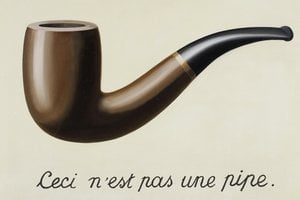
    • La traición de las imágenes
    • Tiempo transcurrido
    • La condición humana
Explore obras de arte organizadas por temas, estilos y características.