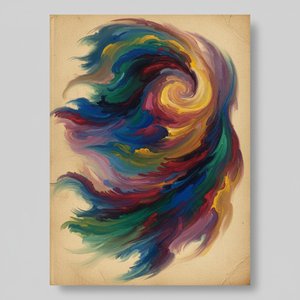
The Lyrical Soul of Renato Birolli
Renato Birolli was an artist whose brushstrokes served as a bridge between the rigid structures of the early twentieth century and the fluid, emotive freedom of post-war abstraction. Born in 1905 to a family of industrial workers in Verona, his upbringing instilled in him a pragmatic resilience that would later anchor his more ethereal artistic explorations. His journey was never merely an aesthetic one; it was deeply intertwined with the turbulent political currents of his era. As he moved to Milan in 1923, Birolli became part of a vibrant avant-garde circle, collaborating with fellow visionaries like Renato Guttuso and Giacomo Manzù. This period was marked by a rebellious spirit, as he sought to dismantle the dominant cultural orders of Fascist Italy, even facing arrest for his political opposition to the regime.
The evolution of Birolli’s style is a fascinating study in artistic metamorphosis. His early years were defined by the intellectual rigor of Cubism and the kinetic energy of Futurism. Drawing inspiration from the fractured perspectives of Picasso and Braque, he mastered the art of geometric deconstruction. However, by 1937, a profound shift occurred as he embraced the dreamlike, subconscious realms of Surrealism. This era, characterized by his involvement with the Corrente di Vita movement, saw him exploring automatism and imagery that reflected the deep-seated anxieties of a world on the brink of war. His art became a vessel for both political resistance and psychological depth, capturing the tension between the tangible reality of conflict and the intangible whispers of the human psyche.
A Transformation in Paris and the Lyrical Horizon
The conclusion of World War II brought about perhaps the most dramatic chapter in Birolli’s career. Relocating to Paris in 1947, he entered a sanctuary of light and color that would fundamentally alter his visual language. In the shadow of masters like Henri Matisse and Pablo Picasso, Birollical moved away from the austere geometries of his youth toward a more expansive, lyrical abstraction. This period was marked by a newfound softness, where the boundaries between sea, sky, and land began to dissolve into a poetic haze. His palette grew more vibrant, utilizing expressive color to evoke atmosphere rather than mere description.
His later works, such as the mesmerizing Legend Of The Sea or the serene Trinité sur Mer, exemplify this mastery of movement and texture. In these pieces, one can observe:
- Organic Fluidity: A departure from rigid lines in favor of undulating shapes that mimic the rhythmic pulse of the ocean.
- Chromatic Depth: The sophisticated layering of pigments—deep blues, verdant greens, and tender whispers of violet—to create a sense of infinite space.
- Emotional Resonance: A technique where brushwork feels alive with the energy of nature, inviting the viewer into a state of contemplation.
Birolli’s legacy remains a powerful testament to the resilience of the human spirit and the transformative power of art. From his monumental frescoes depicting the Battle of Ortona to his quiet, salt-sprayed coastal scenes, he successfully navigated the transition from the heavy weight of history to the weightless beauty of abstraction. He left behind a body of work that continues to resonate, reminding us that even amidst the most profound political and social upheavals, there exists a sanctuary of light, form, and enduring grace.



 Vista previa
 Cambiar a formato impreso
 Compartir
 Compartir
 Ver detalles
 Guía
Guía

 Descargar
 Ver artículos similares
 Radiografía
 Presentación de diapositivas
 Estadísticas


 Leer más






































 La opción de vidrio solo está disponible en tamaños inferiores a 110 cm.