


La obra de arte que se muestra en esta página está protegida por las leyes de propiedad intelectual, lo que significa que no podemos crear ni vender legalmente una reproducción idéntica. Esta protección se hace cumplir en virtud de acuerdos internacionales como el Convenio de Berna y por las leyes nacionales, incluidas aquellas establecidas por el Ley de derechos de autor de los EE. UU. - Título 17.
Este método cumple plenamente con las normativas de derechos de autor, ya que no implica la copia ni la duplicación de la obra protegida. En su lugar, se trata de una reinterpretación creativa: una nueva pintura influenciada por la original, pero que no es idéntica a ella.
Impresiones giclée o en lienzo de calidad de museo con producción rápida y opciones de acabado flexibles. ( Comprar pintura hecha a mano Cambiar a imagen digital)
Elija entre nuestros tamaños predefinidos que respetan las proporciones originales de la obra.

Introduzca el ancho y el alto que necesite para adaptarse a su marco o pared. Una impresión solo puede recortarse, nunca hacerse más grande que la imagen original, por lo que un tamaño con una forma distinta perderá parte de la obra. Le enviaremos una maqueta digital para su aprobación antes de realizar cualquier impresión. La imagen que se muestra en esta página no refleja el recorte real; solo la maqueta lo hace.
Envío a todo el mundo () en 2 semanas en lugar de las 4/5 semanas estándar. (9 noviembre)
Crescendo
Dimensiones de la reproducción
In the realm of mid-century abstraction, few works capture the visceral energy of movement quite like Crescendo. Created in 1957 by the British pioneer of abstract expressionism, Raymond John Mead, this masterpiece serves as a visual manifestation of its namesake—a gradual increase in intensity that culminates in a breathtaking explosion of pigment. The painting is dominated by a commanding, fiery red palette that commands the viewer's immediate attention, pulling the eye toward a central figure that seems to pulse with life. This central focal point is not merely a shape, but an anchor for a complex dance of forms, where deep crimson tones collide with unexpected splashes of blue and green hues. The interplay between these warm and cool tones creates a rhythmic tension, much like the swelling notes of a musical composition reaching its peak.
The technique employed by Mead reflects his profound connection to the Abstract Expressionist movement and his training at the prestigious Slade School of Art. One can sense the influence of his mentor, John Nash, in the structural integrity of the piece, yet the work breathes with the spontaneous, intuitive looseness reminiscent of Franz Kline. The brushwork is bold and decisive, layering colors to create a sense of depth that transcends the two-dimensional canvas. Through these thick, expressive applications, Mead achieves a tactile quality that makes the composition feel as though it is still in the process of unfolding. The smaller figures scattered toward the periphery act as echoes of the central theme, providing a sense of scale and contributing to an intricate design that rewards prolonged, contemplative observation.
To understand Crescendo, one must look to the era of its creation. The late 1950s was a period of immense artistic transition, where the boundaries of representation were being aggressively pushed by artists like Mead, a founding member of the influential Painters Eleven group. Having lived through the turbulence of World War II and experienced the vibrant, experimental atmosphere of New York, Mead brought a unique, global perspective to his work. This painting embodies that post-war spirit—a search for meaning through pure emotion and the rejection of literal imagery. The high horizon lines and structural elements characteristic of his style are present here, providing a hidden architecture beneath the surface chaos.
For the discerning collector or interior designer, this piece offers more than mere decoration; it offers an emotional experience. The vibrant reds evoke passion, strength, and vitality, while the contrasting blues provide moments of necessary respite and introspection. It is a work that demands presence in a room, acting as a conversational centerpiece that can anchor a modern gallery wall or add a sophisticated layer of complexity to a contemporary living space. Whether viewed as a study in color theory or a profound expression of human energy, Crescendo remains a timeless testament to the power of abstract art to stir the soul and transform an environment.
"Crescendo" se define por una paleta de Dark con predominio del Phthalo Green (#2c271b).
"Crescendo" de Raymond John Mead presenta una armonía de color Strong Color Unity.
La luminosidad percibida de "Crescendo" de Raymond John Mead es deep_shadow. Puede armonizarse con la luz del espacio destinado.


1921 - 1998 , Reino Unido

Descubre las 10 obras maestras del Expresionismo Abstracto: Pollock, Rothko y más. Explora la historia, técnica y significado de estos lienzos icónicos. Reproducciones de arte exclusivas en .

Explore the rich history & symbolism of green in art! Discover iconic paintings, techniques, and how to bring verdant harmony into your home with WahooArt's expert guide.

Descubre las 10 pinturas más famosas dominadas por el azul pizarra. Explora la historia, técnica y belleza de Monet, Van Gogh y otros maestros. Encuentra reproducciones de arte exclusivas para decorar tu hogar en .
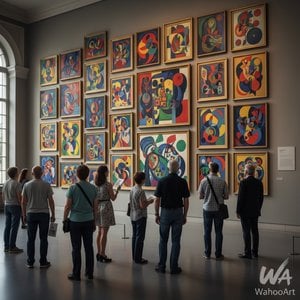
Explora las 25 obras maestras de Kandinsky y su arte abstracto. Descubre reproducciones de museo en WahooArt.com.

Explora las 25 obras maestras de Mark Rothko y el Color Field. Descubre reproducciones de museo en WahooArt.com.
 Ver en contexto
 Enviar
 Compartir
 Detalles
 Guía
Guía

 Descargar
 Similares
 Radiografía
 Presentación de diapositivas
 Preguntas y respuestas
 Estadísticas


 Ver más






































 La opción de vidrio solo está disponible en tamaños inferiores a 110 cm.


