


La obra de arte que se muestra en esta página está protegida por las leyes de propiedad intelectual, lo que significa que no podemos crear ni vender legalmente una reproducción idéntica. Esta protección se hace cumplir en virtud de acuerdos internacionales como el Convenio de Berna y por las leyes nacionales, incluidas aquellas establecidas por el Ley de derechos de autor de los EE. UU. - Título 17.
Este método cumple plenamente con las normativas de derechos de autor, ya que no implica la copia ni la duplicación de la obra protegida. En su lugar, se trata de una reinterpretación creativa: una nueva pintura influenciada por la original, pero que no es idéntica a ella.
Impresiones giclée o en lienzo de calidad de museo con producción rápida y opciones de acabado flexibles. ( Comprar pintura hecha a mano Cambiar a imagen digital)





























Elija entre nuestros tamaños predefinidos que respetan las proporciones originales de la obra.

Introduzca el ancho y el alto que necesite para adaptarse a su marco o pared. Una impresión solo puede recortarse, nunca hacerse más grande que la imagen original, por lo que un tamaño con una forma distinta perderá parte de la obra. Le enviaremos una maqueta digital para su aprobación antes de realizar cualquier impresión. La imagen que se muestra en esta página no refleja el recorte real; solo la maqueta lo hace.
Envío a todo el mundo () en 2 semanas en lugar de las 4/5 semanas estándar. (10 noviembre)
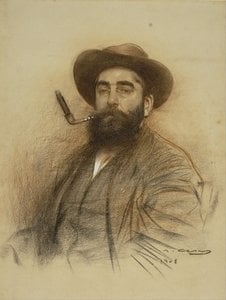
Self-portrait
Dimensiones de la reproducción
In this evocative 1908 drawing, we are invited into the intimate, smoke-filled atmosphere of a bygone era. The piece serves as a profound window into the life of Ramon Casas Carbó, an artist who did not merely paint the world around him but acted as its visual chronicler. Through the delicate yet commanding use of line and shadow, the work captures a moment of quiet introspection. A man, seated with a poised, crossed-legged stance, anchors the composition; his presence is defined by the rugged texture of his beard and the thoughtful weight of his gaze. As he holds a pipe, a thin trail of implied smoke suggests a pause in time, inviting the viewer to share in this contemplative stillness. The monochromatic palette strips away the distractions of color, forcing an encounter with the raw, structural essence of the subject's character.
The technique employed here speaks to the mastery of draftsmanship that defined the Catalan Modernisme movement. Every stroke of the pencil or charcoal serves a purpose, building volume and depth through meticulous hatching and tonal gradations. The artist’s ability to render the heavy fabric of the clothing against the soft, organic textures of facial hair creates a tactile experience for the eye. While the central figure commands our attention, the subtle presence of others in the background adds a layer of social complexity, suggesting that this private moment is occurring within the vibrant, bustling pulse of Barcelona’s intellectual circles. This interplay between the individual and the collective is a hallmark of Casas's ability to capture both personal identity and societal transformation.
For the discerning collector or interior designer, this work offers more than mere decoration; it provides a sense of historical gravity and intellectual depth. The stark, black-and-white aesthetic makes it a versatile masterpiece, capable of anchoring a contemporary minimalist space with its classic elegance or adding a layer of sophisticated nostalgia to a traditional study. It is a piece that demands conversation, acting as a bridge between the late nineteenth-century's artistic revolution and the modern aesthetic. To possess a reproduction of this self-portrait is to hold a fragment of Catalonia's golden age, bringing an atmosphere of timeless wisdom and artistic prestige into any curated environment.
La obra original "Self-portrait" se encuentra en Museu Nacional d'Art de Catalunya y es aún protegido por derechos de autor.
"Self-portrait" de Ramon Casas Carbó es de aún protegido por derechos de autor. Este estado determina cómo se puede reproducir la imagen de la obra.
"Self-portrait" se atribuye a Ramon Casas Carbó.

España

Descubre el rigor formal de la fotografía en blanco y negro y su vínculo con los grandes maestros. Explora la pureza de la luz ahora.

Descubra la elegancia del blanco y negro con WahooArt. Transformamos sus recuerdos en lienzos de óleo hechos a mano, utilizando técnicas maestras como el claroscuro para crear legados eternos. Calidad museística, personalización exclusiva y envío gratuito mundial.

Explore the profound artistry of graphite drawing. Discover professional techniques for mastering depth, texture, and detail through a lens of art history, from classical sketches to modern masterpieces. Elevate your understanding of the pencil medium with our expert guide.

Domine la técnica del grafito y el carboncillo con rigor académico. Explore los secretos de los grandes maestros ahora.
 Ver en contexto
 Enviar
 Compartir
 Detalles
 Guía
Guía

 Descargar
 Similares
 Radiografía
 Presentación de diapositivas
 Preguntas y respuestas
 Estadísticas


 Ver más









 La opción de vidrio solo está disponible en tamaños inferiores a 110 cm.


