A Mystic Engagement With Nature: The Life and Vision of Ralph Rosenborg
Ralph Rosenborg emerged as a profound voice within the mid-century American art scene, carving out a path that was uniquely his own amidst the roaring tides of Abstract Expressionism. While many of his contemporaries in New York were gravitating toward the rigid structures of geometric abstraction or the sheer scale of action painting, Rosenborg sought a more intimate, spiritual connection to the world around him. His artistic journey was not merely one of technical development but a lifelong pursuit of capturing the rhythmic, unseen pulse of the natural landscape. Born into a life enriched by music and literature, he possessed an early sensitivity to the harmonies of existence, a quality that would later define his ability to translate the textures of the earth into vibrant, emotive compositions.
The seeds of his mastery were sown through a pivotal encounter with Henriette Reiss at the American Museum of Natural History. This mentorship provided much more than formal training; it offered Rosenborg a gateway to the avant-garde spirit of Europe. Through Reiss, he was introduced to the transformative theories of Wassily Kandinsky, particularly the concept of synesthesia—the blurring of boundaries between sight and sound. This influence became the heartbeat of his work, as he began to perceive the ripples of a stream or the shifting light of a sunset not just as visual phenomena, but as graphic rhythms capable of being translated into symbolic design. His early years were marked by this intense period of study, where the boundaries between art, music, and nature began to dissolve.
The Alchemy of Color and Form
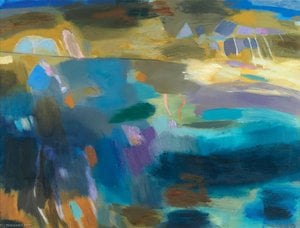
As Rosenborg’s career progressed through the 1930s and 1940s, his work became a testament to the power of expressionism. He did not seek to replicate the world with photographic accuracy; instead, he aimed to interpret its essence. His paintings often functioned as windows into a "super-real" world, a realm where color and brushstroke served as the primary language of emotion. In works such as Country Scene, one can witness the dynamic energy of his palette, where watercolor and oil are used to evoke the vitality of the landscape through fluid, dancing movements of pigment.
Unlike the larger-than-life canvases of the New York School, Rosenborg often found his greatest strength in smaller, more concentrated works. This preference allowed for a sense of preciousness and intense focus, inviting the viewer to lean in and discover the magic hidden within the layers of paint. His technique was characterized by:
- Expressive Brushwork: A reliance on dynamic, gestural strokes that mirror the organic rhythms of nature.
- Luminous Palettes: The use of vibrant, often translucent colors to suggest light, atmosphere, and spiritual depth.
- Organic Abstraction: A commitment to drawing inspiration from natural forms—leaves, water, and earth—rather than man-made geometric shapes.
Legacy and Historical Significance
Throughout a prolific career spanning more than five decades, Ralph Rosenborg maintained an unwavering integrity toward his subject matter. He was a mainstay of the New York art world, exhibiting in prestigious venues such as the ACA Galleries and participating in the celebrated Mile of Art at Radio City Music Hall. His ability to remain a "highly personal artist" while standing alongside the giants of Abstract Expressionism is perhaps his greatest achievement. He resisted the pressure to conform to purely intellectual or cold abstractions, choosing instead to honor the sanctity of the natural world.
Today, Rosenborg is remembered as an artist who bridged the gap between the tangible and the mystical. His work remains a vital link in the history of American modernism, reminding us that abstraction need not be a departure from reality, but can instead be a deeper, more soulful way of seeing it. Through his eyes, the landscape was never static; it was a living, breathing composition of color and rhythm, eternally moving, eternally sacred.



 Vista previa
 Cambiar a formato impreso
 Compartir
 Compartir
 Ver detalles
 Guía
Guía

 Descargar
 Ver artículos similares
 Radiografía
 Presentación de diapositivas
 Estadísticas


 Leer más






































 La opción de vidrio solo está disponible en tamaños inferiores a 110 cm.