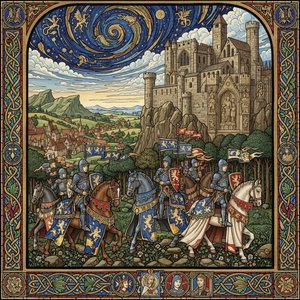
Raphael's Triumph Over Darkness: An Exploration of "Saint George and the Dragon"
Raffaello Sanzio da Urbino’s “Saint George and the Dragon,” completed in 1506, stands as a cornerstone of High Renaissance art—a testament to humanist ideals fused with Christian iconography. More than just a depiction of legend, it embodies Raphael's mastery of composition, color, and textural detail, cementing his place among the artistic titans of his era.
A Classical Framework for Narrative Drama
The painting’s structure adheres rigidly to classical principles—specifically the pyramidal arrangement championed by Leonardo da Vinci. At its apex stands Saint George, radiating nobility and courage as he confronts the monstrous dragon. The horse beneath him anchors the scene, symbolizing strength and righteousness. This deliberate architectural underpinning lends an air of solemn grandeur to the narrative unfolding below.
Harmony Born From Contrasting Elements
Raphael’s palette is deliberately restrained, dominated by earthy greens, browns, and blues—colors that evoke the rugged landscape of Provence where he resided during his Roman period. However, these muted tones are punctuated by flashes of vibrant crimson in the dragon's scales and the princess’s dress—a strategic use of color to draw attention to key elements and heighten dramatic tension. The artist skillfully employs chiaroscuro—the interplay of light and shadow—to sculpt form and emphasize volume, creating a palpable sense of movement.
The Art of Illusion: Texture and Detail
What distinguishes “Saint George and the Dragon” from many other paintings of its time is Raphael’s meticulous attention to textural detail. The dragon's skin is rendered with painstaking accuracy—scales overlapping and shimmering subtly under the light, conveying a sense of reptilian realism. Similarly, Saint George’s armor gleams with polished metal, reflecting the brilliance of the Renaissance sun. Even the rough bark of the trees in the background contributes to the painting’s immersive quality.
Symbolism Rooted in Medieval Tradition
The narrative itself is deeply embedded in medieval Christian lore—a retelling of the tale of Saint George slaying a dragon to rescue Princess Angelica. The saint represents virtue and heroism, embodying the triumph of good over evil—themes that resonated powerfully with audiences of the Renaissance. The dragon symbolizes chaos and pagan darkness, representing the forces opposed to divine order. The princess embodies vulnerability and innocence, requiring protection from danger.
A Legacy of Inspiration
"Saint George and the Dragon" continues to inspire admiration for its artistic excellence and enduring symbolic power. Raphael’s masterful technique—his command of perspective, color theory, and sculptural modeling—established a standard against which subsequent artists would measure themselves. Its serene beauty and dramatic narrative remain relevant today, reminding viewers of the timeless values of courage, faith, and compassion.
Bringing Renaissance Splendor Home
A high-quality reproduction captures the essence of Raphael’s masterpiece—allowing you to experience its grandeur and sophistication in your own living space. Whether displayed prominently on a gallery wall or subtly incorporated into an interior design scheme, this artwork serves as a constant reminder of artistic brilliance and humanist ideals.
Investing in Artistic Heritage
Choosing a reproduction is not merely acquiring decoration; it’s investing in a piece of art history—a tangible connection to one of the most celebrated figures of the Renaissance. Raphael's "Saint George and the Dragon" stands as an enduring symbol of artistic achievement and humanist virtue.



 Vista previa
 Cambiar a formato impreso
 Compartir
 Compartir
 Ver detalles
 Guía
Guía

 Descargar
 Ver artículos similares
 Radiografía
 Presentación de diapositivas
 Estadísticas


 Leer más






































 La opción de vidrio solo está disponible en tamaños inferiores a 110 cm.