Vista previa Vista previa en RA Encargar reproducción pintada a mano Ver versión en imagen digital Compartir
Ver detalles Añadir a favoritos Descargar Ver artículos similares Radiografía Presentación de diapositivas Estadísticas

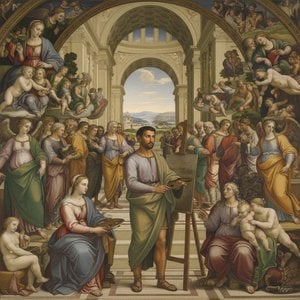
Retrato de un joven hombre

El Retrato de un joven hombre, obra maestra de Rafael Sanzio da Urbino, captura la esencia del retrato renacentista con armonía y detalle en el Museo Nacional de Varsovia.

Descubra a Rafael (1483-1520), el maestro del Alto Renacimiento italiano, reconocido por su gracia, claridad y composiciones armoniosas. Explore obras icónicas como 'La Escuela de Atenas', Madonas y frescos que definen la belleza clásica. #ArteRenacentista #Italia

Giclée / Impresión de arte

Impresiones giclée o en lienzo de calidad de museo con producción rápida y opciones de acabado flexibles. ( Encargar reproducción pintada a mano Ver versión en imagen digital)

P118B $10
P118H $10
P118W $10
P438Z $10
P508JH $12
P508YH $12
P805H $10
P805Z $10
P919BZ $10
P919G $10
P919XJ $10
P959ZH $10
P968JZ $12
W106C $8
W218G $10
W218JH $8
W218Y $10
W307PJ $10
W316G $10
W316PJ $8
W316Y $10
W398PJ $8
W4111J $10
W500HY $15
W500JH $15
W692G $12
W849H $8
W940BG $15
W953PJ $8

Estándar
personalizado
CM
INCH

Elija entre nuestros tamaños predefinidos que respetan las proporciones originales de la obra.

ancho
altura

Puede introducir sus propias dimensiones para adaptarse a un marco o espacio específico. Si el tamaño seleccionado no coincide con las proporciones de la imagen original, recortaremos la obra de arte o extenderemos la imagen con un borde con efecto espejo o de color sólido. Se enviará una maqueta digital para su aprobación antes de que comience la producción.
Tenga en cuenta que la vista previa en pantalla no refleja el recorte o la extensión real. Solo la maqueta mostrará con precisión la composición final.
Aunque existen tamaños personalizados, recomendamos seleccionar una dimensión de la lista predefinida para preservar las proporciones originales.

Envío a todo el mundo () en 2 semanas en lugar de las 4/5 semanas estándar. (19 septiembre)

why_choose_icon
Envío exprés gratuito a todo el mundo
why_choose_icon
Lienzo de lino de alta calidad
why_choose_icon
Seguro de envío completo
why_choose_icon
Garantía de reembolso de impuestos aduaneros
why_choose_icon
Garantía de fidelidad cromática exacta
why_choose_icon
Política de devolución de 100 días (solo por defectos)
why_choose_icon
Garantía de devolución del 100% del dinero
why_choose_icon
Oferta por volumen

Precio total

$ 68

reproduction

Retrato de un joven hombre

Giclée / Impresión de arte

Tamaño de la reproducción

-

Precio total

$ 68

Datos clave

  • Medium: Oil on panel
  • Movement: High Renaissance
  • Artistic style: Harmonious, balanced
  • Dimensions: 75 x 59 cm
  • Title: Portrait of a Young Man
  • Influences: Classical art
  • Subject or theme: Portraiture

Cuestionario de arte

Cada pregunta tiene una única respuesta correcta.

Pregunta 1:
What is the artist known for?
Pregunta 2:
In what city was Raphael born?
Pregunta 3:
What is the predominant style of this painting?
Pregunta 4:
Which Duke commissioned Raphael to create artwork for his court?
Pregunta 5:
What technique is prominently used in this painting?

Portrait of a Young Man (Raphael) – A Masterpiece Rediscovered

The *Portrait of a Young Man*, painted by Raphael between 1513 and 1514, stands as an emblem of Renaissance idealism—a testament to the artist’s unparalleled ability to capture not merely likeness but also inner character. Often debated as a self-portrait, its enigmatic gaze and meticulously rendered features continue to fascinate scholars and art enthusiasts alike.

  • Subject Matter: The painting depicts a young man dressed in black robes, adorned with a scarlet hat embellished with a feather—a symbol of nobility and erudition prevalent during Raphael’s time.
  • Style: Raphael's style embodies the harmonious balance characteristic of High Renaissance art. He skillfully employs linear perspective to create depth and spatial illusion, achieving a remarkable sense of realism despite its idealized form.
  • Technique: Raphael utilized sfumato—a technique perfected by Leonardo da Vinci—to soften transitions between colors and tones, lending the portrait an ethereal quality and conveying a profound emotional resonance. The artist’s meticulous attention to detail is evident in every brushstroke.

Historically situated within the burgeoning humanist movement of Florence, the *Portrait* reflects Raphael's engagement with classical ideals—particularly those expressed in sculptures by Michelangelo Buonarroti. It embodies the Renaissance fascination with human beauty and intellect, portraying a young man poised for intellectual pursuits.

Historical Context – The Florentine Renaissance

Florence during Raphael’s formative years was at the epicenter of artistic innovation. Artists like Leonardo da Vinci and Michelangelo Buonarroti championed humanist principles—emphasizing reason, observation, and human dignity—challenging medieval dogma and fostering a renewed appreciation for classical art.

  • Influence of Classical Sculpture: Raphael’s compositional choices—particularly the positioning of the subject—were informed by his studies of sculptures by Michelangelo Buonarroti, mirroring the humanist ideal of heroic proportions and muscular grace.
  • The Patronage System: The Florentine Renaissance thrived on patronage from wealthy families like the Medici—who commissioned monumental artworks to elevate their prestige and commemorate their achievements. Raphael benefited greatly from this system, securing commissions that propelled him to artistic prominence.

The *Portrait*’s serene expression and subtle gestures convey a sense of contemplative introspection—reflecting Raphael's own intellectual curiosity and his desire to capture the essence of human experience. It stands as an enduring symbol of Renaissance artistry—a masterpiece that continues to inspire admiration for its beauty, precision, and profound emotional depth.

Symbolism – Color and Gesture

  • Color Palette: Raphael’s masterful use of color—primarily scarlet red and black—symbolizes nobility and solemnity. The crimson hue of the hat underscores the subject's social status and intellectual aspirations.
  • Gesture: The young man’s posture exudes confidence and poise—suggesting readiness for intellectual pursuits and embodying the humanist ideal of active engagement with the world.

The *Portrait* transcends mere representation, conveying a deeper understanding of human psychology—capturing not only physical likeness but also inner character. It remains an unforgettable testament to Raphael’s artistic genius—a timeless masterpiece that embodies the spirit of the Florentine Renaissance and continues to resonate with audiences worldwide.

Location – The National Museum in Warsaw

Currently housed at the National Museum in Warsaw, Poland, *Portrait of a Young Man* exemplifies Raphael's skill and artistry. Its presence within this prestigious institution underscores its significance as one of the most celebrated artworks of the Renaissance—a treasure that invites contemplation and inspires admiration for its enduring beauty.


Biografía del artista

**vida temprana y formación**

Rafael (rafaello sanzio da urbino), un renombrado pintor y arquitecto italiano, nació entre el 28 de marzo y el 6 de abril de 1483, en la pequeña pero culturalmente significativa ciudad de Urbino. Su padre, Giovanni Santi, era pintor de corte para el duque, proporcionando a Rafael una exposición temprana al mundo artístico. Después de fallecer su padre a los once años, Rafael probablemente administró el taller familiar, consolidando aún más su base artística.

**carrera artística e influencias**

El viaje artístico de Rafael puede categorizarse en tres fases distintas, cada una marcada por un estilo único:
  • primeros años en Umbría: caracterizado por la influencia de su padre y el ambiente cultural de Urbino.
  • período florentino (1504-1508): absorbiendo las tradiciones artísticas de Florencia, que influyeron significativamente en su estilo.
  • período romano (1508-1520): trabajando para dos papas y sus asociados, produciendo algunas de sus obras más celebradas, incluyendo la escuela de Atenas en la stanza della segnatura del Vaticano.

**obras notables y legado**

Algunas de las obras notables de Rafael incluyen:

**influencia y legado**

La influencia de Rafael en el arte es profunda, con su obra siendo un pilar del Renacimiento italiano. Su estilo sereno y armonioso ha sido un modelo para la pintura neoclásica, como señaló el historiador de arte Johann Joachim Winckelmann. A pesar de la influencia posterior del estilo de Miguel Ángel, Rafael sigue siendo uno de los artistas más reverenciados en la historia. ver el perfil de Rafael en WahooArt
Rafael

Rafael

1483 - 1520 , Italia

Datos clave

  • Artistas Influyentes:
    • Giovanni Santi
    • Pietro Perugino
  • Estilo Artístico: Alto Renacimiento
  • Fecha De Muerte: 06/04/1520
  • Fecha De Nacimiento: 28/03/1483
  • Influencia En Artistas: Neoclasicismo
  • Lugar De Nacimiento: Urbino, Italia
  • Nacionalidad: Italiano
  • Nombre Completo: Rafael (Raffaello Sanzio)
  • Obras Notables:
    • El Juicio de Salomón
    • Madonna del Cardellino
    • La Escuela de Atenas
    • San Sebastián
    • La Dama Velada
Explore obras de arte organizadas por temas, estilos y características.