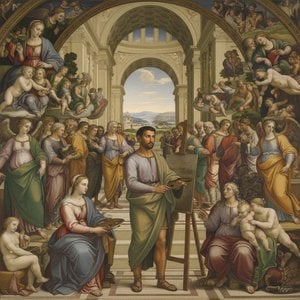
Portrait of Baldassare Castiglione: A Renaissance Ideal Embodied
The Portrait of Baldassare Castiglione stands as a cornerstone of High Renaissance art—a testament to Raphael’s unparalleled skill and the humanist values that defined the era. Painted in 1514, this oil on canvas masterpiece resides at the Musée du Louvre in Paris, France—a location that underscores its enduring significance within the canon of Western art.
The Subject: Baldassare Castiglione
Baldassare Castiglione (1475-1529) was more than just a diplomat; he was the embodiment of the Renaissance ideal—a cultivated gentleman whose virtues encompassed intellect, eloquence, and moral integrity. Raphael’s depiction captures precisely this essence: Castiglione is portrayed with a dignified gaze, conveying both intelligence and composure. He sits calmly against a muted earth tone background, radiating an aura of refined serenity.
Artistic Significance: Mastering Light and Shadow
Raphael’s mastery shines through in every brushstroke—particularly his masterful use of chiaroscuro. This technique employs subtle gradations of light and shadow to create depth and dimensionality, drawing the viewer's eye directly to Castiglione’s face. The artist skillfully renders the textures of Castiglione’s clothing—the dark velvet doublet adorned with fur trim—adding to the painting’s visual richness.
Historical Context: Reflecting Renaissance Values
The portrait emerged during a period of fervent artistic innovation in Italy, mirroring the broader humanist revival that championed reason and human dignity. Raphael, alongside Leonardo da Vinci and Michelangelo, propelled the High Renaissance forward—producing works that celebrated beauty, proportion, and intellectual contemplation. “The Courtier,” Castiglione’s influential treatise on aristocratic conduct, exemplifies these values—a reflection of the cultural landscape in which Raphael flourished.
Conservation and Display: A Louvre Legacy
Acquired by Louis XIV in 1797, the painting was briefly loaned to the High Museum of Art in Atlanta during the Louvre Atlanta exhibition (2006-2007), returning to its permanent home at the Musée du Louvre in January 2007. Its presence within this prestigious institution ensures that future generations will continue to appreciate Raphael’s artistic genius.
Conclusion: An Icon of Renaissance Elegance
“Portrait of Baldassare Castiglione” transcends mere representation; it embodies the humanist ideals of its time—a symbol of grace, intellect, and moral virtue. Raphael's meticulous attention to detail and his profound understanding of human psychology solidify its place as one of the most celebrated portraits of the Renaissance—an artwork that continues to inspire awe and admiration.



 Ver en contexto
 Comprar pintura hecha a mano
 Enviar
 Compartir
 Detalles

 Descargar
 Similares
 Radiografía
 Presentación de diapositivas
 Estadísticas


 Ver más






































 La opción de vidrio solo está disponible en tamaños inferiores a 110 cm.