Ver en contexto Vista previa en RA Comprar pintura hecha a mano Cambiar a imagen digital Enviar
Detalles Guía Añadir a favoritos Descargar Similares Radiografía Presentación de diapositivas Q&A Estadísticas

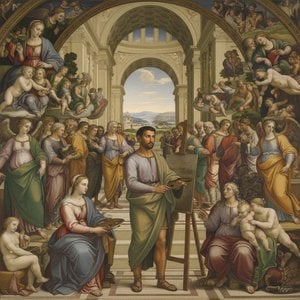
Apollo y Marsias

Una impresionante obra maestra del Renacimiento italiano creada por Rafael Sanzio Da Urbino, este fresco representa una escena mitológica llena de simbolismo y belleza artística.

Descubra a Rafael (1483-1520), el maestro del Alto Renacimiento italiano, reconocido por su gracia, claridad y composiciones armoniosas. Explore obras icónicas como 'La Escuela de Atenas', Madonas y frescos que definen la belleza clásica. #ArteRenacentista #Italia

Giclée / Impresión de arte

Impresiones giclée o en lienzo de calidad de museo con producción rápida y opciones de acabado flexibles. ( Comprar pintura hecha a mano Cambiar a imagen digital)

Corner sample of the P118B picture frame: poliestireno moldeado, 5 cm wide and 3 cm thick
P118B €10
Corner sample of the P118H picture frame: poliestireno moldeado, 5 cm wide and 3 cm thick
P118H €10
Corner sample of the P118W picture frame: poliestireno moldeado, 5 cm wide and 3 cm thick
P118W €10
Corner sample of the P438Z picture frame: poliestireno moldeado, 5.5 cm wide and 3.5 cm thick
P438Z €10
Corner sample of the P508JH picture frame: poliestireno moldeado, 7 cm wide and 3.5 cm thick
P508JH €12
Corner sample of the P508YH picture frame: poliestireno moldeado, 7 cm wide and 3.5 cm thick
P508YH €12
Corner sample of the P805H picture frame: poliestireno moldeado, 5 cm wide and 3.5 cm thick
P805H €10
Corner sample of the P805Z picture frame: poliestireno moldeado, 5 cm wide and 3.5 cm thick
P805Z €10
Corner sample of the P919BZ picture frame: poliestireno moldeado, 7 cm wide and 3.5 cm thick
P919BZ €10
Corner sample of the P919G picture frame: poliestireno moldeado, 7 cm wide and 3.5 cm thick
P919G €10
Corner sample of the P919XJ picture frame: poliestireno moldeado, 7 cm wide and 3.5 cm thick
P919XJ €10
Corner sample of the P959ZH picture frame: poliestireno moldeado, 5 cm wide and 3 cm thick
P959ZH €10
Corner sample of the P968JZ picture frame: poliestireno moldeado, 6 cm wide and 4 cm thick
P968JZ €12
Corner sample of the W106C picture frame: madera maciza, 5 cm wide and 3 cm thick
W106C €8
Corner sample of the W218G picture frame: madera maciza, 5 cm wide and 3 cm thick
W218G €10
Corner sample of the W218JH picture frame: madera maciza, 5 cm wide and 3 cm thick
W218JH €8
Corner sample of the W218Y picture frame: madera maciza, 5 cm wide and 3 cm thick
W218Y €10
Corner sample of the W307PJ picture frame: madera maciza, 6 cm wide and 3 cm thick
W307PJ €10
Corner sample of the W316G picture frame: madera maciza, 6 cm wide and 3 cm thick
W316G €10
Corner sample of the W316PJ picture frame: madera maciza, 6 cm wide and 3 cm thick
W316PJ €8
Corner sample of the W316Y picture frame: madera maciza, 6 cm wide and 3 cm thick
W316Y €10
Corner sample of the W398PJ picture frame: madera maciza, 5 cm wide and 3 cm thick
W398PJ €8
Corner sample of the W4111J picture frame: madera maciza, 6.5 cm wide and 3.5 cm thick
W4111J €10
Corner sample of the W500HY picture frame: madera maciza, 7 cm wide and 5 cm thick
W500HY €15
Corner sample of the W500JH picture frame: madera maciza, 7 cm wide and 5 cm thick
W500JH €15
Corner sample of the W692G picture frame: madera maciza, 8 cm wide and 4 cm thick
W692G €12
Corner sample of the W849H picture frame: madera maciza, 5 cm wide and 3 cm thick
W849H €8
Corner sample of the W940BG picture frame: madera maciza, 7.5 cm wide and 4.5 cm thick
W940BG €15
Corner sample of the W953PJ picture frame: madera maciza, 6 cm wide and 3.5 cm thick
W953PJ €8

Tamaño estándar
a medida
CM
INCH

Elija entre nuestros tamaños predefinidos que respetan las proporciones originales de la obra.

ancho
altura

Introduzca el ancho y el alto que necesite para adaptarse a su marco o pared. Una impresión solo puede recortarse, nunca hacerse más grande que la imagen original, por lo que un tamaño con una forma distinta perderá parte de la obra. Le enviaremos una maqueta digital para su aprobación antes de realizar cualquier impresión. La imagen que se muestra en esta página no refleja el recorte real; solo la maqueta lo hace.

Envío a todo el mundo () en 2 semanas en lugar de las 4/5 semanas estándar. (31 octubre)

Envío exprés gratuito a todo el mundo
Lienzo de lino de alta calidad
Seguro de envío total
Garantía de reembolso de aranceles aduaneros
Garantía de fidelidad cromática exacta
Política de devolución de 100 días (solo por defectos)
Garantía de devolución del 100% del dinero
Descuento por cantidad

Precio total

€ 60

Apollo y Marsias

Giclée / Impresión de arte

Dimensiones de la reproducción

-

Precio total final

€ 60

Datos clave

  • Artistic style: Neoclasicismo
  • Artist: Rafael Sanzio da Urbino
  • Notable elements or técnicas: Contraste de luces y sombras
  • Title: Apollo y Marsias
  • Year: 1509-1511
  • Location: Palacio Apostólico, Vaticano

Test de conocimientos artísticos

Cada pregunta tiene una única respuesta correcta.

Pregunta 1:
¿Quién pintó la obra "Apollo y Marsyas"?
Pregunta 2:
¿En qué edificio se encuentra esta pintura?
Pregunta 3:
¿Cuál es el estilo artístico predominante en esta obra?
Pregunta 4:
¿Qué representa la escena pintada?
Pregunta 5:
¿Cómo se caracteriza la técnica utilizada por Rafael en esta pintura?

Apollo and Marsyas (ceiling panel)

The Apollo and Marsyas painting, created by the renowned artist Raphael (Raffaello Sanzio Da Urbino), stands as a cornerstone of Renaissance art and embodies the humanist ideals that defined the era. Located on the ceiling panel of a prestigious building—specifically, the Apostolic Palace in Vatican City—this monumental fresco transcends mere visual representation; it’s a profound meditation on mythology, morality, and the eternal struggle between order and chaos. Its enduring beauty continues to inspire awe and admiration centuries after its creation.

Artistic Significance

This captivating scene depicts three figures engaged in an ancient Greek narrative: Apollo, the god of music and light, confronting Marsyas, a satyr who dared to challenge his musical supremacy. The composition is deliberately asymmetrical, reflecting the tensions inherent in the conflict itself. Raphael skillfully employs perspective—a revolutionary technique at the time—to create depth and realism within the confines of the frescoed space. The figures are rendered with exquisite anatomical precision, demonstrating Raphael’s mastery of observation and artistic skill. Beyond its technical brilliance, the painting serves as an allegory for the triumph of divine harmony over earthly ambition. Apollo's serene gaze and dignified posture symbolize reason and virtue, while Marsyas embodies passion and defiance—a cautionary tale about hubris and the consequences of transgressing divine law.

Style and Technique

Raphael’s artistic style is characterized by its clarity, grace, and harmonious balance – qualities that firmly establish it within the High Renaissance tradition. He achieves this remarkable effect through meticulous attention to detail and a masterful use of color palettes. The fresco utilizes subtle gradations of hue and tone to convey atmospheric depth and luminosity, capturing the ethereal quality of the celestial realm. Raphael’s brushstrokes are smooth and confident, conveying movement and dynamism without sacrificing compositional stability. Notably, he draws inspiration from classical sculpture—particularly Michelangelo's David—incorporating sculptural forms into his paintings to imbue them with a sense of grandeur and monumentality. The painting’s influence extends far beyond its immediate context, shaping artistic sensibilities for generations to come.

Historical Context

Created during Julius II’s ambitious patronage of the arts—a period marked by papal ambition and artistic innovation—Apollo and Marsyas reflects the humanist revival that swept across Europe in the early 16th century. Raphael’s work aligns with the broader intellectual currents of the time—the rediscovery of classical texts and ideals—and embodies the Renaissance aspiration to represent human experience with dignity and beauty. The fresco's placement within the Stanza della Segnatura underscores its symbolic importance as part of a larger artistic program designed to glorify God and celebrate human intellect. It stands alongside works by Michelangelo and Leonardo da Vinci, forming an unparalleled testament to the artistic genius of the Renaissance.

Emotional Impact

The painting’s enduring power lies in its ability to evoke profound emotions—a blend of contemplation, awe, and moral reflection. Raphael captures the drama of the confrontation between Apollo and Marsyas with remarkable sensitivity, conveying both the grandeur of divine majesty and the vulnerability of human ambition. The luminous colors and masterful composition draw the viewer into the scene, fostering a sense of immersion and emotional engagement. Like Michelangelo’s David—a symbol of human potential—Apollo and Marsyas serves as a reminder of the timeless themes explored by great artists throughout history—the pursuit of excellence, the confrontation with mortality, and the affirmation of human dignity.

Preguntas y respuestas

¿Qué uso y espacio se recomiendan para "Apollo y Marsias" de Rafael?

Se recomienda "Apollo y Marsias" de Rafael para Acento cromático, idealmente en un/a Salón principal. El uso y el espacio juntos ayudan a determinar dónde encaja mejor una reproducción.

¿Qué ambiente aportaría "Apollo y Marsias" a un espacio?

"Apollo y Marsias" de Rafael transmite una atmósfera Elegante y se recomienda para un/a Salón principal. El estado de ánimo es la esencia que la obra aporta al espacio que la rodea.

¿Qué sentimiento transmite "Apollo y Marsias"?

"Apollo y Marsias" de Rafael transmite un tono emocional Romántico.


Biografía del artista

**vida temprana y formación**

Rafael (rafaello sanzio da urbino), un renombrado pintor y arquitecto italiano, nació entre el 28 de marzo y el 6 de abril de 1483, en la pequeña pero culturalmente significativa ciudad de Urbino. Su padre, Giovanni Santi, era pintor de corte para el duque, proporcionando a Rafael una exposición temprana al mundo artístico. Después de fallecer su padre a los once años, Rafael probablemente administró el taller familiar, consolidando aún más su base artística.

**carrera artística e influencias**

El viaje artístico de Rafael puede categorizarse en tres fases distintas, cada una marcada por un estilo único:
  • primeros años en Umbría: caracterizado por la influencia de su padre y el ambiente cultural de Urbino.
  • período florentino (1504-1508): absorbiendo las tradiciones artísticas de Florencia, que influyeron significativamente en su estilo.
  • período romano (1508-1520): trabajando para dos papas y sus asociados, produciendo algunas de sus obras más celebradas, incluyendo la escuela de Atenas en la stanza della segnatura del Vaticano.

**obras notables y legado**

Algunas de las obras notables de Rafael incluyen:

**influencia y legado**

La influencia de Rafael en el arte es profunda, con su obra siendo un pilar del Renacimiento italiano. Su estilo sereno y armonioso ha sido un modelo para la pintura neoclásica, como señaló el historiador de arte Johann Joachim Winckelmann. A pesar de la influencia posterior del estilo de Miguel Ángel, Rafael sigue siendo uno de los artistas más reverenciados en la historia. ver el perfil de Rafael en WahooArt
Rafael

Rafael

1483 - 1520 , Italia

Datos clave

  • Artistas Influyentes:
    • Giovanni Santi
    • Pietro Perugino
  • Estilo Artístico: Alto Renacimiento
  • Fecha De Muerte: 06/04/1520
  • Fecha De Nacimiento: 28/03/1483
  • Influencia En Artistas: Neoclasicismo
  • Lugar De Nacimiento: Urbino, Italia
  • Nacionalidad: Italiano
  • Nombre Completo: Rafael (Raffaello Sanzio)
  • Obras Notables:
    • El Juicio de Salomón
    • Madonna del Cardellino
    • La Escuela de Atenas
    • San Sebastián
    • La Dama Velada
Explore obras de arte organizadas por temas, estilos y características.