La Escuela de Atenas: Un diálogo renacentista sobre la sabiduría y la belleza
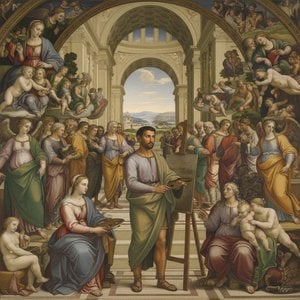
La “Escuela de Atenas” de Rafael, un fresco impresionante que reside en la Stanza della Segnatura del Vaticano, no es simplemente una representación de filósofos; es un testimonio vibrante de los ideales humanistas que definieron el Alto Renaclicmiento. Completada entre 1509 y 1511, esta obra monumental trasciende su espacio físico, invitando a los espectadores a una conversación atemporal sobre el conocimiento, la razón y la búsqueda de la verdad. La escena se desarrolla dentro de un entorno arquitectónico sutilmente inspirado en los ambiciosos planes de Bramante para la reconstrucción de la Basílica de San Pedro —un guiño a la creciente grandeza de la propia Roma—, creando un telón de fondo que ancla simultáneamente la composición en la realidad y la eleva hacia un reino de aspiración intelectual.
En el corazón del fresco se encuentran Platón y Aristóteles, con sus figuras plasmadas con un equilibrio exquisito entre realismo y belleza idealizada. Platón, señalando hacia los cielos, encarna la búsqueda de los ideales abstractos; sus túnicas fluidas y su postura contemplativa sugieren un desapego del mundo terrenal. Frente a él, Aristóteles, con los pies en la tierra y entregado a un animado debate, representa el énfasis en la observación empírica y el estudio de la naturaleza. Este dúo dinámico establece de inmediato la tensión central de la filosofía renacentista: el conflicto entre el idealismo y el realismo, un tema que resuena con fuerza en toda la composición. Las figuras circundantes —Pitágoras, Heráclito, Euclides, Sócrates y muchos otros— no son simples notas al pie históricas; son representantes cuidadosamente elegidos de diversas escuelas de pensamiento, cada uno contribiendo a un rico tapiz de discurso intelectual.
La maestría técnica de Rafael es evidente de inmediato en el asombroso detalle del fresco. Las figuras están representadas con una notable precisión anatómica, pero imbuídas de una cualidad casi etérea. Nótese las sutiles gradaciones de color, el delicado modelado de los ropajes y la precisa ejecución de los elementos arquitectónicos, todos ellos sellos distintivos del refinado estilo de Rafael. El uso del chiaroscuro, el dramático juego de luces y sombras, añade profundidad y volumen a la escena, guiando la mirada del espectador a través de la compleja disposición de las figuras. La perspectiva está ejecutada meticulosamente, creando una ilusión convincente de espacio y contribuyendo al sentido general de realismo. Es importante señalar que Rafael aprendió esta técnica de Leonardo da Vinci, quien había estado experimentando con la perspectiva lineal en sus propias pinturas.
Más allá de sus méritos artísticos, “La Escuela de Atenas” posee un profundo peso simbólico. El fresco es una celebración de la filosofía y la ciencia griegas clásicas, que experimentaban un renacimiento durante el Renacimiento, un período marcado por el renovado interés en los textos e ideas antiguas. Al situar estas figuras en un entorno contemporáneo, Rafael sugiere que la sabiduría de la antigüedad sigue siendo relevante para el pensamiento moderno. La inclusión de Euclides, el padre de la geometría, enfatiza aún más la importancia de la razón y la lógica como herramientas para comprender el mundo. El mensaje general de la pintura es de optimismo: una creencia en el poder del intelecto humano para desentrañar los secretos del universo. Es una declaración poderosa sobre el legado perdurable del pensamiento clásico y su continua influencia en la civilización occidental.
Las figuras: Un diálogo de ideas
Cada figura dentro de “La Escuela de Atenas” ha sido elegida cuidadosamente, no solo por su importancia histórica, sino también por su representación simbólica de conceptos filosóficos específicos. Platón, con su mirada hacia arriba, encarna el reino de las Ideas —las ideas eternas e inmutables que existen más allá del mundo físico—. Su libro, "Timeo", simboliza su teoría de la cosmología, sugiriendo un universo gobernado por principios matemáticos. Aristóteles, por el contrario, es representado gesticulando hacia abajo, participando en un debate más terrenal sobre la ética y la política. Su libro, “Ética a Nicómaco”, representa su enfoque en la sabiduría práctica y la búsqueda de la felicidad dentro de la experiencia humana.
Observe los detalles que rodean a cada figura: Pitágoras, con sus diagramas geométricos, encarna el conocimiento matemático; Euclides, sosteniendo un compás y una regla, simboliza la geometría; Heráclito, representado como un río, representa el concepto del cambio constante. La inclusión de estas figuras específicas demuestra la profunda comprensión de Rafael de la filosofía clásica y su capacidad para traducir ideas complejas en una narrativa visualmente cautivadora. Incluso los detalles aparentemente menores, como los pergaminos que sostiene cada filósofo, están cargados de significado simbólico, enriqueciendo aún más la profundidad intelectual de la pintura.
Entorno arquitectónico e influencia renacentista
El entorno arquitectónico de “La Escuela de Atenas” no es meramente decorativo; es integral a la composición y sirve como una metáfora visual de la búsqueda del conocimiento. El edificio detrás de los filósofos está claramente inspirado en los diseños de Bramante para la Basílica de San Pedro, reflejando la fascinación renacentista por la arquitectura clásica y su grandeza. Sin embargo, Rafael transforma sutilmente este modelo arquitectónico, incorporando elementos de varios períodos históricos —incluyendo estilos romanos y griegos— para crear una mezcla armoniosa de pasado y presente.
El uso de columnas, arcos y frontones evoca la escala monumental de los templos antiguos, sugiriendo que los filósofos están participados en un diálogo digno de los dioses. Las líneas de perspectiva convergen hacia un punto de fuga central, atrayendo la mirada del espectador hacia el corazón de la escena. Esta magistral manipulación del espacio refuerza la sensación de profundidad y realismo, elevando al mismo tiempo la pintura a un reino de belleza atemporal. Los elementos arquitectónicos también sirven como recordatorio de la ambición e innovación que caracterizaron al Renacimiento, un período marcado por un renovado interés en el arte y la arquitectura clásicos.
Poseer una pieza de la historia: Una reproducción de WahooArt
Experimente la profunda belleza y profundidad intelectual de la “Escuela de Atenas” de Rafael con una reproducción al óleo, hecha a mano y meticulosamente elaborada por WahooArt. Nuestros hábiles artistas recrean con esmero cada detalle de esta obra maestra icónica, utilizando técnicas tradicionales y materiales de calidad de archivo para garantizar una vitalidad y autenticidad duraderas. Cada reproducción se crea sobre lienzo, capturando la textura y la luminosidad del fresco original.
Ya sea que usted sea un coleccionista de arte, un entusiasta del diseño o simplemente alguien que aprecia la belleza atemporal, una reproducción de WahooArt de “La Escuela de Atenas” ofrece una oportunidad única de traer esta obra maestra a su hogar u oficina. Explore nuestra selección de tamaños y opciones de enmarcado para encontrar la pieza perfecta que complemente su estilo personal. Visite WahooArt.com hoy mismo para descubrir cómo puede poseer una conexión tangible con una de las más grandes obras de arte de la historia.
Preguntas y respuestas
¿Cómo puedo conseguir una lámina de "8" de Rafael?
Puede solicitar una impresión de "8" de Rafael directamente en esta página: una impresión de bellas artes sobre lienzo de algodón o papel de lienzo de archivo.
¿Cómo equilibra la luz y la sombra "8"?
Los valores registrados para "8" de Rafael son: equilibrado de brillo y Luminosidad suave de luminancia.
¿A qué periodo histórico pertenece "8" de Rafael?
El periodo histórico de "8" de Rafael es Renacimiento. Esta clasificación sitúa la obra en la historia del arte.
¿A qué artista se le atribuye "8"?
"8" fue creada por Rafael. La información en esta página describe la obra original de Rafael.
¿Qué colores predominan en "8" de Rafael?
"8" de Rafael utiliza una paleta de Tonos tierra, con el Gris masilla (#e4d4cb) como color dominante.
¿Puedo pedir una reproducción al óleo de "8"?
Puede solicitar una reproducción pintada a mano de "8" de Rafael directamente en esta página: una reproducción al óleo pintada a mano sobre lienzo de lino, realizada bajo pedido.
¿Es "8" de Rafael una obra de arte reconocida?
"8" de Rafael tiene un nivel de popularidad Icónico. Esta clasificación refleja el grado de reconocimiento de la obra.



 Vista previa
 Cambiar a formato impreso
 Compartir
 Compartir
 Ver detalles
 Guía
Guía

 Descargar
 Ver artículos similares
 Radiografía
 Presentación de diapositivas
 Estadísticas

 Leer más






































 La opción de vidrio solo está disponible en tamaños inferiores a 110 cm.


![Escuela De Atenas - Detalle [02] — Rafael, High Renaissance](/media/artworks/images-thumb/ff/73/ff7321cc7f1d85f7343079c25e188bce.jpg)
![La Escuela De Atenas (detalle) [03] — Rafael, High Renaissance](/media/artworks/images-thumb/30/f3/30f39c600ce9f8eb336752926431690e.jpg)