Ver en contextoVer en contexto Vista previa en RAVista previa en RA Cambiar a Impresión Cambiar a ImpresiónCambiar a imagen digital Cambiar a imagen digital EnviarEnviar
DetallesDetalles Añadir a favoritos Añadir a favoritos DescargarDescargar SimilaresSimilares RadiografíaRadiografía Presentación de diapositivasPresentación de diapositivas EstadísticasEstadísticas

not identified

Explore Piet Mondrian’s iconic geometric abstraction in this captivating depiction of a Dutch clock tower building—a testament to the artist's pioneering style and enduring influence during the early 20th century. Discover the beauty of simplicity and commission your own exquisite reproduction.

Explore la obra de Piet Mondrian (1872-1944), un pionero del arte abstracto y el movimiento De Stijl. Descubre sus icónicos cuadros geométricos, su estilo Neoplasticismo y su influencia duradera en el diseño moderno, la arquitectura y el arte del siglo XX.

Reproducción al óleo hecha a mano

Óleo sobre lienzo pintado a mano en el tamaño y marco de su elección, realizado por encargo por nuestros artistas. (Cambiar a Impresión Cambiar a ImpresiónCambiar a imagen digital Cambiar a imagen digital)

P118B $10
P118H $10
P118W $10
P438Z $10
P508JH $12
P508YH $12
P805H $10
P805Z $10
P919BZ $10
P919G $10
P919XJ $10
P959ZH $10
P968JZ $12
W106C $8
W218G $10
W218JH $8
W218Y $10
W307PJ $10
W316G $10
W316PJ $8
W316Y $10
W398PJ $8
W4111J $10
W500HY $15
W500JH $15
W692G $12
W849H $8
W940BG $15
W953PJ $8

Estándar
a medida
CM
INCH

Elija entre nuestros tamaños predefinidos que respetan las proporciones originales de la obra.

ancho
altura

Puede ingresar sus propias dimensiones para adaptarse a un marco o espacio específico. Si el tamaño seleccionado no coincide con las proporciones de la imagen original, recortaremos la obra o extenderemos la pintura con elementos adicionales pintados a mano. Se le enviará una maqueta digital para su aprobación antes de comenzar la producción.
Tenga en cuenta que la vista previa en pantalla no refleja el recorte o la extensión reales. Solo la maqueta mostrará con precisión la composición final.
Si bien existen tamaños personalizados, recomendamos seleccionar una dimensión de la lista predefinida para preservar las proporciones originales.

Ejemplos de lo que se puede personalizar: Reemplace el rostro con una foto del cliente; Agregue una mascota (por ejemplo, cambie un gato por un perro); Incluya un mensaje oculto en el fondo; Cambie el paisaje o los elementos del fondo.
Tras realizar el pedido, el equipo de WahooArt.com enviará un correo electrónico al cliente para solicitar instrucciones y proporcionarle una vista previa del boceto.

Envío a todo el mundo () en 3-4 semanas en lugar de las 5 semanas estándar. (11 septiembre). Sin comprometer la calidad.

why_choose_icon
Envío exprés gratuito a todo el mundo
why_choose_icon
Lienzo de lino de alta calidad
why_choose_icon
Seguro de envío total
why_choose_icon
Garantía de reembolso de impuestos aduaneros
why_choose_icon
Garantía de fidelidad cromática exacta
why_choose_icon
Política de devolución de 100 días (solo por defectos)
why_choose_icon
Garantía de devolución del 100% del dinero
why_choose_icon
Descuento por cantidad

Precio total

$ 272

reproduction

not identified

Técnica de reproducción

Dimensiones de la reproducción

-

Precio total final

$ 272

Datos clave

  • Artist: Piet Mondrian
  • Notable elements or techniques: Geometric abstraction
  • Influences:
    • Hague School
    • Dutch Impressionism
  • Artistic style: Neoplasticism
  • Subject or theme: Architecture
  • Movement: Post-Impressionism

A Symphony of Structure and Spirit

In the vast landscape of modern art, few names resonate with as much transformative power as Piet Mondrian. His work, often characterized by a radical departure from the visible world, seeks to uncover a deeper, more universal truth hidden beneath the surface of reality. In this captivating piece, we encounter a moment of profound stillness—a quiet reflection on form and color that invites the viewer into a meditative state. While the painting may initially present as a stately architectural scene, featuring a prominent clock tower and figures poised in observation, it serves as a gateway to the artist's evolving philosophy of Neo-Plasticism. It is not merely a depiction of urban grandeur, but an exploration of the equilibrium between the physical structure we inhabit and the spiritual energy that animates it.

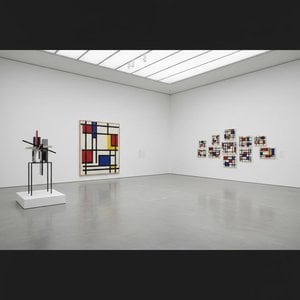
The composition is a masterclass in controlled tension and geometric precision. Executed with meticulous care in oil on canvas, the artwork utilizes the strength of orthogonal lines—the steadfast horizontal and vertical—to construct a sense of permanence and order. This grid-like framework does more than just define the building's silhouette; it creates a rhythmic pulse that guides the eye across the canvas. The color palette is intentionally disciplined, relying on the primal impact of primary hues. Splashes of red, yellow, and blue are applied with surgical accuracy within the intersections of the grid, providing a striking visual contrast against the more muted, earthy tones of the architecture. This technique transforms the canvas from a mere window into a scene into a complex tapestry of light and mathematical harmony.

The Architecture of the Soul

To understand this work is to understand the historical currents that shaped Mondrian’s vision during the mid-20th century. Emerging from a period of immense global upheaval, his art reflects a profound desire for stability amidst chaos. The influence of the Bauhaus movement and the principles of De Stijl are palpable here, as the artist strips away the unnecessary to reveal the essential. Every line and every block of color is a deliberate choice, intended to mirror the underlying mathematical order of the universe. For the discerning collector or interior designer, this piece offers more than just aesthetic beauty; it provides a focal point of intellectual depth and structural integrity.

Beyond its formal qualities, the painting carries a heavy symbolic weight. The grid represents the rationality and structure of human thought, acting as a necessary counterbalance to the unpredictable nature of human emotion. The primary colors are not merely decorative; they symbolize a spiritual vitality that transcends the material world. When placed within a contemporary living space or a sophisticated gallery setting, this reproduction evokes a sense of calm detachment and contemplative peace. It is an invitation to slow down, to look past the superficial layers of our environment, and to find beauty in the fundamental balance of existence. For those seeking to infuse their surroundings with a sense of timelessness and grace, Mondrian’s vision remains an unparalleled source of inspiration.


Biografía del artista

**vida temprana y carrera en los Países Bajos (1872-1911)**

pieter cornelis mondriaan, conocido a partir de 1911 como piet mondrian, fue un pintor y teórico del arte holandés nacido el 7 de marzo de 1872, en Amersfoort, Países Bajos. Comenzó su carrera como maestro en educación primaria mientras practicaba la pintura, inicialmente en el estilo impresionista holandés de la Escuela de Ámsterdam.
  • Su obra temprana, caracterizada por paisajes naturalistas, se puede ver en pinturas como the red mill y trees in moonrise, que se exhibieron en el kunstmuseum den haag.
  • La búsqueda de Mondrian por parte de un estilo personal lo llevó a explorar diversos movimientos artísticos, incluyendo el puntillismo y el fauvismo.
  • Su primera exposición en 1893 marcó el comienzo de su prolífica carrera.

**la evolución del estilo de Mondrian**

de figurativo a abstracto La dirección artística de Mondrian se desplazó hacia un estilo cada vez más abstracto, culminando en una forma no representacional que llamó neoplasticismo. Esta 'arte plástico puro' tenía como objetivo crear 'belleza universal', limitando su vocabulario formal a los colores primarios (rojo, azul y amarillo), valores (negro, blanco y gris) y direcciones (horizontal y vertical).

**legado e influencia**

El legado de Mondrian se extiende más allá de su propia obra, influyendo en estilos y movimientos importantes como la pintura de campo de color, el expresionismo abstracto y el minimalismo. El historiador del diseño stephen bayley señaló que Mondrian se ha convertido en un símbolo para todo lo que el modernismo pretendía ser.
  • Explore más de la obra de Mondrian en WahooArt.com.
  • Aprenda sobre el movimiento De Stijl y su influencia en el arte moderno en wikipedia.
  • Descubra otros artistas influyentes como vincent van gogh y su impacto en el mundo del arte.

**obras clave y exposiciones**

* piet mondrian: apple blossom (cubismo) (ver en WahooArt.com) * piet mondrian: still life with vase of spices ii (cubismo) (ver en WahooArt.com) * piet mondrian: passionflower (73 x 48 cm, kunstmuseum den haag, post impressionismo, acuarela) (ver en WahooArt.com)
Piet Mondrian

Piet Mondrian

1872 - 1944 , Países Bajos

Datos clave

  • Artistas Que Influyeron:
    • Hague School
    • Puntillismo
    • Fauvismo
    • Cubismo
  • Estilo Artístico: Neoplasticismo, De Stijl
  • Fecha De Nacimiento: 7 de marzo de 1872
  • Influenciado A Artistas:
    • Expresionismo abstracto
    • Minimalismo
    • Color Field painting
  • Lugar De Nacimiento: Amersfoort, Países Bajos
  • Nacionalidad: Holandés
  • Nombre Completo: Piet Mondrian
  • Obras Notables:
    • Nueva York I
    • Composición con Rojo, Azul y Amarillo
    • Broadway Boogie Woogie
    • Tableau no. 2
Explore obras de arte organizadas por temas, estilos y características.