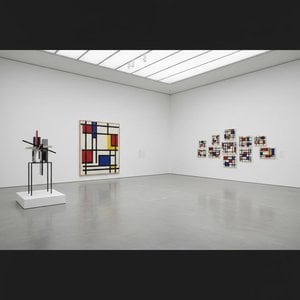
Composition with Red, Yellow and Blue
Piet Mondrian’s Composition with Red, Yellow and Blue is not merely a painting; it is a visual manifesto—a declaration of artistic intent that embodies the core tenets of Neoplasticism. Emerging from the crucible of early 20th-century artistic experimentation, this work represents a radical departure from traditional representational art, seeking instead to distill reality down to its most fundamental elements. The canvas presents a carefully orchestrated grid of black horizontal and vertical lines, defining rectangles filled with blocks of primary colors: vibrant red, sunny yellow, and deep blue, alongside areas of pure white. It’s deceptively simple in appearance, yet within this apparent austerity lies a profound exploration of balance, harmony, and the spiritual potential inherent in abstract art.
From Dutch Landscapes to Universal Forms
To truly appreciate Composition with Red, Yellow and Blue, one must understand Mondrian’s artistic journey. Born Pieter Cornelis Mondriaan in Amersfoort, Netherlands, he initially trained as a teacher while simultaneously pursuing his passion for painting. His early works were steeped in the traditions of Dutch landscape painting, echoing the muted tones and naturalistic depictions of the Hague School. Artists like Willem Maris profoundly influenced him during this formative period—pieces like *The Red Mill* demonstrate Mondrian’s meticulous observation of nature and mastery of technique.
However, a restless spirit drove him to experiment with various styles – Pointillism, Fauvism – always searching for a more authentic means of expression. The pivotal moment arrived with his move to Paris in 1912, where exposure to Cubism ignited a transformative shift in his artistic thinking. He began deconstructing forms, dismantling traditional perspective, and gradually moving away from representing the visible world. This evolution wasn’t abrupt; it was a deliberate process of reduction—a stripping away of all that Mondrian deemed superfluous.
The Philosophy of Neoplasticism
By the time he created Composition with Red, Yellow and Blue, Mondrian had fully embraced his signature style. Neoplasticism, as he termed it, wasn’t simply an artistic technique; it was a philosophical system rooted in the belief that art could reflect a deeper, universal order. He believed that by reducing painting to its essential components – lines, colors, and geometric shapes – he could express underlying spiritual truths. The horizontal and vertical lines symbolized opposing forces: earthly versus divine, masculine versus feminine. The primary colors were chosen for their purity and inherent energy, representing the fundamental building blocks of reality. White, in Mondrian’s view, represented space and potentiality—a crucial element in achieving balance and harmony.
A Lasting Legacy: Impact on Art and Design
The impact of Composition with Red, Yellow and Blue extends far beyond the realm of painting. Mondrian’s Neoplasticism profoundly influenced countless artists and designers throughout the 20th century and continues to resonate today. From Color Field painters like Mark Rothko to minimalist architects who embraced geometric forms—figures like Ludwig Mies van der Rohe—his ideas have permeated various creative disciplines. The clean lines, bold colors, and emphasis on structure found in this painting can be seen echoed in furniture design, graphic arts, and even fashion. It’s a testament to Mondrian's vision that his work remains so relevant and inspiring, offering a timeless exploration of form, color, and the pursuit of universal harmony.
Considered one of the most important artists of the century, Mondrian’s influence transcends stylistic boundaries. His unwavering commitment to abstraction—to distilling visual experience into its purest essence—established him as a pioneer of modern art. As Stephen Bayley eloquently stated: “Mondrian has come to mean Modernism. His name and his work sum up the High Modernist ideal.” Indeed, Mondrian’s legacy continues to inspire artists and designers alike, reminding us that beauty can be found in simplicity and that art possesses the capacity to communicate profound philosophical ideas.
The Sidney and Harriet Janis Collection holds a remarkable specimen of Mondrian's oeuvre—a canvas titled *Composition with Red, Blue and Yellow*, completed in 1937–42. This artwork exemplifies Mondrian’s unwavering dedication to Neoplastic principles, demonstrating his commitment to relational opposites, asymmetry, and pure planes of color.
The painting’s subtle interplay of hues—the vibrant reds juxtaposed against the sunny yellows and deep blues—creates a visual equilibrium that speaks to the artist's belief in achieving harmony between opposing forces. Furthermore, Mondrian’s meticulous use of black lines delineates geometric shapes with precision, reinforcing the overarching structure of the composition.
This piece stands as an enduring symbol of Modernist aesthetics and continues to captivate viewers with its understated elegance and intellectual depth. Its influence can be seen in numerous subsequent artistic endeavors—a testament to Mondrian’s transformative contribution to the history of art.



 Ver en contexto
 Cambiar a Impresión
 Enviar
 Compartir
 Detalles

 Descargar
 Similares
 Radiografía
 Presentación de diapositivas
 Estadísticas

 Ver más






































 La opción de vidrio solo está disponible en tamaños inferiores a 110 cm.