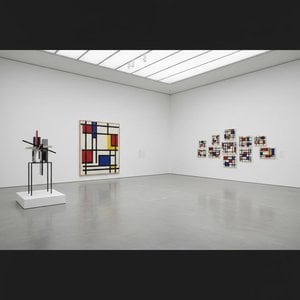
A Symphony of Balance: Deconstructing Mondrian’s ‘Composition with Double Line and Yellow’
Piet Mondrian's 1932 painting, ‘Composition with Double Line and Yellow,’ is not merely an arrangement of colors and lines; it is a visual distillation of a profound philosophical quest. Emerging from the crucible of early 20th-century artistic experimentation, this work embodies the core tenets of Neoplasticism – Mondrian’s signature style and a radical departure from representational art. The canvas presents a deceptively simple composition: a grid of black lines delineating rectangles of primary colors (primarily yellow), white, and black against a pale yellow background. Yet within this apparent austerity lies a dynamic tension, a carefully orchestrated balance that speaks to Mondrian’s ambition to express universal harmony.
The Evolution of an Aesthetic
To understand ‘Composition with Double Line and Yellow,’ one must trace the artist's journey. Born Pieter Cornelis Mondriaan in 1872, he initially painted traditional landscapes, influenced by the Hague School and Dutch Impressionism. However, a move to Paris in 1912 proved pivotal. Immersed in the avant-garde scene, particularly Cubism, Mondrian began deconstructing forms, gradually shedding representational elements. This process wasn’t merely stylistic; it was driven by a spiritual yearning. Inspired by Theosophy – a mystical philosophy emphasizing underlying unity – Mondrian sought to transcend the visible world and express essential truths through abstract art. The introduction of double lines in works like this one marked a subtle but significant shift, adding a sense of optical movement and depth that hadn’t been present in his earlier compositions with single black lines. This technique creates an almost vibrating energy within the confines of the geometric structure.
Decoding the Language of Neoplasticism
Mondrian believed that by reducing painting to its most fundamental elements – horizontal and vertical lines, primary colors, and neutral tones – he could achieve a pure, universal aesthetic. The horizontal and vertical lines, he argued, represented opposing forces in nature, while the primary colors symbolized essential energies. The black lines aren’t simply boundaries; they are active participants in the composition, creating a rhythmic interplay with the colored rectangles. The yellow, often featured prominently as in this work, is not merely a color but a radiant force, injecting vitality into the otherwise austere arrangement. This isn’t about depicting reality, but *creating* a new reality – one based on order, clarity, and spiritual resonance. The precise placement of each element wasn’t arbitrary; Mondrian meticulously adjusted proportions and relationships to achieve an equilibrium that he believed reflected cosmic harmony.
A Lasting Legacy: Beyond the Canvas
‘Composition with Double Line and Yellow’ is more than a historical artifact; it continues to resonate deeply with contemporary audiences. Its influence extends far beyond the realm of painting, permeating architecture, design, and fashion. The clean lines, geometric forms, and limited color palette have become synonymous with modernism itself. The work invites contemplation – a moment to pause and appreciate the power of simplicity, the beauty of balance, and the enduring human quest for meaning in an increasingly complex world. Owning a reproduction of this iconic piece isn’t just acquiring a beautiful artwork; it’s embracing a legacy of artistic innovation and philosophical inquiry.
- Artist: Piet Mondrian
- Born Year: 1872
- Death Year: 1944
- Birth City: Amersfoort
- Birth Country: Netherlands
Biography:
Mondrian was born Pieter Cornelis Mondriaan in 1872, in the quiet Dutch town of Amersfoort, province of Utrecht. He was descended from Christian Dirkzoon Monderyan who lived in The Hague as early as 1670. The family moved to Winterswijk when his father, Pieter Cornelius Mondriaan, was appointed head teacher at a local primary school.
Additional Research:
Size:
Unknown
Date:
1932



 Vista previa
 Encargar reproducción pintada a mano
 Compartir
 Compartir
 Ver detalles
 Guía
Guía

 Descargar
 Ver artículos similares
 Radiografía
 Presentación de diapositivas
 Estadísticas


 Leer más






































 La opción de vidrio solo está disponible en tamaños inferiores a 110 cm.