A Symphony of Balance: Deconstructing Piet Mondrian’s Composition III Blue and Yellow
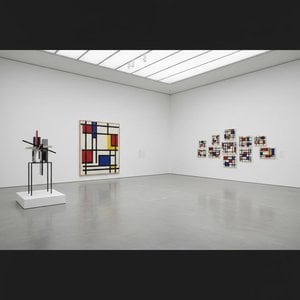
Piet Mondrian's Composition III blue and yellow is not merely a painting; it is a visual manifesto, a distillation of artistic principles that would come to define an era. Emerging from the vibrant currents of early 20th-century abstraction, this work embodies the core tenets of Neoplasticism – a style Mondrian himself championed as a pathway towards universal harmony. The canvas presents a rigorously structured grid of black lines, dividing the space into rectangles filled with primary colors: bold reds, serene blues, and luminous yellows, punctuated by areas of pure white. It’s a deceptively simple arrangement that belies a profound intellectual and spiritual quest.
From Naturalism to Neo-Plasticism: A Journey of Artistic Refinement
To truly appreciate Composition III blue and yellow, one must understand the artistic evolution of Piet Mondrian. Born in Amersfoort, Netherlands, in 1872, Mondrian initially trained as a teacher while simultaneously pursuing his passion for art. His early works were steeped in naturalism, reflecting the Dutch landscape tradition – windmills, fields, and rivers rendered with Impressionistic brushstrokes. However, this representational phase was merely a stepping stone. A pivotal move to Paris in 1912 exposed him to the radical ideas of Cubism, igniting a period of intense experimentation. Mondrian began deconstructing forms, dismantling traditional perspective, and gradually reducing his palette. This journey led him towards an increasingly abstract aesthetic, culminating in the birth of Neoplasticism around 1917.
The Language of Abstraction: Geometry, Color, and Spiritual Resonance
Neoplasticism, as Mondrian envisioned it, was not simply about creating aesthetically pleasing arrangements. It was a philosophical system aimed at expressing underlying spiritual truths through the purest possible visual language. The horizontal and vertical lines, he believed, represented opposing forces – masculine and feminine, static and dynamic – achieving equilibrium when perfectly balanced. The primary colors were chosen for their inherent energy and clarity, devoid of any emotional or representational baggage. White, representing nothingness, served as a crucial element, allowing the colors to breathe and resonate. In Composition III blue and yellow, these elements coalesce into a harmonious whole, inviting contemplation on themes of order, balance, and the search for universal beauty. The seemingly random placement of colored rectangles is, in fact, meticulously calculated to achieve a dynamic equilibrium, a visual rhythm that captivates the eye and soothes the soul.
A Lasting Legacy: Mondrian’s Influence on Modern Design
The impact of Piet Mondrian extends far beyond the realm of painting. His aesthetic principles have profoundly influenced countless artists, architects, and designers throughout the 20th and 21st centuries. From furniture design to fashion, the clean lines, geometric forms, and primary color palettes characteristic of Neoplasticism continue to inspire contemporary creations. Composition III blue and yellow stands as a testament to Mondrian’s enduring vision – a belief in the power of abstraction to transcend the material world and connect us to something deeper, more universal. Owning a reproduction of this iconic work is not merely acquiring a beautiful object; it's embracing a legacy of artistic innovation and philosophical inquiry.
Detailed Analysis: Decoding Mondrian’s Composition
At first glance, Composition III blue and yellow appears to be an exercise in formal simplicity. However, beneath this surface lies a complex interplay of visual elements designed to convey profound spiritual concepts. The grid structure—composed of intersecting black lines dividing the canvas into nine rectangles—is not merely decorative; it’s fundamental to Mondrian’s philosophical framework. Each line represents opposing forces – masculine and feminine – striving for equilibrium. The rectangles themselves are filled with primary colors: red, yellow, and blue – chosen for their purity and lack of emotional association.
- Color Harmony: Mondrian meticulously arranged the colors to achieve visual balance. The dominant hues—blue and yellow—are positioned diagonally across from each other, creating tension that is simultaneously resolved by the horizontal black lines.
- Geometric Precision: Every element in the painting adheres to strict geometric proportions. The rectangles are precisely defined, reflecting Mondrian’s belief in rationality and order as expressions of divine truth.
- Negative Space: The white areas surrounding the colored rectangles contribute significantly to the overall composition. White represents nothingness—the absence of form—and serves as a crucial element in achieving balance and highlighting the vibrancy of the colors.
- Texture: Although seemingly flat, Mondrian’s brushwork introduces subtle textural variations that add depth and richness to the painting. The thick black lines create a tactile surface that contrasts with the smooth expanse of white and color.
The deliberate asymmetry of the composition—a characteristic feature of Neoplasticism—further underscores Mondrian's quest for equilibrium. It’s a visual paradox: apparent disorder concealing underlying harmony.
Historical Context & Influence
Mondrian’s artistic breakthrough occurred during the turbulent years following World War I, coinciding with the rise of De Stijl movement – a collective of artists and architects committed to exploring pure abstraction. Influenced by thinkers like Rudolf Steiner and Henri Bergson, Mondrian sought to liberate art from representational constraints and express universal spiritual truths.
His work resonated deeply with contemporaries and continues to inspire designers today. The simplicity and elegance of Composition III blue and yellow embody the core principles of modern design—clarity, functionality, and geometric abstraction—establishing Mondrian as one of the most influential figures in twentieth-century art.
The painting’s enduring appeal lies not only in its aesthetic beauty but also in its intellectual depth. It invites viewers to contemplate fundamental questions about existence and to appreciate the transformative power of visual art.



 Ver en contexto
 Comprar pintura hecha a mano
 Enviar
 Compartir
 Detalles

 Descargar
 Similares
 Radiografía
 Presentación de diapositivas
 Estadísticas

 Ver más






































 La opción de vidrio solo está disponible en tamaños inferiores a 110 cm.