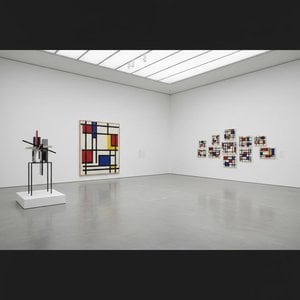
Composition with Red, Yellow, Blue and Black: A Symphony of Geometric Harmony
Piet Mondrian’s *Composition with Red, Yellow, Blue and Black*, created in 1930, stands as a cornerstone of Neo-Plasticism—a movement born from the fervent spirit of Russian Suprematism and championed by Kazimir Malevich. More than just pigment on canvas; it's an embodiment of philosophical inquiry into the fundamental nature of reality, distilled into its purest visual form.
- Artist: Piet Mondrian (1872-1944) – A Dutch painter whose relentless pursuit of simplification revolutionized artistic expression.
- Date: 1930 – Produced during a period of intense experimentation and intellectual fervor within the European avant-garde.
- Dimensions: 51 x 101 cm (approximately 20 x 40 inches) – Its substantial size commands attention, inviting contemplation of its intricate geometric arrangement.
- Location: San Francisco Museum of Modern Art (SFMOMA), United States – Currently housed in one of the world’s premier collections dedicated to modern art.
The painting itself is dominated by a grid structure—a deliberate rejection of naturalistic representation—composed of horizontal and vertical lines intersecting at right angles. Within these lines reside rectangles filled with primary colors: bold reds, vibrant yellows, serene blues, and stark blacks. These hues are not blended or mixed; rather, they appear as distinct planes of color, creating a visual equilibrium that transcends mere chromatic variation.
Neo-Plasticism’s roots lie in Suprematism—Malevich's radical assertion that art should reduce itself to pure geometric abstraction. Mondrian sought to liberate painting from the constraints of illusionistic depiction, believing it could express universal truths and achieve spiritual transcendence. As Stephanie Chadwick eloquently describes, “Mondrian’s *Composition with Red, Blue, and Yellow*demonstrates his commitment to relational opposites, asymmetry, and pure planes of color.”
The meticulous application of black brushstrokes—a technique crucial to achieving depth and solidity—further enhances the painting's impact. These lines delineate the boundaries between colored rectangles, emphasizing their structural integrity and contributing to a sense of controlled dynamism. The overall effect is one of serene contemplation – Mondrian’s intention was not merely to depict color but to convey an underlying harmony reflecting his belief in the cosmos.
Considered alongside other seminal works from SFMOMA's collection, *Composition with Red, Yellow and Black* exemplifies the enduring legacy of Neo-Plasticism. Its geometric precision and harmonious palette continue to inspire artists and designers alike, solidifying Mondrian’s place as a pivotal figure in shaping the trajectory of 20th-century art.



 Vista previa
 Encargar reproducción pintada a mano
 Compartir
 Compartir
 Ver detalles
 Guía
Guía

 Descargar
 Ver artículos similares
 Radiografía
 Presentación de diapositivas
 Estadísticas

 Leer más






































 La opción de vidrio solo está disponible en tamaños inferiores a 110 cm.