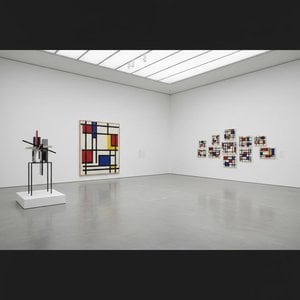
The Genesis of Pure Abstraction: Exploring Mondrian’s Composition with Yellow and Blue
Piet Mondrian's *Composition with Yellow and Blue* stands as a pivotal work in the evolution of abstract art, a testament to his relentless pursuit of a universal visual language. Emerging from a period of intense artistic experimentation, this painting isn’t merely an arrangement of colors and lines; it is a philosophical statement distilled onto canvas. Born from Mondrian's deep engagement with Theosophy – a spiritual movement seeking underlying unity in the universe – the artwork embodies his belief that art could transcend the material world and reveal fundamental truths about reality. Initially rooted in naturalistic landscapes reminiscent of Dutch Impressionism, Mondrian embarked on a radical journey toward abstraction, influenced by encounters with Cubism during his time in Paris. He began to deconstruct forms, stripping away representational elements to arrive at what he termed “Neoplasticism,” or the "New Plastic Art." This wasn’t simply about simplification; it was about uncovering an essential order hidden beneath the surface of things.
Deconstructing Reality: Form and Color as Spiritual Expression
The power of *Composition with Yellow and Blue* lies in its deliberate reduction to the most fundamental visual elements. Mondrian eschewed the complexities of traditional painting, opting instead for a rigorously controlled vocabulary of black horizontal and vertical lines, rectangular planes of primary colors – red, yellow, and blue – and expanses of white. The seemingly simple arrangement is anything but arbitrary. Each line, each color field, exists in dynamic tension with its neighbors, creating a sense of balance and harmony that feels both intellectually precise and emotionally resonant. The black grid acts as a structural framework, containing and defining the vibrant hues within. Yellow and blue, specifically, are not chosen at random; they represent opposing forces – activity and passivity, warmth and coolness – brought into equilibrium through careful placement and proportion. This interplay isn’t merely aesthetic; it's an attempt to visualize the underlying cosmic energies that Mondrian believed governed existence. He wasn’t interested in depicting *what* things looked like, but rather *how* they related to one another within a larger universal order.
A Legacy of Influence: From Painting to Modern Life
The impact of *Composition with Yellow and Blue*, and indeed the broader body of Mondrian's Neoplastic work, extends far beyond the realm of painting. It became a foundational influence on numerous artistic movements that followed, including Color Field painting, Minimalism, and even aspects of Abstract Expressionism. However, its reach isn’t limited to fine art. The principles of geometric abstraction and primary color palettes championed by Mondrian permeated design disciplines – architecture, furniture, fashion, and graphic arts – shaping the visual landscape of the 20th century and continuing to inspire contemporary creators today. The clean lines and bold simplicity of his compositions found their way into everyday objects, reflecting a broader cultural desire for order, clarity, and modernity. To own a reproduction of *Composition with Yellow and Blue* is not simply to acquire a beautiful artwork; it’s to connect with a pivotal moment in art history and embrace a vision of universal harmony that continues to resonate deeply.
## The Philosophical Roots of Geometric Harmony
Mondrian’s fascination with Theosophy profoundly shaped his artistic worldview, fueling his conviction that art could serve as a conduit for accessing spiritual truths. This belief drove him to reject representational imagery altogether, arguing that it obscured the underlying unity of existence—a concept central to Theosophical thought. He sought to express this unity not through depiction but through pure abstraction, prioritizing geometric forms and primary colors as symbols of cosmic order. The deliberate reduction of visual elements wasn’t merely stylistic; it was a conceptual undertaking aimed at capturing the essence of reality beyond sensory experience.
## Technique and Material Considerations: Precision and Balance
The execution of *Composition with Yellow and Blue* exemplifies Mondrian's meticulous approach to painting. He employed a technique known as alla prima, applying paint directly onto the canvas without underpainting—a method that demanded exceptional control over color and texture. The artist painstakingly prepared the surface with gesso, ensuring optimal adhesion for subsequent layers of pigment. Careful consideration was given to the selection of materials: Mondrian utilized oil paints mixed with turpentine and linseed oil, achieving a luminous finish that highlighted the interplay of colors and lines. The resulting artwork showcases an unwavering commitment to balance and harmony—a characteristic that extends beyond the visual realm into the artist’s philosophical convictions.
## Symbolism Beyond Color: Lines as Vessels of Cosmic Energy
The black horizontal and vertical lines in *Composition with Yellow and Blue* transcend their structural function, representing more than just boundaries; they embody cosmic energy—the fundamental forces governing the universe according to Mondrian's Theosophical beliefs. These lines are not merely decorative elements but active participants in the composition’s dynamic equilibrium. Their precise placement contributes to a sense of stability while simultaneously conveying movement and tension—a paradoxical relationship that reflects Mondrian’s desire to capture both order and dynamism simultaneously. The white planes serve as counterweights, creating visual balance and emphasizing the purity of color.
## Influence on Contemporary Design: A Timeless Aesthetic
The aesthetic principles enshrined in *Composition with Yellow and Blue* continue to inspire designers today. Its minimalist geometry—characterized by simple shapes and restrained color palettes—has become a cornerstone of modern design movements such as Bauhaus and Scandinavian design. The artwork’s emphasis on clarity, functionality, and harmony resonates deeply with contemporary sensibilities, demonstrating the enduring relevance of Mondrian's vision for creating spaces that promote tranquility and contemplation. Reproductions of *Composition with Yellow and Blue* adorn homes and offices worldwide—a testament to its timeless beauty and intellectual depth.



 Ver en contexto
 Comprar pintura hecha a mano
 Enviar
 Compartir
 Detalles

 Descargar
 Similares
 Radiografía
 Presentación de diapositivas

 Ver más






































 La opción de vidrio solo está disponible en tamaños inferiores a 110 cm.