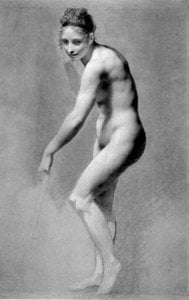
A Portrait of Refined Elegance: Pierre-Paul Prud’hon's “Untitled (D2X835)”
Pierre-Paul Prud’hon’s “Untitled (D2X835),” painted in 1817, offers a captivating glimpse into the world of Parisian society during the early 19th century. More than just a simple portrait, it's a carefully constructed tableau vivant—a staged scene brimming with subtle social commentary and an exquisite mastery of chiaroscuro, a technique that defines Prud’hon’s distinctive style. The painting depicts a gentleman in formal attire – a dark suit, top hat, and crisp tie – positioned beside a chair, creating an immediate sense of quiet contemplation. His clasped hands suggest both formality and perhaps a touch of restrained emotion.
Prud’hon, a pivotal figure bridging the Neoclassical and Romantic movements in French art, was deeply influenced by classical antiquity yet possessed a sensitivity that foreshadowed the emotional intensity of the Romantics. Born in Cluny, he spent formative years in Rome, absorbing the ideals of Greco-Roman sculpture and architecture, which informed his meticulous draftsmanship and his preference for idealized forms. This painting showcases this influence; the gentleman’s posture, attire, and overall composition echo the formality and restraint characteristic of Neoclassical portraiture, while the subtle play of light and shadow—the hallmark of *chiaroscuro*—injects a dramatic depth that hints at the Romantic sensibility he would later embrace.
The Setting: A Window into 19th-Century Domesticity
Beyond the central figure, Prud’hon skillfully employs background elements to enrich the scene and provide context. The presence of several individuals – partially visible in the distance – suggests a gathering or social event, hinting at the importance of hospitality and social interaction within Parisian society. A comfortable couch and another smaller one further contribute to the atmosphere of an affluent home, reflecting the lifestyle of the upper class. Notably, a vase on the left adds a touch of decorative elegance, demonstrating Prud’hon's attention to detail and his understanding of how objects could enhance a scene’s narrative.
The inclusion of these secondary figures isn’t merely decorative; it subtly underscores the social dynamics at play. They are less defined, almost like ghosts in the background, suggesting a hierarchy within the gathering – the central figure commanding attention while others remain peripheral. This layering of detail is characteristic of Prud'hon’s approach, inviting viewers to actively interpret the scene and consider its broader implications.
Symbolism and Emotional Resonance
While the subject matter appears straightforward—a portrait of a gentleman—Prud’hon imbues the painting with layers of symbolic meaning. The man’s posture, the formality of his attire, and the quiet contemplation suggested by his clasped hands invite speculation about his thoughts and feelings. The top hat, a symbol of status and sophistication during this period, further emphasizes his position within society.
Furthermore, Prud'hon’s masterful use of light and shadow—the *chiaroscuro* technique—creates an emotional atmosphere that is both elegant and subtly melancholic. The deep shadows cast upon the background figures and the subtle highlighting of the central figure contribute to a sense of intimacy and introspection. It’s as if we are privy to a private moment, observing a man lost in thought amidst the backdrop of refined domesticity.
A Legacy of Artistic Innovation
"Untitled (D2X835)" stands as a testament to Pierre-Paul Prud’hon's artistic genius and his pivotal role in bridging the gap between Neoclassicism and Romanticism. His meticulous draftsmanship, combined with his innovative use of *chiaroscuro* and his keen eye for detail, produced works that continue to captivate viewers today. WahooArt’s hand-painted reproduction faithfully captures the essence of this remarkable painting, offering a stunning addition to any art collection or interior space. The meticulous attention to color, texture, and composition ensures an authentic representation of Prud'hon’s vision, allowing you to experience the beauty and emotional depth of this iconic artwork firsthand.



 Vista previa
 Encargar reproducción pintada a mano
 Compartir
 Compartir
 Ver detalles

 Descargar
 Ver artículos similares
 Radiografía
 Presentación de diapositivas
 Estadísticas


 Leer más






































 La opción de vidrio solo está disponible en tamaños inferiores a 110 cm.