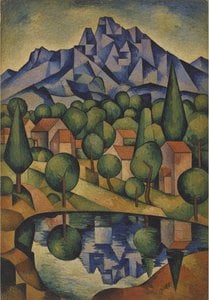
Château Noir: Cézanne’s Vision of Rustic Tranquility
Paul Cézanne's
Château Noir stands as a cornerstone of Post-Impressionism and a testament to the artist’s revolutionary approach to capturing the essence of nature. Created in 1904 during Cézanne's prolific period, this monumental oil on canvas resides prominently at the National Gallery of Art in Washington, D.C., inviting viewers into a serene contemplation of Provence landscape.
Composition and Technique: Breaking Boundaries
The painting’s visual impact stems from Cézanne’s masterful manipulation of form and color—elements that fundamentally challenged the conventions of academic art. Rather than striving for photographic realism, Cézanne employed thick brushstrokes, layering pigment to build up surfaces with palpable texture. These bold strokes aren't merely descriptive; they actively sculpt the canvas, conveying a sense of volume and depth that transcends traditional perspective. The house itself—a simplified geometric form—dominates the foreground, anchoring the composition while simultaneously serving as a focal point for Cézanne’s exploration of spatial relationships. Surrounding it are trees rendered with equally expressive brushwork, creating an interwoven tapestry of color and shape that captures the dynamism of the natural world.
Influences Beyond Impressionism
Cézanne's artistic journey was shaped by diverse influences—Romantic idealism and Realist observation—yet he ultimately forged his own distinctive path, bridging the gap between Impressionism’s fleeting impressions and Cubism’s fragmented geometries. Like Monet and Renoir before him, Cézanne sought to depict light and atmosphere, but he rejected Impressionism's optical illusion in favor of a more conceptual representation. His unwavering dedication to capturing underlying structure—a principle championed by thinkers like Friedrich Nietzsche—became the bedrock of his artistic vision. The painting’s palette is dominated by earthy tones—ochres, browns, and greens—reflecting Cézanne’s fascination with the materiality of pigment and his desire to convey a sense of solidity and permanence.
Historical Context: Recognition Amidst Skepticism
Cézanne's work initially encountered resistance from critics who deemed it incomprehensible and lacking in aesthetic merit. The prevailing artistic climate of the late 1890s favored polished surfaces and idealized depictions—a stark contrast to Cézanne’s uncompromising exploration of form and color. However, Cézanne gained crucial support from fellow artists like Camille Pissarro and the discerning art dealer Ambroise Vollard, who recognized his genius and championed his artistic endeavors. Vollard organized Cézanne's inaugural solo exhibition in Paris in 1895—a pivotal moment that established his reputation as a trailblazing innovator and secured him a loyal following among collectors and connoisseurs alike.
Legacy: An Enduring Influence on Modern Art
Cézanne’s impact on subsequent generations of artists is undeniable. Henri Matisse, Pablo Picasso, Georges Braque, and many others acknowledged Cézanne's profound influence on their own stylistic developments—particularly his pioneering use of geometric forms and planar surfaces. As a precursor to Cubism, Cézanne liberated painting from the constraints of illusionistic representation, paving the way for radical experimentation and reshaping the artistic landscape of the 20th century. His unwavering belief in the primacy of form continues to inspire artists today, reminding us that beauty resides not merely in visual appearance but also in the underlying structure of reality.
- The Chateau Noir (National Gallery of Art, Washington, D.C.) - /art/list/?Filter=8XX6E6-Paul-Cezanne-Chateau-Noir
- A Turn on the Road at Roche-Ruyon (Smith College Museum of Art, United States) - /art/list/?Filter=8YE5UX-Paul-Cezanne-A-Turn-on-the-Road-at-Roche-Ruyon
- Owl on a Chair and Sea Urchin (Pablo Picasso, Cubism) - /art/list/?Filter=8EWNFJ-Pablo-Picasso-Owl-on-a-Chair-and-Sea-Urchin
Further Exploration: For more insights into Cézanne’s artistic philosophy and his enduring legacy, visit
Paul Cézanne: Chateau Noir at WahooArt.



 Ver en contexto
 Comprar pintura hecha a mano
 Enviar
 Compartir
 Detalles

 Descargar
 Similares
 Radiografía
 Presentación de diapositivas
 Estadísticas


 Ver más






































 La opción de vidrio solo está disponible en tamaños inferiores a 110 cm.