Adquiera una imagen digital de alta resolución y optimizada, muy superior a la vista previa en línea.
Cada archivo es preparado meticulosamente por nuestros especialistas internos mediante el uso de herramientas avanzadas y un experto retoque manual. Nos aseguramos de que cada imagen posea una claridad excepcional, una precisión cromática impecable y un detalle minucioso.
El archivo final se entrega por correo electrónico en un plazo de 72 horas, optimizado para su uso inmediato en entornos profesionales, editoriales y de impresión. Esta es la misma calidad en la que confían los estudios de diseño, las editoriales y las galerías de primer nivel.
Descarga un archivo de alta resolución para exhibición personal, impresión y proyectos creativos. ( Comprar impresión Comprar pintura hecha a mano)
Al elegir WahooArt.com, no solo está adquiriendo una imagen; está recibiendo una obra de arte digital mejorada profesionalmente, elaborada con precisión y respaldada por una garantía de satisfacción. Esto es todo lo que incluye su pedido, automáticamente:

Recibirá su archivo de imagen digital en alta resolución por correo electrónico en un plazo de 72 horas tras realizar su pedido, listo para su uso inmediato.

Su obra de arte se optimiza profesionalmente mediante herramientas avanzadas de IA y edición manual, garantizando el máximo detalle, claridad y precisión cromática.

¿Has borrado o perdido tu archivo por error? No te preocupes: te lo volveremos a enviar en cualquier momento, sin coste adicional.

Disfrute de su obra de arte al instante sin aduanas, aranceles ni gastos de envío; las descargas digitales siempre están libres de impuestos.

Garantizamos que su imagen digital refleje los colores originales con la mayor fidelidad posible, mediante el uso de herramientas profesionales y gestión del color.

Si no está satisfecho con su imagen digital, la revisaremos o le reembolsaremos el 100% en un plazo de 100 días, sin preguntas.

¿No está satisfecho? Obtenga un reembolso completo dentro de los 100 días posteriores a la recepción de su archivo digital, sin preguntas.

Compra 3 imágenes, ahorra 10% - Compra 5, ahorra 15% - Compra 10+, ahorra 20%. Ideal para proyectos creativos, galerías y agencias.
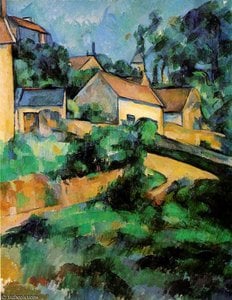
Paul Cézanne's *Château Noir*, painted in 1904, isn’t merely a depiction of a castle; it’s an invitation into the heart of a revolutionary artistic vision. This oil on canvas, currently residing within the hallowed halls of the Musée du Louvre in Paris, embodies the culmination of Cézanne's lifelong pursuit to capture not just what he saw, but *how* he perceived – a profound shift away from traditional representation and towards an exploration of form, color, and structure. The painting immediately draws the eye with its bold contrasts: the fiery red of the castle’s roof against the deep azure of the sky, creating a visual tension that speaks to both power and tranquility.
Cézanne's approach to landscape painting was profoundly influenced by the Impressionists, particularly their focus on capturing fleeting moments of light. However, he quickly moved beyond mere observation, seeking to distill the essence of his subjects into fundamental geometric shapes. *Château Noir* exemplifies this shift brilliantly. The castle itself isn’t rendered with meticulous detail; instead, it's broken down into a series of interlocking planes and angles – rectangles, triangles, and cylinders – that suggest volume and depth. This deliberate simplification wasn’t an abandonment of realism but rather a conscious decision to prioritize the underlying structure of the scene, anticipating the radical innovations of Cubism by decades.
Cézanne's masterful use of color is equally significant. He employs a palette of rich, saturated hues – deep blues, vibrant reds, earthy greens – not to mimic reality but to convey emotional resonance. The red roof, for instance, isn’t simply painted red; it pulsates with energy and warmth, dominating the composition and drawing the viewer’s attention. Notice how Cézanne uses color to define space and create a sense of atmosphere. He employs broken brushstrokes, layering colors in small, distinct patches, rather than blending them smoothly – a technique that adds texture and dynamism to the surface of the canvas.
The surrounding landscape is rendered with equally expressive strokes. The trees, positioned strategically in the foreground and background, aren’t depicted as individual forms but as masses of color and shape, contributing to the overall sense of spatial ambiguity. Cézanne deliberately obscures precise details, inviting the viewer to actively participate in constructing the image – a hallmark of his unique style.
Painted during Cézanne's final years—a period marked by intense experimentation and a deepening preoccupation with formal abstraction—*Château Noir* represents a pivotal moment in artistic history. Cézanne was responding to the challenges posed by Impressionism, rejecting its emphasis on optical illusion and striving instead for a more intellectually rigorous approach. Influenced by thinkers like Nietzsche and Bergson, he sought to capture not just what he saw but also the underlying vibrations of existence—a concept that would become central to his artistic philosophy.
The painting’s genesis lies in Cézanne's fascination with Mont Sainte-Victoire, a towering limestone massif overlooking Aix-en-Provence. He repeatedly depicted this mountain throughout his career, transforming it into an emblem of permanence and stability amidst the ephemeral beauty of nature. *Château Noir*, however, transcends mere topographical representation; it’s infused with Cézanne's desire to explore the fundamental principles of visual perception.
*Château Noir* is laden with symbolic significance. The castle itself—a crumbling ruin—represents decay and transformation, mirroring Cézanne’s own contemplation of mortality. Yet, its fiery red roof symbolizes vitality and resilience, suggesting that beauty can endure even in the face of decline. The juxtaposition of color and form underscores Cézanne's belief that art should engage both intellect and emotion.
Ultimately, *Château Noir* stands as a testament to Cézanne’s unwavering commitment to artistic innovation—a legacy that continues to inspire artists and captivate audiences worldwide. Its enduring appeal resides in its ability to evoke contemplation and wonder, prompting viewers to consider the profound questions posed by art about the nature of reality.
If you’re seeking a high-quality reproduction of this iconic masterpiece, WahooArt offers meticulously crafted oil painting reproductions that capture the essence of Cézanne’s artistic genius. Explore Paul Cézanne: Château Noir today and bring a piece of art history into your home.


1839 - 1906 , Francia

 Ver en contexto
 Enviar
 Compartir
 Detalles

 Descargar
 Similares
 Radiografía
 Presentación de diapositivas


 Ver más