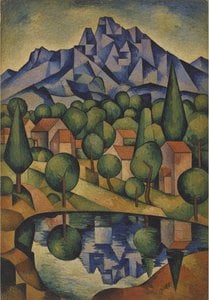
Still Life with Fruit Geraniums Stock: A Revolutionary Vision
Paul Cézanne’s *Still life with fruit geraniums Stock*, painted in 1894, stands as an undeniable cornerstone of modern art—a pivotal moment where Impressionism relinquished its fleeting grasp on light and sensation to embrace a radically new approach to perception. Measuring 58 x 91 cm, this oil on canvas transcends the conventional confines of the still life genre, transforming it into a profound exploration of geometric forms and color relationships that would reverberate throughout the artistic landscape of the early 20th century. The painting presents an exquisitely arranged assemblage of apples, oranges, pears, and a vibrant vase overflowing with geraniums resting upon a subtly draped table—a deceptively simple composition concealing layers of intellectual ambition and artistic innovation. Cézanne wasn’t merely depicting objects; he was dissecting them, analyzing their underlying structure to reveal the fundamental principles governing our visual experience. This deliberate methodology distinguishes him from his Impressionist predecessors who sought to capture momentary impressions of light and atmosphere—a quest Cézanne deemed insufficient for conveying the essence of reality.
- Formal Innovations: Cézanne’s breakthrough lay in abandoning traditional perspective and employing a technique characterized by visible brushstrokes that build up the canvas surface layer upon layer.
- Geometric Forms: The fruits are rendered not with photographic accuracy but as simplified shapes—spheres, cubes, cylinders—representing Cézanne's conviction that nature itself operates according to geometric laws.
- Color Palette: Cézanne’s muted color palette—dominated by greens, blues, reds, and whites—emphasizes tonal harmony rather than vibrant hues, mirroring the artist’s desire to capture the underlying structure of visual perception.
Deconstructing Perception: Post-Impressionism in Practice
Cézanne's artistic journey represents a decisive break from Impressionism, marking the genesis of Post-Impressionism—a movement that championed subjective vision and symbolic meaning as counterpoints to the objective observation favored by Impressionist painters. *Still life with fruit geraniums Stock* exemplifies this paradigm shift, demonstrating Cézanne’s unwavering commitment to analyzing visual experience through a prism of geometric abstraction. The artist's brushstrokes are deliberately visible—textured and expressive—creating a palpable sense of materiality that contrasts sharply with the diffused light characteristic of Impressionist paintings. This technique underscores Cézanne’s belief that art should strive for an understanding beyond mere surface appearances, mirroring his broader philosophical preoccupation with uncovering hidden truths beneath the veneer of sensory experience. Consider how Cézanne's approach anticipates the radical transformations ushered in by Cubism—a movement that would further dismantle traditional pictorial conventions and redefine artistic representation.
The artist’s focus is on capturing the essence of form and color, prioritizing structural analysis over fleeting atmospheric effects.
Visible brushstrokes contribute to a tactile quality, mirroring Cézanne's conviction that art should engage with materiality.
Symbolism & Emotional Resonance
Beyond its formal innovations, *Still life with fruit geraniums Stock* invites contemplation on themes of abundance, transience, and the beauty found within everyday life—a reflection of Cézanne’s profound engagement with the natural world. The fruits themselves serve as symbols of nourishment and earthly pleasure, presented not as idealized objects but as tangible forms susceptible to decay—a subtle acknowledgment of mortality that imbues the painting with a contemplative spirit. Simultaneously, the geraniums—with their vibrant color and delicate petals—represent a celebration of life’s fleeting beauty—a visual counterpoint to the melancholic contemplation evoked by Cézanne's masterful composition. The overall effect is one of quiet introspection; the painting doesn’t clamor for attention but rather encourages viewers to slow down, observe carefully, and engage with the underlying emotional depth of the scene.
The artist’s deliberate use of color contributes to a harmonious tonal palette that enhances the painting's contemplative mood.
The inclusion of geraniums symbolizes beauty and fragility—a poignant reminder of life’s impermanence.
Cézanne’s Legacy & Collecting Today
Paul Cézanne’s influence extends far beyond the confines of his own time, shaping artistic sensibilities for generations to come. *Still life with fruit geraniums Stock* remains a cornerstone of modern art education and continues to inspire artists worldwide—a testament to Cézanne's enduring vision of artistic exploration. Its balanced composition and harmonious color palette make it an ideal centerpiece for various interior spaces—from traditional homes to contemporary galleries alike. For those seeking to enrich their collections with masterpieces embodying intellectual rigor and aesthetic beauty, high-quality reproductions offer a compelling pathway to experience the transformative power of Cézanne’s groundbreaking work. Pairing *Still life with fruit geraniums Stock* with other Post-Impressionist pieces—such as works by Matisse or Picasso—creates an immersive artistic dialogue that underscores Cézanne's pivotal role in shaping the trajectory of 20th-century art history.



 Vista previa
 Encargar reproducción pintada a mano
 Compartir
 Compartir
 Ver detalles
 Guía
Guía

 Descargar
 Ver artículos similares
 Radiografía
 Presentación de diapositivas
 Estadísticas


 Leer más






































 La opción de vidrio solo está disponible en tamaños inferiores a 110 cm.