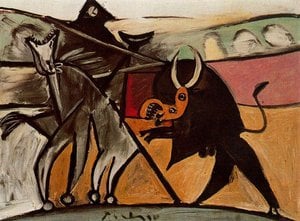
The Haunting Echoes of Conflict: Pablo Picasso’s *War*
Pablo Picasso's *War*, painted in 1937, isn’t merely a depiction of a battlefield; it’s a visceral scream against the brutality and senselessness of conflict. Born from the immediate aftermath of the bombing of Guernica during the Spanish Civil War – an event that shocked Europe and ignited international outrage – the painting transcends its specific historical context to become a timeless indictment of violence itself. It's a work saturated with grief, disorientation, and a profound sense of loss, rendered in Picasso’s signature fractured style, reflecting the shattered reality of war.
The monochrome palette—a stark blend of greys, blacks, and whites—immediately establishes an atmosphere of devastation. There's no romanticism here, no heroic grandeur; instead, we are confronted with a scene stripped bare of color, mirroring the emotional desolation at its core. The figures – a screaming woman cradling her dead child, a wounded horse writhing in agony, a dismembered soldier clutching a broken sword – are not individualized portraits but archetypes of suffering, embodying universal themes of loss and despair. Picasso deliberately avoids specific details, opting for symbolic representation that allows the painting to resonate across cultures and generations.
Cubism’s Fragmented Reality
Picasso's masterful use of Cubist techniques is central to *War*'s power. He dismantles forms, fracturing them into geometric shards and presenting multiple perspectives simultaneously. This fragmentation isn’t merely an aesthetic choice; it mirrors the psychological disorientation experienced by those caught in the chaos of war. The figures are not presented as solid, unified beings but rather as broken fragments, reflecting the shattered lives and fragmented realities left behind. The overlapping planes and distorted shapes create a sense of instability and unease, pulling the viewer into the heart of the scene’s turmoil.
Notice how Picasso employs sharp angles and jagged lines to convey violence and pain. The horse, perhaps the most iconic element of the painting, is rendered in agonizing detail – its body contorted, its mouth open in a silent scream. The bull, often interpreted as representing brutality or Spain itself, stands impassively amidst the carnage. Even the light source—a single, glaring eye-like shape—feels oppressive and accusatory, highlighting the horror of the scene.
Historical Context & Legacy
Painted in response to the bombing of Guernica, a Basque town deliberately targeted by Nazi German and Fascist Italian warplanes during the Spanish Civil War, *War* quickly became an emblem of anti-war sentiment. Picasso stipulated that the painting should not be displayed in Spain until democracy was restored, a testament to his commitment to freedom and justice. It traveled extensively throughout Europe and America, raising awareness about the horrors of the conflict and serving as a powerful symbol of resistance against fascism.
Today, *War* resides at the Museo Reina Sofía in Madrid, where it continues to captivate viewers with its raw emotional intensity. It remains a potent reminder of the devastating consequences of war and a testament to Picasso’s enduring legacy as one of art history's most revolutionary figures. Reproductions of this iconic work offer a tangible connection to this pivotal moment in history, allowing us to contemplate the timeless themes of suffering, loss, and the urgent need for peace.
Preguntas y respuestas
¿Puedo ver una vista de rayos X de "War" de Pablo Picasso?
La vista de rayos X de "War" de Pablo Picasso se encuentra en la página Rayos X de la obra: un examen interactivo de la imagen a través de once capas ópticas.
¿Para qué ocasión se sugiere "War" de Pablo Picasso como regalo?
"War" de Pablo Picasso es una recomendación ideal como regalo para Birthday. Se puede obsequiar una reproducción de la obra de arte.
¿Quién es el artista detrás de "War"?
"War" fue creada por Pablo Picasso. La información en esta página describe la obra original de Pablo Picasso.



 Vista previa
 Encargar reproducción pintada a mano
 Compartir
 Compartir
 Ver detalles
 Guía
Guía

 Descargar
 Ver artículos similares
 Radiografía
 Presentación de diapositivas
 Estadísticas
 Leer más






































 La opción de vidrio solo está disponible en tamaños inferiores a 110 cm.