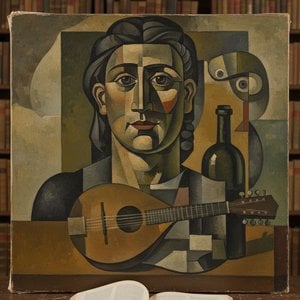
Violin, glass, pipe and inkwell
In the realm of modern art, few pieces have captured the essence of innovation and creativity as profoundly as Pablo Picasso's “Violin, Glass, Pipe and Inkwell.” This 1912 masterpiece is a quintessential representation of Analytical Cubism, a style pioneered by Picasso himself. The painting measures 81 x 54 cm and is executed in oil on canvas.
The Artistic Movement: Analytical Cubism
Analytical Cubism, as coined by Juan Gris, was the first phase of Cubism, an avant-garde movement that revolutionized European painting and sculpture. This style involved breaking down subjects into geometric shapes to create a new visual experience. Picasso's “Violin, Glass, Pipe and Inkwell” exemplifies this technique, where everyday objects are fragmented and reassembled in abstract forms.
The goal wasn’t merely to depict what was seen but to explore how perception itself transforms reality. Artists like Picasso wrestled with representing multiple viewpoints simultaneously—a radical departure from traditional perspective—resulting in canvases that appear deceptively simple yet brimming with complex spatial relationships.
Composition and Symbolism
The composition of the painting is striking, with each object carefully positioned to create a sense of harmony amidst fragmentation. The violin on the left, the glass above it, the pipe in the middle, and the inkwell on the right are all depicted in multiple viewpoints simultaneously. This technique allows the viewer to see the objects from different angles at once, challenging traditional representation.
The choice of objects is also significant. The violin represents artistry and creativity, while the glass symbolizes clarity and purity. The pipe, often associated with relaxation and contemplation, adds a sense of calmness. The inkwell, a tool for writing and creation, ties all these elements together, suggesting the fusion of artistic expression.
Artistic Technique
Picasso’s use of monochromatic colors enhances the geometric forms, creating a sense of depth and dimensionality. The brushstrokes are bold and expressive, adding texture to the painting. This technique not only reflects Picasso's innovative approach but also underscores his ability to transform ordinary objects into extraordinary art.
Consider the deliberate flatness achieved through careful layering of pigment—a hallmark of Analytical Cubism—where shadows and highlights subtly delineate shapes without adhering rigidly to conventional shading conventions. It’s a masterful demonstration of how artistic vision can transcend mere imitation, forging instead a new visual language.
Conclusion
"Violin, Glass, Pipe and Inkwell" is a testament to Picasso's genius in pushing the boundaries of art. It stands as a landmark piece in the history of modern art, influencing generations of artists to come. For those interested in exploring more of Picasso’s works or learning about other artists who contributed to the Cubist movement, Pablo Picasso: Violin, glass, pipe and inkwell and Analytical Cubism on WahooArt provide valuable insights.
This painting is a must-see for anyone fascinated by the evolution of art in the 20th century. Its unique blend of fragmentation and harmony makes it a captivating piece that continues to inspire and intrigue art lovers today.



 Ver en contexto
 Comprar pintura hecha a mano
 Enviar
 Compartir
 Detalles

 Descargar
 Similares
 Radiografía
 Presentación de diapositivas
 Estadísticas


 Ver más






































 La opción de vidrio solo está disponible en tamaños inferiores a 110 cm.