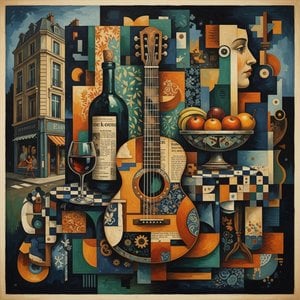
Violin by Pablo Picasso
Pablo Picasso, one of the most influential artists of the 20th century, captivated audiences worldwide with his groundbreaking explorations of form and emotion. Among his prolific output is “Violin,” a seminal work that embodies the core principles of Synthetic Cubism—a movement he spearheaded alongside Georges Braque—and continues to inspire admiration for its innovative visual language. This article delves into the intricacies of this painting, examining its composition, stylistic choices, and enduring significance within the broader panorama of modernist art.
### Background and Context: The Birth of Synthetic Cubism
The early years of the 20th century witnessed a dramatic shift in artistic sensibilities, fueled by intellectual currents like Futurism and Dada. Picasso and Braque responded to these challenges with Cubism, initially characterized by Analytical Cubism—a method focused on dissecting objects into geometric planes and presenting multiple viewpoints simultaneously. However, recognizing the limitations of this approach, they embarked upon Synthetic Cubism, a daring experiment that sought to transcend mere representation. This new style prioritized collage techniques and flattened surfaces, rejecting traditional illusionistic perspective in favor of a more conceptual engagement with visual information. The result was an art form radically different from anything seen before—one that would profoundly impact subsequent artistic movements.
### Composition and Elements: A Dialogue Between Planes
“Violin” measures 46 x 38 cm and is executed with meticulous attention to detail using collage techniques. At its heart lies a violin, rendered as a series of interlocking planes—a deliberate departure from the single-point perspective favored by Renaissance painters. The neck extends upwards from the center, anchoring the composition while simultaneously directing the viewer’s gaze towards the upper right corner. Beneath this dominant element are two boats—one positioned in the lower left quadrant and another slightly to its right—creating a dynamic interplay of shapes and textures. Scattered throughout the canvas are smaller objects: cups clustered near the bottom left and center, a bottle strategically placed in the middle-left area, and a bowl situated towards the top right. Picasso’s masterful use of color—muted ochre tones dominate—further enhances the painting's visual impact, emphasizing the flatness of the surface and fostering a contemplative mood.
### Artistic Movement: Beyond Illusionism – Embracing Conceptual Depth
Synthetic Cubism represented a decisive break from Proto-Cubist and Analytical Cubist predecessors. It championed collage as a transformative tool, allowing artists to incorporate textures and materials—such as newspaper fragments—into their canvases—a bold gesture against the conventions of academic painting. This movement wasn’t merely about replicating visual reality; it was about conveying ideas and emotions through abstracted forms and flattened planes. Picasso's influence extended far beyond Cubism itself, inspiring movements like Orphism and Surrealism and establishing a precedent for exploring subjective experience in art—a legacy that continues to resonate with artists today.
### Artist’s Influence: Picasso – A Titan of Modern Art
Pablo Picasso (1881-1973) remains an undisputed icon of modern art, celebrated for his versatility across painting, sculpture, printmaking, and ceramics. His relentless experimentation—coupled with a profound understanding of artistic history—established him as a pivotal figure in shaping the visual culture of the 20th century. “Violin,” alongside numerous other masterpieces, stands testament to Picasso’s unwavering commitment to pushing boundaries and redefining artistic expression—a legacy that secures his place among the greatest artists of all time.
Pablo Picasso: Violin is available for viewing on WahooArt.com. To learn more about Synthetic Cubism and its influence on modern art, refer to the following resources:
-
Synthetic Cubism Art Movement
-
Cubism
Preguntas y respuestas
¿A qué etapa de la carrera de Pablo Picasso corresponde la fecha de 1912 de "Violin"?
"Violin", creada en 1912, pertenece al Cubismo Sintético de la trayectoria de Pablo Picasso.
¿Cómo encaja "Violin" con los temas y el estilo de Pablo Picasso?
"Violin" pertenece a la obra Cubismo Sintético de Pablo Picasso, cuyos temas recurrentes incluyen breakdown of perspective, influence of braque, experimentation with form, symbolic representation, iconic cubist piece, exploring multiple viewpoints, reflection of artistic evolution.
¿Qué color predomina en la composición de "Violin" de Pablo Picasso?
El Madera de deriva (#bc9a41) es el color predominante de "Violin" de Pablo Picasso.



 Vista previa
 Encargar reproducción pintada a mano
 Compartir
 Compartir
 Ver detalles
 Guía
Guía

 Descargar
 Ver artículos similares
 Radiografía
 Presentación de diapositivas
 Estadísticas


 Leer más






































 La opción de vidrio solo está disponible en tamaños inferiores a 110 cm.