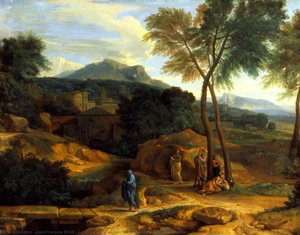
Landscape with Polyphemus: A Symphony of Classical Calm
Nicolas Poussin’s Landscape with Polyphemus stands as a cornerstone of Baroque art—though paradoxically imbued with the serenity and rationality characteristic of classical ideals. Painted in 1648 for Jean Pointel, this monumental canvas transcends mere depiction; it’s an invitation to contemplate the harmonious interplay between mythology and nature, executed with breathtaking precision.
The painting resides within the hallowed halls of The Hermitage Museum in St. Petersburg, Russia—one of the world’s most revered repositories of artistic treasures—a testament to its enduring beauty and significance.
Composition and Narrative Depth
Measuring 150 x 199 cm, Landscape with Polyphemus unfolds like a carefully orchestrated drama. At its heart is Polyphemus—the cyclops from Homer’s Odyssey—a figure rendered with remarkable anatomical accuracy and imbued with palpable menace. He dominates the central vista, holding a bow and arrow, poised for action yet simultaneously absorbed in contemplation.
Surrounding him are two horses—one on the right side of the canvas and another positioned more prominently—adding dynamism to the scene while reinforcing the sense of movement. The landscape itself is meticulously crafted: towering rocks punctuate the horizon, providing a dramatic backdrop for the figures below. Trees—particularly cypress trees—are strategically placed to convey solemnity and evoke associations with mourning and remembrance.
Technique and Artistic Vision
Poussin’s mastery of technique is evident in every brushstroke. Employing oil paint on canvas, he achieved unparalleled tonal gradation—a hallmark of his style—creating a luminous surface that captures the subtle nuances of light and shadow. The artist skillfully utilized linear perspective to establish depth and create an illusionistic space that draws the viewer into the scene.
More than just a visual spectacle, Landscape with Polyphemus speaks to profound themes—the confrontation between humanity and the sublime, the triumph of reason over instinct, and the enduring power of myth.
Historical Context and Legacy
Created during Poussin’s formative years in Rome—a period marked by an intense engagement with classical art and philosophy—the painting reflects the prevailing artistic sensibilities of its time. It aligns seamlessly with the broader movement toward neoclassicism, championed by artists like Jacques-Louis David and Jean-Auguste-Dominique Ingres.
The Hermitage Museum’s acquisition solidified Landscape with Polyphemus's place as an icon of Western art—inspiring generations of artists and continuing to captivate audiences today.
For those seeking a tangible connection to this masterpiece, reproductions crafted by WahooArt.com offer exceptional quality—capturing the essence of Poussin’s vision with meticulous detail.
Preguntas y respuestas
¿Qué nivel de contraste tiene "Paisaje con Polifemo" de Nicolás Poussin?
El contraste entre luces y sombras de "Paisaje con Polifemo" se registra como Equilibrado. El contraste describe la intensidad con la que difieren las zonas claras y oscuras.
¿Qué atmósfera transmite "Paisaje con Polifemo"?
"Paisaje con Polifemo" transmite una atmósfera Elegante.
¿Qué uso y espacio se recomiendan para "Paisaje con Polifemo" de Nicolás Poussin?
Se sugiere "Paisaje con Polifemo" para Acento cromático, y el espacio recomendado es un Salón principal.



 Ver en contexto
 Comprar pintura hecha a mano
 Enviar
 Compartir
 Detalles
 Guía
Guía

 Descargar
 Similares
 Radiografía
 Presentación de diapositivas
 Q&A
Q&A Estadísticas


 Ver más






































 La opción de vidrio solo está disponible en tamaños inferiores a 110 cm.