


 Acrílico sobre lienzoArte de paredClassicism
 1630Renacimiento
 119.0 x 98.0 cm
Óleo sobre lienzo pintado a mano en el tamaño y marco de su elección, realizado por encargo por nuestros artistas. ( Comprar impresión Comprar imagen)





























Elija entre nuestros tamaños predefinidos que respetan las proporciones originales de la obra.

Puede ingresar sus propias dimensiones para adaptarse a un marco o espacio específico. Si el tamaño seleccionado no coincide con las proporciones de la imagen original, recortaremos la obra o extenderemos la pintura con elementos adicionales pintados a mano. Se le enviará una maqueta digital para su aprobación antes de comenzar la producción.
Tenga en cuenta que la vista previa en pantalla no refleja el recorte o la extensión reales. Solo la maqueta mostrará con precisión la composición final.
Si bien existen tamaños personalizados, recomendamos seleccionar una dimensión de la lista predefinida para preservar las proporciones originales.
Envío a todo el mundo () en 3-4 semanas en lugar de las 5 semanas estándar. (7 septiembre). Sin comprometer la calidad.


Descendimiento de la cruz
Dimensiones de la reproducción
Nicolas Poussin (1594–1665) stands as a monumental figure in French Baroque painting, yet his artistic vision remained profoundly rooted in the traditions of classical art—a distinction that cemented his legacy as one of the foremost practitioners of Neoclassicism. Unlike many of his contemporaries who embraced flamboyant ornamentation and dramatic theatricality, Poussin pursued an aesthetic characterized by serene beauty, meticulous detail, and a deliberate restraint that prioritized intellectual contemplation over mere visual sensation.
His formative years were spent in Les Andelys, Normandy, where he absorbed the influences of humanist scholarship and the artistic ideals championed by Jean Baptiste Colbert—the architect of Louis XIV’s opulent court. This exposure to classical thought profoundly shaped his approach to painting, informing his compositional strategies and his unwavering commitment to capturing idealized forms.
Poussin's breakthrough came in Paris around 1624 when he secured a prestigious commission from Cardinal Francesco Barberini—a patron who recognized Poussin’s exceptional talent and fostered an environment conducive to artistic experimentation. This patronage allowed him to hone his skills, refine his technique, and establish himself as a leading artist of the era.
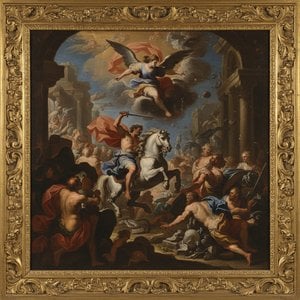
Among Poussin's most celebrated works is “Descent from the Cross,” completed in 1630. This monumental canvas—measuring 119 x 98 cm—houses itself within The State Hermitage Museum in Saint Petersburg, Russia, and exemplifies the apex of his artistic achievement.
The painting depicts the poignant moment following Jesus’ crucifixion when he is lowered from the cross by Roman soldiers. Poussin skillfully employs chiaroscuro—the dramatic interplay of light and shadow—to heighten the emotional intensity of the scene. The dark background serves as a counterpoint to the radiant luminescence emanating from Christ’s body, emphasizing his divine grace amidst profound suffering.
The composition is meticulously structured according to classical principles of balance and proportion. Three central figures dominate the canvas: Jesus himself, Mary Magdalene kneeling beside him, and Nicodemus—a disciple who stands attentively watching the event unfold. Two ladders ascend from opposite sides of the frame, symbolizing humanity’s aspiration towards divine grace.
The inclusion of a baby Jesus nestled in Mary’s arms underscores the painting's overarching theme of innocence and redemption—a deliberate allusion to Christian theology that elevates the scene beyond mere historical representation. The meticulous rendering of drapery and flesh tones demonstrates Poussin’s mastery of technique, reflecting his unwavering dedication to anatomical accuracy.
Nicolas Poussin's influence extended far beyond his own lifetime, inspiring generations of artists who embraced Neoclassicism—a movement that sought to revive the ideals of ancient Greece and Rome. Artists such as Jacques-Louis David and Jean-Auguste-Dominique Ingres drew inspiration from Poussin’s serene compositions and masterful use of light and shadow, establishing him as a cornerstone of Western artistic heritage.
“Descent From The Cross” remains an enduring testament to Poussin's artistic genius—a masterpiece that continues to captivate viewers with its sublime beauty and profound spiritual resonance. For more information on Nicolas Poussin’s life and work, visit WahooArt.com.


1594 - 1665 , Francia
Explore the breathtaking power of Baroque art. Delve into the dramatic interplay of light, shadow, and motion through the works of masters like Caravaggio. Discover how the era's intense emotional realism continues to inspire collectors and connoisseurs of classical grandeur.

Explore the profound elegance of Baroque Classicism. Discover how masters fused dramatic chiaroscuro with structured order to redefine art history through light, shadow, and emotional grandeur.

 Ver en contexto
 Enviar
 Compartir
 Detalles

 Descargar
 Similares
 Radiografía
 Presentación de diapositivas
 Ver más







 La opción de vidrio solo está disponible en tamaños inferiores a 110 cm.


