Ver en contexto Vista previa en RA Comprar pintura hecha a mano Cambiar a imagen digital Enviar
Detalles Guía Añadir a favoritos Descargar Similares Radiografía Presentación de diapositivas Q&A Estadísticas

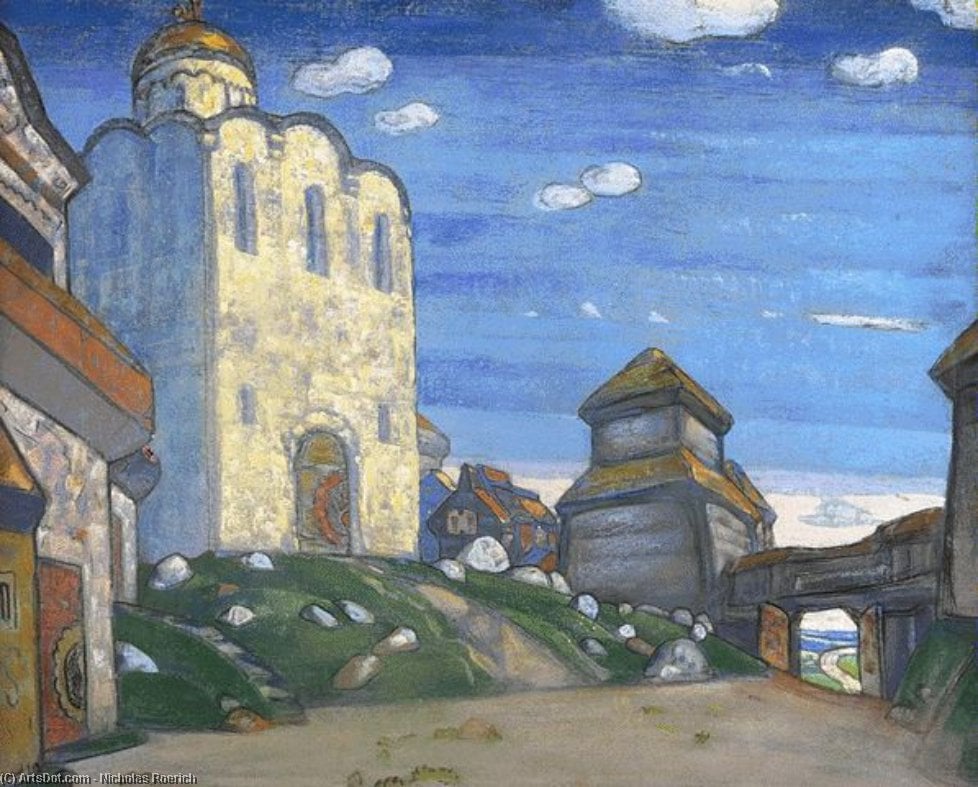
Putivl

Nicholas Roerich’s ‘Putivl’ captures a captivating cityscape with a castle-like structure and vibrant blue skies, showcasing the artist's distinctive style and spirit. Discover this beautiful hand-painted reproduction and bring a piece of art history into your home.

Explora el arte cautivador de Nicolás Roerich (1874-1947): Simbolismo, paisajes himalayos y pinturas místicas. Diseños para los Ballets Russes y defensor de la preservación cultural.

Giclée / Impresión de arte

Impresiones giclée o en lienzo de calidad de museo con producción rápida y opciones de acabado flexibles. ( Comprar pintura hecha a mano Cambiar a imagen digital)

Corner sample of the P118B picture frame: poliestireno moldeado, 5 cm wide and 3 cm thick
P118B €10
Corner sample of the P118H picture frame: poliestireno moldeado, 5 cm wide and 3 cm thick
P118H €10
Corner sample of the P118W picture frame: poliestireno moldeado, 5 cm wide and 3 cm thick
P118W €10
Corner sample of the P438Z picture frame: poliestireno moldeado, 5.5 cm wide and 3.5 cm thick
P438Z €10
Corner sample of the P508JH picture frame: poliestireno moldeado, 7 cm wide and 3.5 cm thick
P508JH €12
Corner sample of the P508YH picture frame: poliestireno moldeado, 7 cm wide and 3.5 cm thick
P508YH €12
Corner sample of the P805H picture frame: poliestireno moldeado, 5 cm wide and 3.5 cm thick
P805H €10
Corner sample of the P805Z picture frame: poliestireno moldeado, 5 cm wide and 3.5 cm thick
P805Z €10
Corner sample of the P919BZ picture frame: poliestireno moldeado, 7 cm wide and 3.5 cm thick
P919BZ €10
Corner sample of the P919G picture frame: poliestireno moldeado, 7 cm wide and 3.5 cm thick
P919G €10
Corner sample of the P919XJ picture frame: poliestireno moldeado, 7 cm wide and 3.5 cm thick
P919XJ €10
Corner sample of the P959ZH picture frame: poliestireno moldeado, 5 cm wide and 3 cm thick
P959ZH €10
Corner sample of the P968JZ picture frame: poliestireno moldeado, 6 cm wide and 4 cm thick
P968JZ €12
Corner sample of the W106C picture frame: madera maciza, 5 cm wide and 3 cm thick
W106C €8
Corner sample of the W218G picture frame: madera maciza, 5 cm wide and 3 cm thick
W218G €10
Corner sample of the W218JH picture frame: madera maciza, 5 cm wide and 3 cm thick
W218JH €8
Corner sample of the W218Y picture frame: madera maciza, 5 cm wide and 3 cm thick
W218Y €10
Corner sample of the W307PJ picture frame: madera maciza, 6 cm wide and 3 cm thick
W307PJ €10
Corner sample of the W316G picture frame: madera maciza, 6 cm wide and 3 cm thick
W316G €10
Corner sample of the W316PJ picture frame: madera maciza, 6 cm wide and 3 cm thick
W316PJ €8
Corner sample of the W316Y picture frame: madera maciza, 6 cm wide and 3 cm thick
W316Y €10
Corner sample of the W398PJ picture frame: madera maciza, 5 cm wide and 3 cm thick
W398PJ €8
Corner sample of the W4111J picture frame: madera maciza, 6.5 cm wide and 3.5 cm thick
W4111J €10
Corner sample of the W500HY picture frame: madera maciza, 7 cm wide and 5 cm thick
W500HY €15
Corner sample of the W500JH picture frame: madera maciza, 7 cm wide and 5 cm thick
W500JH €15
Corner sample of the W692G picture frame: madera maciza, 8 cm wide and 4 cm thick
W692G €12
Corner sample of the W849H picture frame: madera maciza, 5 cm wide and 3 cm thick
W849H €8
Corner sample of the W940BG picture frame: madera maciza, 7.5 cm wide and 4.5 cm thick
W940BG €15
Corner sample of the W953PJ picture frame: madera maciza, 6 cm wide and 3.5 cm thick
W953PJ €8

Tamaño estándar
a medida
CM
INCH

Elija entre nuestros tamaños predefinidos que respetan las proporciones originales de la obra.

ancho
altura

Introduzca el ancho y el alto que necesite para adaptarse a su marco o pared. Una impresión solo puede recortarse, nunca hacerse más grande que la imagen original, por lo que un tamaño con una forma distinta perderá parte de la obra. Le enviaremos una maqueta digital para su aprobación antes de realizar cualquier impresión. La imagen que se muestra en esta página no refleja el recorte real; solo la maqueta lo hace.

Envío a todo el mundo () en 2 semanas en lugar de las 4/5 semanas estándar. (30 octubre)

Envío exprés gratuito a todo el mundo
Lienzo de lino de alta calidad
Seguro de envío total
Garantía de reembolso de aranceles aduaneros
Garantía de fidelidad cromática exacta
Política de devolución de 100 días (solo por defectos)
Garantía de devolución del 100% del dinero
Descuento por cantidad

Precio total

€ 60

Putivl

Giclée / Impresión de arte

Dimensiones de la reproducción

-

Precio total final

€ 60

Datos clave

  • Notable elements: Castle, birds
  • Artist: Nicholas Roerich
  • Influences:
    • Russian art
    • Spirituality
  • Artistic style: Roerichism

Nicholas Roerich’s ‘Putivl’: A Tapestry of Spirit and Place

Nicholas Roerich's “Putivl” is more than just a depiction of a Ukrainian cityscape; it’s a profound meditation on the intersection of history, spirituality, and the enduring human spirit. Painted during a period of intense personal and artistic exploration for the artist, this work embodies Roerich’s signature style – a meticulous blend of realism and symbolic layering that invites prolonged contemplation. The scene itself, a vibrant snapshot of Putivl, a historic city in Ukraine, is rendered with remarkable detail, from the weathered stone of the central building to the subtle play of light on the cloudy sky. Yet, it's the underlying currents of meaning – Roerich’s lifelong fascination with ancient cultures and his belief in a universal spiritual consciousness – that elevate “Putivl” beyond a simple landscape painting.

A Masterclass in Technique: Roerich’s Layered Realism

  • Oil on Canvas: The artwork is executed in oil paint on canvas, a medium Roerich favored for its ability to capture subtle nuances of light and texture.
  • Detailed Rendering: Notice the painstaking attention to detail – the individual bricks of the castle-like structure, the folds of clothing worn by the figures, and the delicate brushstrokes that define the clouds. This meticulous approach was characteristic of Roerich’s process, reflecting his belief in the importance of precise observation.
  • Glazing Technique: Roerich employed a glazing technique, applying thin layers of translucent paint over dried underlayers to build up depth and luminosity. This creates a shimmering effect, particularly noticeable in the sky and the reflections on the buildings.

Symbolic Resonance: Echoes of Ancient Cultures and Spiritual Beliefs

Roerich’s work is replete with symbolism, drawing heavily from his research into ancient cultures, particularly those of Tibet, India, and Central Asia. The castle-like building in “Putivl” isn't merely a representation of a fortified structure; it evokes the imagery of ancient citadels – symbols of power, protection, and spiritual knowledge. The presence of numerous people scattered throughout the scene suggests humanity’s collective experience across time and space. The birds soaring through the sky are often interpreted as messengers of the spirit, connecting the earthly realm with a higher plane of existence—a recurring motif in Roerich's oeuvre.

Historical Context: Roerich’s Quest for Universal Harmony

Created during a period of significant personal and artistic development for Roerich, “Putivl” reflects his growing interest in exploring themes of cultural unity and spiritual harmony. His travels throughout Asia, particularly his expeditions to Tibet, profoundly shaped his worldview, leading him to believe in a shared human heritage rooted in ancient wisdom. This belief fueled his lifelong advocacy for peace and understanding, and informed the symbolic language he employed in his art. The painting can be seen as part of a larger project – Roerich’s attempt to create a visual vocabulary that could bridge cultural divides and promote a sense of global interconnectedness.

Emotional Impact: A Sense of Timeless Beauty and Contemplation

"Putivl" possesses an undeniable emotional resonance. The composition, with its balanced use of color and form, evokes a feeling of serenity and contemplation. The painting’s enduring appeal lies in its ability to transport the viewer to another time and place, inviting them to reflect on the beauty of the natural world and the profound mysteries of human existence. It is a testament to Roerich's artistic vision—a work that continues to captivate and inspire viewers today.

Preguntas y respuestas

¿Cuál es la atmósfera general de "Putivl" de Nicolás Roerich?

"Putivl" transmite una atmósfera Ethereal.

¿Existe una guía para "Putivl" de Nicolás Roerich?

La página Ficha informativa de "Putivl" de Nicolás Roerich ofrece una ficha informativa imprimible de dos páginas: la obra con su ficha técnica, una línea de tiempo por décadas que la sitúa en la vida del artista, otras obras del mismo autor, la paleta de colores extraída de la pieza y citas listas para copiar en cuatro estilos diferentes.

¿Qué tan intensos son los colores de "Putivl"?

Los colores de "Putivl" de Nicolás Roerich presentan una saturación Balanced Soft con una intensidad Balanced.


Biografía del artista

Nicholas Roerich: Vida, Arte y Legado

Primeros Años y Educación

  • Nikolai Konstantinovich Roerich nació el 9 de octubre de 1874 en San Petersburgo, Rusia.
  • Su padre, un notario alemán del Báltico, y su madre, una mujer rusa, fomentaron una temprana apreciación por las artes en él.
  • Roerich estudió tanto derecho como arte simultáneamente, matriculándose en la Universidad de San Petersburgo y la Academia Imperial de Artes en 1893.
  • Recibió el título de “Artista” en 1897 y un título de abogado al año siguiente.

Deseos Artísticos e Influencias

  • El desarrollo artístico de Roerich fue significativamente influenciado por el Simbolismo Ruso, un movimiento que enfatizaba la espiritualidad y la profundidad emocional.
  • Se involucró con la sociedad “Arte del Mundo” de Serguéi Diáguilev, eventualmente convirtiéndose en su presidente desde 1910 hasta 1916.
  • Su trabajo temprano mostró una fascinación por la arqueología y el diseño teatral, lo que llevó a colaboraciones en producciones para los Ballets Russes.
  • También se vio influenciado por apócrifos y escrituras secretistas medievales como el Libro de la Paloma.

Colaboración con los Ballets Russes

  • Los diseños de Roerich para los Ballets Russes fueron muy elogiados, particularmente su trabajo en Príncipe Igor de Alexander Borodin (1909) e El Ritual de la Primavera de Igor Stravinsky (1913).
  • Sus diseños escénicos combinaban la investigación histórica con el arte imaginativo, creando producciones visualmente impresionantes.
  • Esta colaboración lo estableció como una figura destacada en el diseño teatral a principios del siglo XX.

Desarrollo Artístico y Temas

  • Las pinturas de Roerich evolucionaron para incorporar temas cada vez más místicos y espirituales, reflejando su creciente interés en la Teosofía y las religiones orientales.

  • Su serie Estudios Arquitectónicos (1904–1905) demostró su destreza arquitectónica y su compromiso con la preservación del patrimonio cultural.
  • Motivos recurrentes en su obra incluyen paisajes majestuosos, ciudades antiguas y figuras religiosas como San Panteleimon y Kuan Yin.
  • A menudo representaba el Himalaya, una región que tenía un profundo significado espiritual para él.

Logros y Reconocimientos Principales

  • Roerich fue un defensor dedicado de la protección del arte y la arquitectura durante los tiempos de guerra.
  • Sus esfuerzos llevaron a la creación del Pacto Roerich (1935), un tratado internacional para la preservación de objetos culturales, lo que le valió múltiples nominaciones al Premio Nobel de la Paz.
  • Viajó extensamente por Asia Central, realizando investigaciones arqueológicas y documentando culturas antiguas.
  • Su obra se exhibe en importantes colecciones museísticas en todo el mundo, incluida la Galería de Pinturas Estatal de Astrakhan.

Significado Histórico y Legado

  • El impacto de Nicholas Roerich en el arte y la cultura rusos es inmensurable.
  • Puenteó la brecha entre la expresión artística y la exploración espiritual, influyendo a generaciones de artistas e intelectuales.
  • Su compromiso con la preservación cultural sigue siendo relevante hoy en día, destacando la importancia de proteger nuestro patrimonio compartido.
  • El legado de Roerich se extiende más allá de sus pinturas; es recordado como un artista visionario, erudito y humanitario.
Nicolás Roerich

Nicolás Roerich

1874 - 1947 , Rusia

Datos clave

  • Artistas Que Influyeron:
    • León Tolstói
    • Arjip Kuindzhi
  • Fecha De Muerte: 13 de diciembre de 1947
  • Fecha De Nacimiento: 9 de octubre de 1874
  • Influenciado A Artistas: ['Artistas e intelectuales']
  • Lugar De Nacimiento: San Petersburgo, Rusia
  • Movimiento Artístico: Simbolismo Ruso
  • Nacionalidad: Ruso
  • Nombre Completo: Nicolás Roerich
  • Obras Notables:
    • Camino al Kailas 4
    • Monte de cinco tesoros
    • Puente de Gloria
    • Lago de las Nagas
    • Tempe-jal-tzen-baykin
Explore obras de arte organizadas por temas, estilos y características.


































