


Impresiones giclée o en lienzo de calidad de museo con producción rápida y opciones de acabado flexibles. ( Comprar pintura hecha a mano Comprar imagen)





























Elija entre nuestros tamaños predefinidos que respetan las proporciones originales de la obra.

Puede introducir sus propias dimensiones para adaptarse a un marco o espacio específico. Si el tamaño seleccionado no coincide con las proporciones de la imagen original, recortaremos la obra de arte o extenderemos la imagen con un borde con efecto espejo o de color sólido. Se enviará una maqueta digital para su aprobación antes de que comience la producción.
Tenga en cuenta que la vista previa en pantalla no refleja el recorte o la extensión real. Solo la maqueta mostrará con precisión la composición final.
Aunque existen tamaños personalizados, recomendamos seleccionar una dimensión de la lista predefinida para preservar las proporciones originales.
Envío a todo el mundo () en 2 semanas en lugar de las 4/5 semanas estándar. (7 septiembre)


Giantess Krimgerd
Dimensiones de la reproducción
Nicholas Roerich’s “Giantess Krimgerd,” painted in 1915, stands as a testament to the artist's profound engagement with mythology and landscape painting—a fusion that exemplifies the Symbolist movement’s core tenets. This striking monochrome depiction captures a desolate yet powerfully evocative scene: a jagged rock face dominates the foreground, bearing an unsettling visage reminiscent of ancient stone sculptures.
Roereich's artistic vision wasn’t merely concerned with capturing visual beauty; it sought to convey deeper spiritual truths. Krimgerd draws heavily from Slavic folklore—specifically tales of a colossal female figure guarding sacred places—injecting an element of primal energy into the composition. The rock face itself isn’t simply geological formation; it embodies resilience, endurance, and perhaps even sorrowful contemplation. Its gaze seems fixed upon something beyond our immediate perception.
Executed in charcoal and graphite on paper, “Giantess Krimgerd” showcases Roereich's masterful command of tonal shading—a technique characteristic of Symbolism that prioritizes conveying mood and emotion over precise realism. The artist meticulously builds up layers of graphite to achieve a velvety surface texture, highlighting the contours of the rock face with subtle gradations of grey. This deliberate approach underscores the painting’s expressive power.
Painted during a period marked by significant artistic and intellectual ferment—the aftermath of World War I and the burgeoning interest in Eastern mysticism—Krimgerd reflects Roereich's broader preoccupation with exploring spiritual dimensions alongside aesthetic concerns. Symbolism arose as a reaction against Impressionism’s focus on fleeting sensory experience, advocating instead for art that communicates ideas and emotions through symbolic imagery.
"Giantess Krimgerd" transcends its formal elements to elicit a palpable sense of solitude and wonder. The bleak expanse of the rocky terrain—coupled with the enigmatic expression of the stone giant—invites viewers into a meditative state, prompting reflection on themes of timelessness, resilience, and the enduring presence of mythic narratives.


1874 - 1947 , Rusia

Descubre las 25 obras maestras de John Constable, el pintor romántico inglés que capturó la belleza del paisaje. Explora su técnica, historia y significado en WahooArt.com. Reproducciones de arte de alta calidad para tu hogar.

Descubre los 10 paisajes románticos más influyentes de artistas como Caspar David Friedrich y Turner. Explora la belleza, el simbolismo y las técnicas del movimiento romántico. Reproducciones de arte exclusivas en WahooArt.com.

Explore the rich history of landscape art with WahooArt. Discover renowned artists, movements like Impressionism & Romanticism, and expert guidance for collecting timeless pieces. Find your perfect serene escape today!
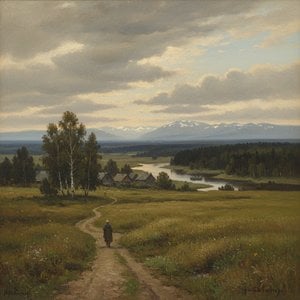
Explore the captivating world of Fyodor Vasilyev, a pioneering Russian landscape painter. Discover his lyrical style, influential works like 'Clouds' & lasting legacy. Learn about his life, artistic journey & impact on Russian art history.

Explore the captivating landscapes of Vasily Polenov, a pivotal figure in Russian art history. Discover his lyrical realism, biblical series & influence on Impressionism. Learn about the 'Knight of Beauty' and his enduring legacy.

 Ver en contexto
 Enviar
 Compartir
 Detalles

 Descargar
 Similares
 Radiografía
 Presentación de diapositivas

 Ver más







 La opción de vidrio solo está disponible en tamaños inferiores a 110 cm.


