Vista previa Vista previa en RA Cambiar a formato impreso Ver versión en imagen digital Compartir
Ver detalles Guía Añadir a favoritos Descargar Ver artículos similares Radiografía Presentación de diapositivas Estadísticas

Forest

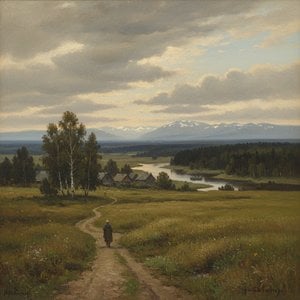
Nicholas Roerich’s "Forest" (1921) – A mesmerizing Symbolist landscape of dark trees & emerging figures. Explore this evocative artwork's rich detail & mystical atmosphere.

Explora el arte cautivador de Nicolás Roerich (1874-1947): Simbolismo, paisajes himalayos y pinturas místicas. Diseños para los Ballets Russes y defensor de la preservación cultural.

Reproducción al óleo hecha a mano

Óleo sobre lienzo pintado a mano en el tamaño y marco de su elección, realizado por encargo por nuestros artistas. ( Cambiar a formato impreso Ver versión en imagen digital)

Corner sample of the P118B picture frame: poliestireno moldeado, 5 cm wide and 3 cm thick
P118B €10
Corner sample of the P118H picture frame: poliestireno moldeado, 5 cm wide and 3 cm thick
P118H €10
Corner sample of the P118W picture frame: poliestireno moldeado, 5 cm wide and 3 cm thick
P118W €10
Corner sample of the P438Z picture frame: poliestireno moldeado, 5.5 cm wide and 3.5 cm thick
P438Z €10
Corner sample of the P508JH picture frame: poliestireno moldeado, 7 cm wide and 3.5 cm thick
P508JH €12
Corner sample of the P508YH picture frame: poliestireno moldeado, 7 cm wide and 3.5 cm thick
P508YH €12
Corner sample of the P805H picture frame: poliestireno moldeado, 5 cm wide and 3.5 cm thick
P805H €10
Corner sample of the P805Z picture frame: poliestireno moldeado, 5 cm wide and 3.5 cm thick
P805Z €10
Corner sample of the P919BZ picture frame: poliestireno moldeado, 7 cm wide and 3.5 cm thick
P919BZ €10
Corner sample of the P919G picture frame: poliestireno moldeado, 7 cm wide and 3.5 cm thick
P919G €10
Corner sample of the P919XJ picture frame: poliestireno moldeado, 7 cm wide and 3.5 cm thick
P919XJ €10
Corner sample of the P959ZH picture frame: poliestireno moldeado, 5 cm wide and 3 cm thick
P959ZH €10
Corner sample of the P968JZ picture frame: poliestireno moldeado, 6 cm wide and 4 cm thick
P968JZ €12
Corner sample of the W106C picture frame: madera maciza, 5 cm wide and 3 cm thick
W106C €8
Corner sample of the W218G picture frame: madera maciza, 5 cm wide and 3 cm thick
W218G €10
Corner sample of the W218JH picture frame: madera maciza, 5 cm wide and 3 cm thick
W218JH €8
Corner sample of the W218Y picture frame: madera maciza, 5 cm wide and 3 cm thick
W218Y €10
Corner sample of the W307PJ picture frame: madera maciza, 6 cm wide and 3 cm thick
W307PJ €10
Corner sample of the W316G picture frame: madera maciza, 6 cm wide and 3 cm thick
W316G €10
Corner sample of the W316PJ picture frame: madera maciza, 6 cm wide and 3 cm thick
W316PJ €8
Corner sample of the W316Y picture frame: madera maciza, 6 cm wide and 3 cm thick
W316Y €10
Corner sample of the W398PJ picture frame: madera maciza, 5 cm wide and 3 cm thick
W398PJ €8
Corner sample of the W4111J picture frame: madera maciza, 6.5 cm wide and 3.5 cm thick
W4111J €10
Corner sample of the W500HY picture frame: madera maciza, 7 cm wide and 5 cm thick
W500HY €15
Corner sample of the W500JH picture frame: madera maciza, 7 cm wide and 5 cm thick
W500JH €15
Corner sample of the W692G picture frame: madera maciza, 8 cm wide and 4 cm thick
W692G €12
Corner sample of the W849H picture frame: madera maciza, 5 cm wide and 3 cm thick
W849H €8
Corner sample of the W940BG picture frame: madera maciza, 7.5 cm wide and 4.5 cm thick
W940BG €15
Corner sample of the W953PJ picture frame: madera maciza, 6 cm wide and 3.5 cm thick
W953PJ €8

Estándar
personalizado
CM
INCH

Elija entre nuestros tamaños predefinidos que respetan las proporciones originales de la obra.

ancho
altura

Escriba el ancho y el alto que necesite para adaptarse a su marco o a su pared. Al ser una obra pintada a mano, para un tamaño con una forma distinta, el artista puede pintar un poco más alrededor de la imagen o recortar un poco; usted elige. Le enviaremos una maqueta digital para su aprobación antes de comenzar la pintura. La imagen que se muestra en esta página no refleja el resultado real; solo la maqueta lo hace.

Ejemplos de lo que se puede personalizar: Reemplace el rostro con una foto del cliente; Agregue una mascota (por ejemplo, cambie un gato por un perro); Incluya un mensaje oculto en el fondo; Cambie el paisaje o los elementos del fondo.
Tras realizar el pedido, el equipo de WahooArt.com enviará un correo electrónico al cliente para solicitar instrucciones y proporcionarle una vista previa del boceto.

Envío a todo el mundo () en 3-4 semanas en lugar de las 5 semanas estándar. (23 octubre). Sin comprometer la calidad.

Envío exprés gratuito a todo el mundo
Lienzo de lino de alta calidad
Seguro de envío completo
Garantía de reembolso de impuestos aduaneros
Garantía de fidelidad cromática exacta
Política de devolución de 100 días (solo por defectos)
Garantía de devolución del 100% del dinero
Oferta por volumen

Precio total

€ 239

Forest

Técnica de reproducción

Tamaño de la reproducción

-

Precio total

€ 239

Datos clave

  • Artistic style: Symbolist
  • Year: 1921
  • Subject or theme: Dark forest scene
  • Medium: Hand-painted reproduction
  • Influences:
    • Roerich's spiritism
    • Russian landscape painting

Nicholas Roerich’s “Forest”: A Journey Into the Depths of the Psyche

This meticulously crafted hand-painted reproduction captures the essence of Nicholas Roemerich's 1921 artwork, "Forest," a piece that resonates with an unsettling beauty and profound psychological depth. The image depicts a group of figures emerging from a dark, imposing forest – a scene immediately evocative of classic Romanticism yet imbued with Roerich’s unique spiritual vision. Measuring 57 x 77 cm, this work invites the viewer into its shadowed depths, prompting contemplation on themes of isolation, mystery, and the human condition.

The Artist's Vision: Roerich and the Spirit Within

Nicholas Roemerich (1874-1947), born in Saint Petersburg, was far more than a painter; he was a polymath deeply invested in exploring the intersection of art, archaeology, philosophy, and spirituality. His work, particularly during this period, reflects his fascination with Eastern mysticism and shamanistic traditions, seeking to represent not just what is seen but what *feels* within. Roerich believed that art could be a conduit for accessing higher consciousness, and “Forest” exemplifies this belief through its dramatic use of light and shadow, and the ambiguous figures within.

Technique and Composition: Verticality and Unease

The artwork’s composition is dominated by strong vertical lines representing the towering trees, creating a sense of oppressive height and confinement. This deliberate emphasis on verticals contributes to the unsettling atmosphere, drawing the eye upwards into the darkness while simultaneously suggesting an inescapable presence. Roerich's technique involved layering thin washes of color – predominantly deep greens, browns, and blacks – building up texture through meticulous brushwork. The use of glazing creates a luminous quality within the shadows, enhancing the dramatic effect. The figures themselves are rendered with a degree of abstraction, their forms partially obscured by the dense foliage, further contributing to the feeling of mystery and unease.

Symbolism and Emotional Impact

"Forest" is rich in symbolic meaning, reflecting Roerich’s broader philosophical concerns. The forest itself represents the unconscious mind – a place of both danger and potential transformation. The figures emerging from its depths could be interpreted as humanity's struggle to confront its inner demons or to seek enlightenment. The darkness isn't simply an absence of light; it is actively charged with symbolic weight, suggesting hidden truths and forgotten memories. This reproduction offers more than just a beautiful image; it provides a window into Roerich’s complex worldview and invites the viewer to engage in their own personal interpretation of this powerful and evocative artwork.

Preguntas y respuestas

¿Está disponible una descarga para "Forest"?

La imagen de "Forest" de Nicolás Roerich puede descargarse desde la página de Descargar de la obra: descarga de una imagen digital en alta resolución.

¿Cuál es la fecha y el estilo de "Forest" de Nicolás Roerich?

"Forest" fue realizada en 1921, dentro del movimiento Symbolism.

¿Puedo ver "Forest" como una presentación de diapositivas a pantalla completa?

Puede ver "Forest" de Nicolás Roerich en formato de diapositivas en la página de Presentación de diapositivas de la obra.


Biografía del artista

Nicholas Roerich: Vida, Arte y Legado

Primeros Años y Educación

  • Nikolai Konstantinovich Roerich nació el 9 de octubre de 1874 en San Petersburgo, Rusia.
  • Su padre, un notario alemán del Báltico, y su madre, una mujer rusa, fomentaron una temprana apreciación por las artes en él.
  • Roerich estudió tanto derecho como arte simultáneamente, matriculándose en la Universidad de San Petersburgo y la Academia Imperial de Artes en 1893.
  • Recibió el título de “Artista” en 1897 y un título de abogado al año siguiente.

Deseos Artísticos e Influencias

  • El desarrollo artístico de Roerich fue significativamente influenciado por el Simbolismo Ruso, un movimiento que enfatizaba la espiritualidad y la profundidad emocional.
  • Se involucró con la sociedad “Arte del Mundo” de Serguéi Diáguilev, eventualmente convirtiéndose en su presidente desde 1910 hasta 1916.
  • Su trabajo temprano mostró una fascinación por la arqueología y el diseño teatral, lo que llevó a colaboraciones en producciones para los Ballets Russes.
  • También se vio influenciado por apócrifos y escrituras secretistas medievales como el Libro de la Paloma.

Colaboración con los Ballets Russes

  • Los diseños de Roerich para los Ballets Russes fueron muy elogiados, particularmente su trabajo en Príncipe Igor de Alexander Borodin (1909) e El Ritual de la Primavera de Igor Stravinsky (1913).
  • Sus diseños escénicos combinaban la investigación histórica con el arte imaginativo, creando producciones visualmente impresionantes.
  • Esta colaboración lo estableció como una figura destacada en el diseño teatral a principios del siglo XX.

Desarrollo Artístico y Temas

  • Las pinturas de Roerich evolucionaron para incorporar temas cada vez más místicos y espirituales, reflejando su creciente interés en la Teosofía y las religiones orientales.

  • Su serie Estudios Arquitectónicos (1904–1905) demostró su destreza arquitectónica y su compromiso con la preservación del patrimonio cultural.
  • Motivos recurrentes en su obra incluyen paisajes majestuosos, ciudades antiguas y figuras religiosas como San Panteleimon y Kuan Yin.
  • A menudo representaba el Himalaya, una región que tenía un profundo significado espiritual para él.

Logros y Reconocimientos Principales

  • Roerich fue un defensor dedicado de la protección del arte y la arquitectura durante los tiempos de guerra.
  • Sus esfuerzos llevaron a la creación del Pacto Roerich (1935), un tratado internacional para la preservación de objetos culturales, lo que le valió múltiples nominaciones al Premio Nobel de la Paz.
  • Viajó extensamente por Asia Central, realizando investigaciones arqueológicas y documentando culturas antiguas.
  • Su obra se exhibe en importantes colecciones museísticas en todo el mundo, incluida la Galería de Pinturas Estatal de Astrakhan.

Significado Histórico y Legado

  • El impacto de Nicholas Roerich en el arte y la cultura rusos es inmensurable.
  • Puenteó la brecha entre la expresión artística y la exploración espiritual, influyendo a generaciones de artistas e intelectuales.
  • Su compromiso con la preservación cultural sigue siendo relevante hoy en día, destacando la importancia de proteger nuestro patrimonio compartido.
  • El legado de Roerich se extiende más allá de sus pinturas; es recordado como un artista visionario, erudito y humanitario.
Nicolás Roerich

Nicolás Roerich

1874 - 1947 , Rusia

Datos clave

  • Artistas Que Influyeron:
    • León Tolstói
    • Arjip Kuindzhi
  • Fecha De Muerte: 13 de diciembre de 1947
  • Fecha De Nacimiento: 9 de octubre de 1874
  • Influenciado A Artistas: ['Artistas e intelectuales']
  • Lugar De Nacimiento: San Petersburgo, Rusia
  • Movimiento Artístico: Simbolismo Ruso
  • Nacionalidad: Ruso
  • Nombre Completo: Nicolás Roerich
  • Obras Notables:
    • Camino al Kailas 4
    • Monte de cinco tesoros
    • Puente de Gloria
    • Lago de las Nagas
    • Tempe-jal-tzen-baykin
Explore obras de arte organizadas por temas, estilos y características.