A Descent into the Subconscious: The Dreamscape of Max Ernst
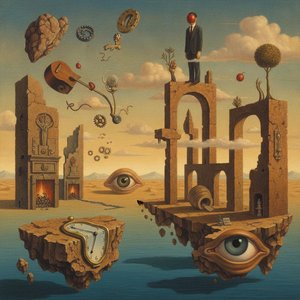
To encounter Max Ernst’s "Untitled (93)" is to step through a threshold where the boundaries of reality dissolve into the fluid architecture of a dream. Created around 1940, during a period of profound global upheaval, this masterpiece serves as a haunting portal into the human psyche. The painting presents a scene of visceral tension: a woman submerged in water, her head bowed downward in a struggle that feels both deeply personal and universally tragic. There is an immediate, palpable sense of vulnerability as she appears to battle for breath, drawing the viewer into an emotional vortex of suspense and quiet desperation. This is not merely a depiction of a moment, but an exploration of the weight of existence itself.
Ernst’s technical mastery lies in his ability to marry meticulous, almost photographic detail with a landscape that defies every law of logic. His signature style—a hallmark of the Surrealist movement—utilizes an unsettling disregard for conventional perspective to create a hallucinatory atmosphere. As one gazes into the depths of the composition, distorted forms swirl around the central figure, echoing the psychoanalytic theories of Sigmund Freud that were so prevalent in the intellectual ferment of Paris at the time. The texture of the water and the precision of the woman’s form provide a grounding realism that makes the surrounding irrationality even more jarring and effective.
Symbolism and the Echoes of History
Beyond its striking visual surface, "Untitled (93)" is rich with symbolic layers that reward deep contemplation. Perched above the struggling woman, a bird takes flight, acting as a poignant beacon of aspiration and freedom—a flicker of hope amidst the encroaching shadows of despair. This celestial element contrasts sharply with the more grounded, enigmatic objects scattered throughout the scene, such as the sports ball nestled in the bottom corner or the books that appear like silent witnesses to the drama. These elements introduce a sense of cognitive dissonance, blending the playful with the profound, and the mundane with the mythic.
The historical context of the piece adds a layer of somber gravity to its interpretation. Painted during the early years of World War II, the artwork reflects the widespread anxieties of an era defined by displacement and trauma. As a German-born artist living in exile, Ernst infused his work with the tension of a world on the brink of collapse. The struggle for breath depicted in the painting can be read as a metaphor for the suffocating atmosphere of ideological fervor and war gripping Europe. For the collector or the admirer, this piece offers more than just aesthetic beauty; it provides a profound connection to one of the most turbulent and transformative eras in modern history.
An Evocative Addition to the Modern Interior
For the discerning art lover or interior designer, a high-quality reproduction of "Untitled (93)" offers an unparalleled opportunity to introduce intellectual depth and emotional resonance into a living space. The painting’s complex interplay of light, shadow, and surreal imagery makes it a commanding focal point that invites conversation and introspection. Whether placed in a curated gallery setting or used as a sophisticated centerpiece in a contemporary home, Ernst's work brings with it an aura of mystery and timelessness.
Owning a piece of this caliber is about more than decoration; it is about surrounding oneself with the echoes of the avant-garde. The haunting beauty of the submerged figure and the dreamlike fluidity of the composition provide a sense of movement and narrative that can transform the atmosphere of any room, turning a mere wall into a window onto the infinite possibilities of the subconscious mind.
Preguntas y respuestas
¿Qué tono emocional transmite el estilo Surrealism de "untitled (93)"?
Dentro del movimiento Surrealism, "untitled (93)" se presenta con un tono Melancholic.
¿Cómo se combinan el contraste y la armonía en "untitled (93)"?
El análisis cromático de "untitled (93)" de Max Ernst presenta un Gentle contraste y una Balanced Harmony armonía.
¿Qué representa "untitled (93)" de Max Ernst?
"untitled (93)" de Max Ernst representa: woman, water, bird, ball, books, surrealism, symbolism, mystery.



 Ver en contexto
 Cambiar a impresiones
 Enviar
 Compartir
 Detalles
 Guía
Guía

 Descargar
 Similares
 Radiografía
 Presentación de diapositivas
 Estadísticas

 Ver más






































 La opción de vidrio solo está disponible en tamaños inferiores a 110 cm.