Descripción de la obra
A Fragment of Dreamscape: Decoding Max Ernst’s Untitled (5794)
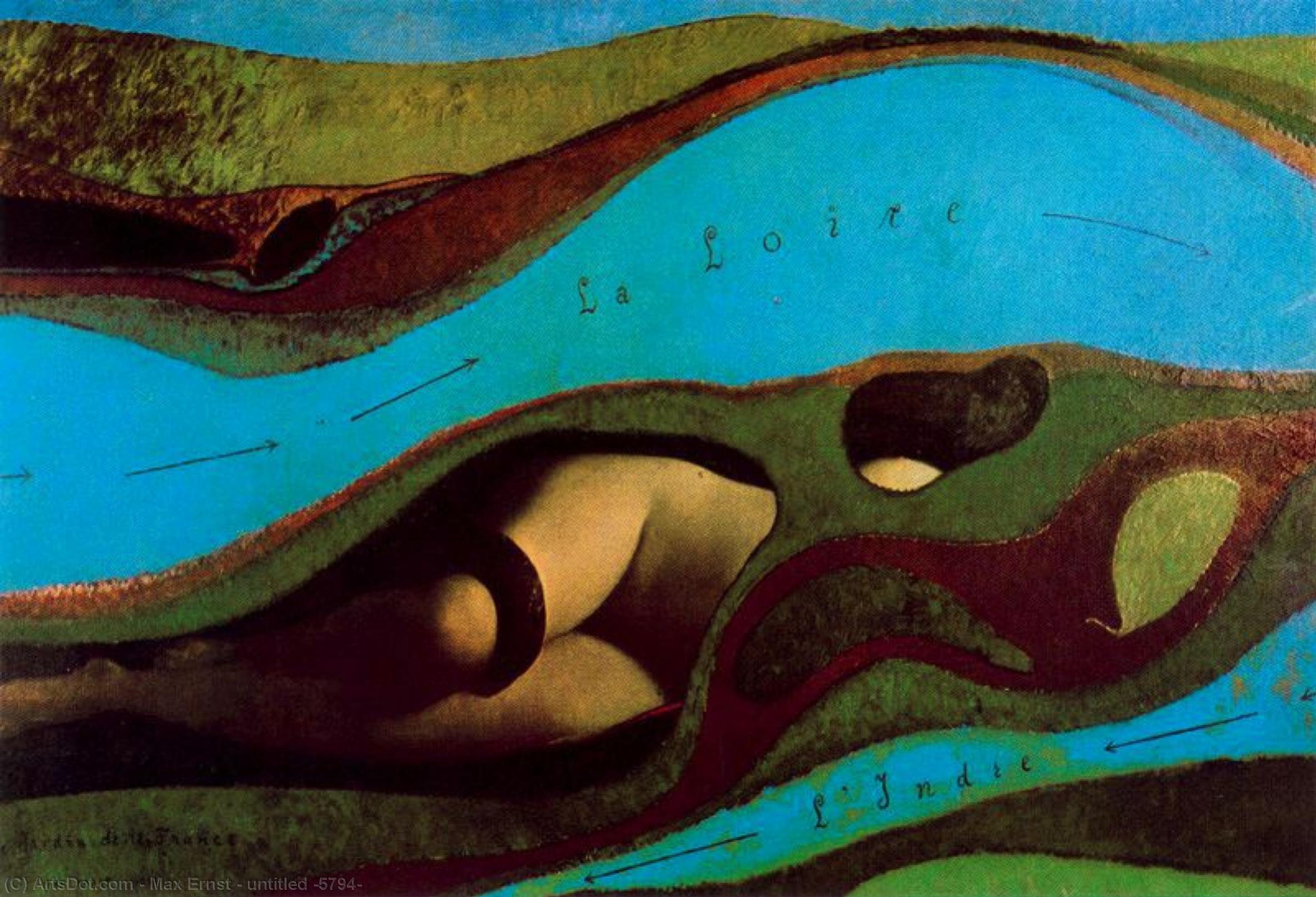
The painting “untitled (5794)” by Max Ernst, a cornerstone of Surrealist art, isn't merely an image; it’s an invitation into the subconscious. Executed sometime in the mid-1960s, this piece exemplifies Ernst’s signature approach – a deliberate disruption of rational thought to tap into the realm of dreams and primal instinct. It depicts a solitary man lying prone on grassy ground beneath a riverbank, his head submerged in the flowing water. The backdrop is dominated by dense foliage, hinting at an untamed wilderness that mirrors the inner turmoil suggested by the figure’s posture. Scattered throughout the composition are birds – some soaring aloft, others perched motionless on branches – adding to the sense of unease and disorientation. Notably positioned near the center is a single apple, a symbol laden with complex meanings rooted in mythology and folklore; it represents fertility, temptation, and perhaps even the fragility of existence.
The Surrealist Method: Ernst’s Pioneering Technique
Ernst's artistic process was revolutionary for its time. Rejecting academic conventions, he embraced techniques designed to bypass conscious control. He famously developed *frottage*, a method involving rubbing pencil or charcoal over textured surfaces – such as bark or leaves – transferring their patterns onto canvas. This technique, alongside *grattage* (scraping paint off the surface), allowed Ernst to access imagery hidden beneath the surface of his mind. “untitled (5794)” embodies this spirit; the seemingly random placement of elements isn’t accidental but a product of deliberate experimentation aimed at unlocking latent associations and creating an unsettling juxtaposition of forms. The artist himself described it as "a kind of automatic drawing," prioritizing intuition over meticulous planning.
Historical Context: Dada and Beyond
Ernst emerged from the turbulent milieu of Dada, an anti-establishment movement born in Zurich during World War I. Dada artists vehemently rejected bourgeois values and embraced absurdity as a weapon against societal hypocrisy. While Ernst distanced himself from Dada’s nihilistic tendencies, he absorbed its rebellious ethos and utilized it to propel his artistic explorations into uncharted territory. Surrealism, which Ernst helped establish alongside André Breton, sought to liberate the imagination from rational constraints and delve into the depths of psychological experience. “untitled (5794)” reflects this broader movement's preoccupation with exploring the unconscious mind and confronting anxieties about mortality—themes prevalent throughout Ernst’s oeuvre.
Symbolism: Birds, Apples, and the Landscape of Inner Thought
The imagery within "untitled (5794)" is rife with symbolic resonance. The birds represent freedom, aspiration, but also vulnerability – mirroring the man's precarious position in the riverbed. Their flight upwards suggests a desire to escape earthly concerns, while their stillness hints at contemplation and perhaps even paralysis. The apple, as alluded to earlier, carries echoes of biblical narratives concerning temptation and knowledge—a reminder that beauty can conceal hidden dangers. Simultaneously, the dense forest symbolizes the labyrinthine complexities of the human psyche, representing both solace and confinement. Ernst’s masterful use of color – muted greens and browns dominate the palette – contributes to the painting's melancholic mood and reinforces its connection to dreamlike landscapes.
Emotional Impact: A Portrait of Quiet Disquiet
Ultimately, “untitled (5794)” succeeds in conveying a profound sense of unease and contemplation. It’s not a painting that seeks to dazzle with visual spectacle; rather, it invites the viewer into a space of psychological introspection. The solitary figure embodies vulnerability and surrender—a confrontation with the unknown—while the surrounding landscape underscores the immensity of existence. Viewing this artwork evokes feelings of melancholy, curiosity, and perhaps even apprehension – mirroring Ernst’s own artistic mission to provoke thought and challenge conventional perceptions. It remains a testament to his ability to capture the elusive essence of human experience within the framework of Surrealist aesthetics.



 Encargar reproducción
 Enviar
 Compartir
 Detalles

 Descargar
 Similares
 Rayos X
 Presentación de diapositivas

 Ver más






































 La opción de vidrio solo está disponible en tamaños inferiores a 110 cm.