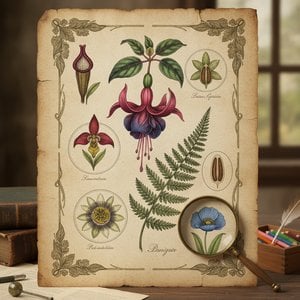
(Untitled--Flower Study) de Mary Vaux Walcott, reproducción al óleo pintada a mano por un maestro artista
Ver en contexto Vista previa en RA Cambiar a impresiones Cambiar a imagen digital Enviar
Detalles Guía Añadir a favoritos Descargar Similares Radiografía Presentación de diapositivas Preguntas y respuestas Descargar presentación Estadísticas

(Untitled--Flower Study) Reproducción de pintura al óleo pintada a mano

Dimensiones
25.0 x 17.0 cm

Watercolor study of clover by Mary Vaux Walcott ('Audubon of Botany'). Detailed botanical illustration showcasing delicate floral forms & naturalistic style. Explore this unique 19th-century artwork.

Descubre a Mary Vaux Walcott (1860-1940), artista estadounidense y 'Audubon de la Botánica'. Sus delicadas acuarelas de flores silvestres capturan la belleza natural. ¡Explora su legado en WahooArt!

Reproducción al óleo hecha a mano

Óleo sobre lienzo pintado a mano en el tamaño y marco de su elección, realizado por encargo por nuestros artistas. ( Cambiar a impresiones Cambiar a imagen digital)

Corner sample of the P118B picture frame: poliestireno moldeado, 5 cm wide and 3 cm thick
P118B €10
Corner sample of the P118H picture frame: poliestireno moldeado, 5 cm wide and 3 cm thick
P118H €10
Corner sample of the P118W picture frame: poliestireno moldeado, 5 cm wide and 3 cm thick
P118W €10
Corner sample of the P438Z picture frame: poliestireno moldeado, 5.5 cm wide and 3.5 cm thick
P438Z €10
Corner sample of the P508JH picture frame: poliestireno moldeado, 7 cm wide and 3.5 cm thick
P508JH €12
Corner sample of the P508YH picture frame: poliestireno moldeado, 7 cm wide and 3.5 cm thick
P508YH €12
Corner sample of the P805H picture frame: poliestireno moldeado, 5 cm wide and 3.5 cm thick
P805H €10
Corner sample of the P805Z picture frame: poliestireno moldeado, 5 cm wide and 3.5 cm thick
P805Z €10
Corner sample of the P919BZ picture frame: poliestireno moldeado, 7 cm wide and 3.5 cm thick
P919BZ €10
Corner sample of the P919G picture frame: poliestireno moldeado, 7 cm wide and 3.5 cm thick
P919G €10
Corner sample of the P919XJ picture frame: poliestireno moldeado, 7 cm wide and 3.5 cm thick
P919XJ €10
Corner sample of the P959ZH picture frame: poliestireno moldeado, 5 cm wide and 3 cm thick
P959ZH €10
Corner sample of the P968JZ picture frame: poliestireno moldeado, 6 cm wide and 4 cm thick
P968JZ €12
Corner sample of the W106C picture frame: madera maciza, 5 cm wide and 3 cm thick
W106C €8
Corner sample of the W218G picture frame: madera maciza, 5 cm wide and 3 cm thick
W218G €10
Corner sample of the W218JH picture frame: madera maciza, 5 cm wide and 3 cm thick
W218JH €8
Corner sample of the W218Y picture frame: madera maciza, 5 cm wide and 3 cm thick
W218Y €10
Corner sample of the W307PJ picture frame: madera maciza, 6 cm wide and 3 cm thick
W307PJ €10
Corner sample of the W316G picture frame: madera maciza, 6 cm wide and 3 cm thick
W316G €10
Corner sample of the W316PJ picture frame: madera maciza, 6 cm wide and 3 cm thick
W316PJ €8
Corner sample of the W316Y picture frame: madera maciza, 6 cm wide and 3 cm thick
W316Y €10
Corner sample of the W398PJ picture frame: madera maciza, 5 cm wide and 3 cm thick
W398PJ €8
Corner sample of the W4111J picture frame: madera maciza, 6.5 cm wide and 3.5 cm thick
W4111J €10
Corner sample of the W500HY picture frame: madera maciza, 7 cm wide and 5 cm thick
W500HY €15
Corner sample of the W500JH picture frame: madera maciza, 7 cm wide and 5 cm thick
W500JH €15
Corner sample of the W692G picture frame: madera maciza, 8 cm wide and 4 cm thick
W692G €12
Corner sample of the W849H picture frame: madera maciza, 5 cm wide and 3 cm thick
W849H €8
Corner sample of the W940BG picture frame: madera maciza, 7.5 cm wide and 4.5 cm thick
W940BG €15
Corner sample of the W953PJ picture frame: madera maciza, 6 cm wide and 3.5 cm thick
W953PJ €8

Tamaño estándar
a medida
CM
INCH

Elija entre nuestros tamaños predefinidos que respetan las proporciones originales de la obra.

ancho
altura

Indique el ancho y el alto que necesite para adaptarse a su marco o pared. Al tratarse de una obra pintada a mano, si requiere un tamaño con una proporción distinta, el artista puede pintar un poco más alrededor de la imagen o recortarla ligeramente; usted elige. Le enviaremos una maqueta digital para su aprobación antes de comenzar la pintura. La imagen que se muestra en esta página no refleja el resultado real; solo la maqueta lo hace.

Ejemplos de lo que se puede personalizar: Reemplace el rostro con una foto del cliente; Agregue una mascota (por ejemplo, cambie un gato por un perro); Incluya un mensaje oculto en el fondo; Cambie el paisaje o los elementos del fondo.
Tras realizar el pedido, el equipo de WahooArt.com enviará un correo electrónico al cliente para solicitar instrucciones y proporcionarle una vista previa del boceto.

Envío a todo el mundo () en 3-4 semanas en lugar de las 5 semanas estándar. (9 noviembre). Sin comprometer la calidad.

Envío exprés gratuito a todo el mundo
Lienzo de lino de alta calidad
Seguro de envío total
Garantía de reembolso de aranceles aduaneros
Garantía de fidelidad cromática exacta
Política de devolución de 100 días (solo por defectos)
Garantía de devolución del 100% del dinero
Descuento por cantidad

Precio total

€ 243

(Untitled--Flower Study)

Técnica de reproducción

Dimensiones de la reproducción

-

Precio total final

€ 243

Datos clave

  • Location: Smithsonian Institution
  • Medium: Watercolor on paper
  • Notable elements or techniques: Detailed botanical illustration; Layered watercolor washes
  • Title: (Untitled--Flower Study)
  • Movement: American Impressionism

A Delicate Dance of Observation: Mary Vaux Walcott’s “Untitled--Flower Study”

Mary Vaux Walcott, a name synonymous with meticulous botanical illustration and unwavering dedication to American conservation, achieved the moniker "the Audubon of Botany" – a testament to her unparalleled ability to capture the exquisite beauty of wildflowers with breathtaking precision. Born in Philadelphia in 1860 into a Quaker family deeply rooted in intellectual pursuits, Walcott’s artistic journey began unexpectedly at age eight when she received a set of watercolor paints as a gift. This simple act ignited a lifelong passion for translating the natural world onto paper, shaping her career and cementing her legacy as one of America's foremost botanical artists.
  • Subject Matter: The artwork presents a captivating study of three clover plants—a humble yet remarkably complex specimen—each rendered in varying stages of bloom. Walcott’s focus isn’t on grand landscapes or dramatic narratives; rather, she delves into the minute details of floral anatomy and foliage texture, revealing an astonishing level of observation.
  • Style & Technique: Embracing realism alongside a distinctly botanical aesthetic, Walcott employed watercolor paint on paper—a medium perfectly suited to conveying subtle tonal variations and capturing the ethereal quality of light filtering through petals. Her technique is characterized by layering washes of color, creating soft gradients that imbue the image with an atmosphere of tranquility and understated elegance.
  • Composition & Perspective: The vertical orientation emphasizes the plants as central subjects against a softly textured off-white background—a deliberate choice designed to heighten visual impact without distracting from the botanical subject matter. Lines delineate stems, leaves, and flower petals, establishing structural integrity while maintaining a naturalistic feel. Depth is achieved through overlapping elements and careful consideration of shading, fostering a sense of spatial realism.
Historical Context: Walcott’s work emerged during the late 19th century, coinciding with a burgeoning interest in scientific exploration and artistic representation of the natural world. Influenced by luminaries like John Audubon—whose detailed ornithological illustrations revolutionized scientific understanding—Walcott sought to emulate Audubon's commitment to accuracy and artistry. Her contributions to the Smithsonian Institution further solidified her position as a champion of conservation, demonstrating the profound connection between art and environmental stewardship. Symbolism & Emotional Impact: Beyond its technical brilliance, “Untitled--Flower Study” resonates with deeper symbolic significance. The clover itself—often associated with fertility, peace, and good fortune—represents resilience and renewal amidst simplicity. Walcott’s masterful rendering captures not just the visual splendor of these flowers but also conveys an emotional response to their beauty – a quiet reverence for the natural world and its inherent capacity for wonder. This artwork serves as a poignant reminder that profound artistic expression can arise from humble subjects, transforming them into emblems of enduring values.
  • Material: Watercolor paint on paper

Preguntas y respuestas

¿Qué orientación tiene "(Untitled--Flower Study)" de Mary Vaux Walcott?

El formato de "(Untitled--Flower Study)" es Portrait, un dato útil para planificar la ubicación de una reproducción.

¿De qué manera "(Untitled--Flower Study)" de Mary Vaux Walcott vincula el Contemporary Realism con el país de origen del artista?

La obra de Contemporary Realism "(Untitled--Flower Study)" fue realizada por un artista nacido en Estados Unidos de América.

¿Cómo se combinan la técnica y el movimiento en "(Untitled--Flower Study)"?

"(Untitled--Flower Study)" de Mary Vaux Walcott combina la técnica de Watercolor con el estilo Contemporary Realism. La técnica y el movimiento describen la ejecución y el estilo de la obra.


Biografía del artista

Primeros años y educación

Mary Morris Vaux Walcott, una artista y naturalista estadounidense, nació el 31 de julio de 1860 en Filadelfia, Pensilvania, dentro de una acomodada familia cuáquera. Tras graduarse del Friends Select School de Filadelfia en 1879, desarrolló un interés por la pintura a la acuarela. Su educación temprana inculcó en ella un profundo respeto por la naturaleza y los principios cuáqueros de simplicidad y servicio, valores que se reflejarían en su arte.

Carrera y Contribuciones: La "Audubon de la Botánica"

Mary Vaux Walcott es reconocida principalmente por sus exquisitas pinturas a la acuarela de flores silvestres, lo que le valió el apodo de “la Audubon de la botánica”. Su trabajo se distingue por su precisión científica y su delicada belleza artística. Se dedicó a documentar la flora norteamericana con un nivel de detalle excepcional. Sus obras incluyen:

Vida Personal y Legado

En 1914, Mary Vaux Walcott se casó con Charles Doolittle Walcott, secretario de la Institución Smithsonian. Continuó pintando flores silvestres y participó en los proyectos de su esposo hasta su fallecimiento en 1927. Su trabajo no solo es una celebración de la belleza natural sino también un valioso registro científico de la flora norteamericana. Su meticulosa documentación contribuyó significativamente al conocimiento botánico de la época.

Significado Histórico y Influencia

El legado de Mary Vaux Walcott reside en su capacidad para combinar arte y ciencia. Su trabajo se distingue por su precisión, detalle y sensibilidad artística. Como "Audubon de la Botánica", sentó un precedente importante para las ilustraciones botánicas científicas, inspirando a generaciones de artistas y naturalistas. Sus obras son apreciadas tanto por su valor estético como por su importancia científica, consolidándola como una figura clave en el arte estadounidense del siglo XIX y principios del XX. Ver más obras de Mary Vaux Walcott en WahooArt. Aprender más sobre Mary Vaux Walcott en Wikipedia.
Mary Vaux Walcott

Mary Vaux Walcott

1860 - 1940 , Estados Unidos de América

Datos clave

  • Estilo Artístico: Botánico, acuarela
  • Fecha De Fallecimiento: 1940
  • Fecha De Nacimiento: 31 de julio de 1860
  • Lugar De Nacimiento: Filadelfia, EE. UU.
  • Nacionalidad: Estadounidense
  • Nombre Completo: Mary Vaux Walcott
  • Obras Notables:
    • Hojas de otoño (sin título)
    • Gaillardia perenne
    • Rosa Bourgeau
    • Bushpoppy
    • Fremontia mexicana
Explore obras de arte organizadas por temas, estilos y características.